


Audio By Carbonatix
It was a little after 3 pm when we arrived at St. Peter’s Anglican School in Ofankor.
School had already closed, though the bell had not rung to signal the usual cheerful end to the day.
A few students lingered, some of their uniforms stained with mud, while others trudged home along the roadside.
Earlier that morning, it had rained. Not heavily. Just enough to disrupt everything.
Inside the school compound, a wide, stagnant pool of water had formed right in the middle of the yard. What should be a safe, open space for play and movement has been swallowed up by water. The ground beneath was slippery, caked in mud. Some pathways were nearly impassable.
The aftermath of the rainfall was clear: learning had once again been interrupted. For students and teachers here, this is nothing new.
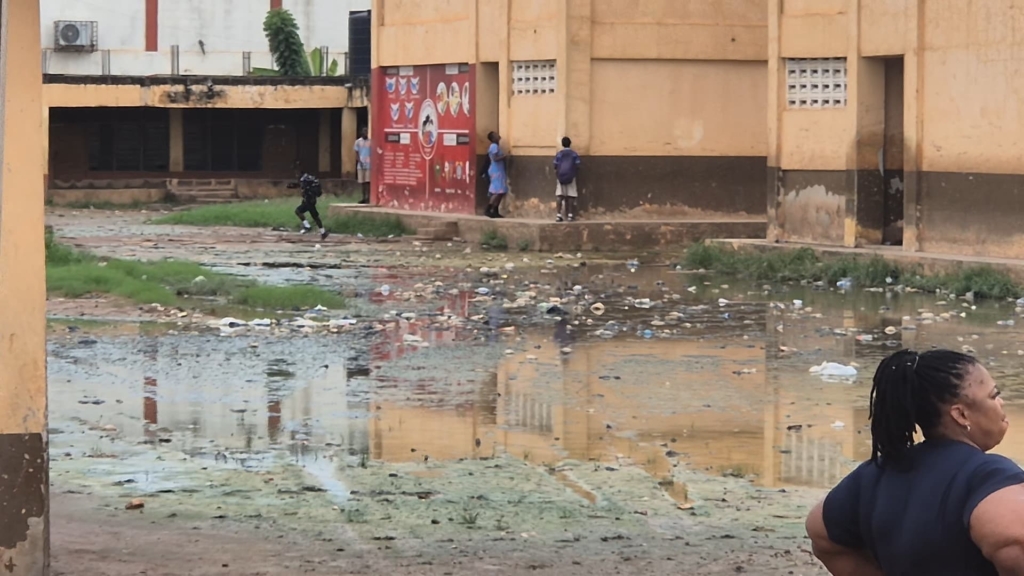
St. Peter’s Anglican School, a basic public school nestled in one of Accra’s many growing communities, has battled flooding for years. Whenever it rains, water collects across the compound due to poor drainage. Classrooms sometimes flood. The playground becomes unusable. And on some days, school has to be dismissed early if it opens at all.
Off camera, a few students quietly expressed their frustration. “We can’t even play anymore,” one said. “The playground is always full of water.”
However, trying to report on the issue openly proved more difficult than expected. During our visit, we were approached by the Assemblywoman for the area, who insisted we stop filming. She claimed we had no right to document the scene, even though it’s a public school facing a public concern.
This reaction underscores a deeper issue: a culture of silence around problems that directly affect children in public schools. Why should students have to navigate flooded grounds and risk injury or illness just to get an education? Why has nothing been done for so long?
Multiple sources from the community say the problem has existed for years without any structural intervention. Drainage in the area is poor, and the school sits on a low-lying plot, turning it into a catchment for runoff whenever it rains.
As urban development continues in Ofankor and similar communities, questions around infrastructure planning and school safety become even more urgent. For the children of St. Peter’s, the rainy season has become a recurring nightmare.
The cost of inaction is high, and it's the children who are paying for it. Each day the water returns, so does the message: their school is not a priority.
Have you seen this at other schools in your community? Share your story with us.
Latest Stories
-
Church of Pentecost supports over 2,000 BECE candidates in Obuasi with career guidance seminar
40 minutes -
Brandon Asante and Coventry all but promoted to Premier League despite Sheffield Wednesday draw
1 hour -
GPL 2025/26: Late Kwartemaa strike downs Hearts in Tema
1 hour -
Ghana Faces Sierra Leone Moment as Prosecutorial Powers come under strain
1 hour -
Don’t consume fish or seafood from Tema Shipyard until further notice – FDA warns
1 hour -
Why volunteering might be Africa’s most underrated career accelerator
1 hour -
ActionAid Ghana raises concern over gender gaps in Feed Ghana Programme
2 hours -
Windstorm wreaks havoc in Gushegu, displacing nearly 2,000 residents and damaging schools
2 hours -
Friends of Bridget Bonnie Marks her 35th birthday with donation to Kasseh Model Health Centre
2 hours -
From Ekumfi Kokodo to the Pulpit Stage: Essi Donkor’s gospel journey takes shape
3 hours -
Landfilling waste management creates no value, it’s an economic waste
3 hours -
Photos: Speaker Bagbin Commissions MPs constituency office under parliamentary decentralisation programme
3 hours -
Black Stars technical advisor Winfried Schäfer sacked as GFA shakes up backroom staff
3 hours -
Wenchi water project almost complete, critical to gov’t agenda – GWL MD
3 hours -
Anti-LGBTQ+ bill not part of government’s legislative agenda – Inusah Fuseini
3 hours