

Audio By Carbonatix
Ekow Eshun is a British writer, broadcaster, and curator. All opinions expressed in this article belong to the author.
African art is having a vogue moment. People are very interested in it, but there's still a sense of Africa and African art as something of an exotic "other" that sits on the periphery and not really at the center of dialogues and debate.
However, it's more important than ever to assert the position of Africa as a place that has something significant to say.
There's a historical tendency to imagine Africa on the edge of history, cultural conversation, and global affairs.
But across the continent, there's a powerful interchange of ideas -- about who we are and how we live -- that hasn't been truly globally recognized.That's changing.
This year, Ghana made its debut at the Venice Biennale, the art world's most important event, with an all-star pick of artists. Moments like this shift the narrative, from a position of exceptional otherness to a place where African artists are fully engaged in the dialogue of contemporary art.
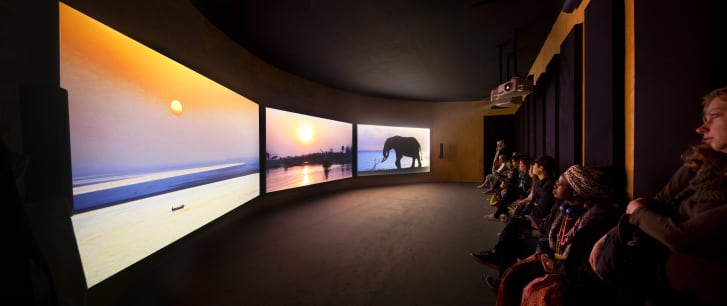
The work of artists like British-Nigerian installation artist Yinka Shonibare and Accra-born filmmaker John Akomfrah show a fascination with narratives of history, memory, place, identity, and race.
They're interested in telling and retelling the story of the role of Africa and African people on the international stage.
At the heart of their search is a desire to present Africa in a fresh way, breaking down prevalent stories and fictions to tell new stories -- of possibility and openness about Africa.
It's not the role of artists -- whether from music, design, architecture, or fashion -- to portray an authentic version of Africa.
Their role is to expand our expectations and our ideas of what Africa can be.
Africa is a place of multiplicity. You can stand on a street corner in any given city -- in Dakar, Lagos, or Accra, for example -- and you see different influences, cultures, colors and patterns that come from all over the world.
That's what you hear in the music. That's what you see in the films. That's what you see referenced in art as well.
Africa isn't a separate part of the world.
Some people argue we should not look at African artists as artists from Africa, that we should think about them as artists of the world. Personally, I don't buy that.
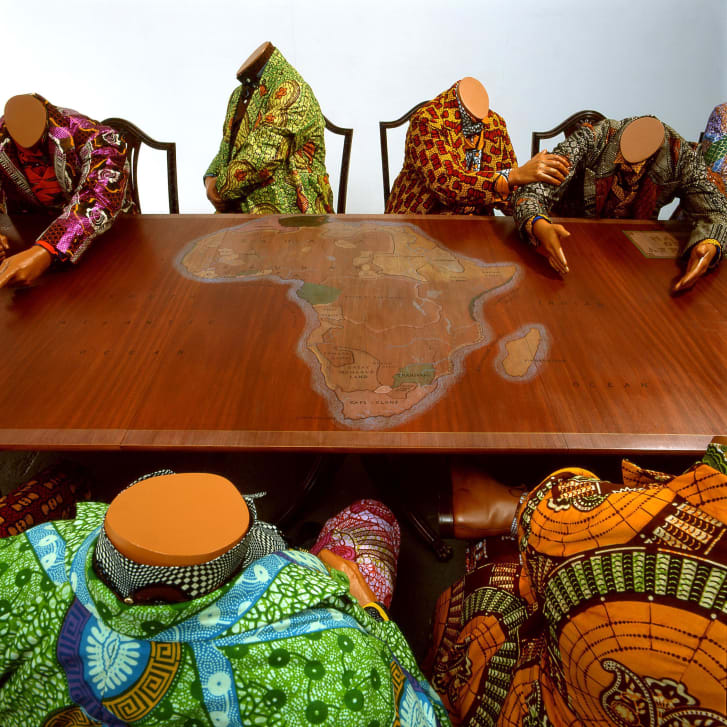
I think the mistake we make is to assume that if you're an artist from Africa, your job is to faithfully represent Africa to the exclusion of anything else.
Your job, as it were, is to be an African artist, which is just to say that you have the space, the liberty, the luxury, the possibility to draw from Africa and to make of that lineage and that heritage what you will, and to present Africa not as a fixed proposition, but as a state of possibility.
Latest Stories
-
From Golgotha to Kwahu: The Easter Migration of the Faithful and the Faithless
6 minutes -
How the Ghanaian onion traders’ standoff with Nigeria unfolded and threatened local supply
8 minutes -
No compensation for demolished structures on 24-Hour Economy market lands — Gov’t to structure owners
16 minutes -
Financial Institutions must back local enterprises to spur growth – Deputy Minority Whip
38 minutes -
Photos: Gomoa Easter Carnival 2026 ends in a burst of colour and celebration
60 minutes -
Gomoa Easter carnival ends in colour as fashion, music and celebrity appearances light up final night
1 hour -
Families pick Luv Fm Family Party to celebrate Easter Monday with music and more
1 hour -
Legal and procurement red flags in Ghana Gas insurance change — IMANI
2 hours -
Kaneshie footbridge rehabilitation to take up to 9 months — AMA
2 hours -
AMA confirms trading will be banned on Kaneshie footbridge after rehabilitation
2 hours -
IMANI flags procurement concerns in state insurance placements
2 hours -
Mahama’s push for visa-free Africa reflects Nkrumah’s Pan-African vision – Rashid Tanko-Computer
2 hours -
Redefining sweetness: Why our celebrations must heal, not harm
2 hours -
IMANI urges Mahama to reaffirm his 2014 directive on competitive state insurance placements
2 hours -
Maiden Katon Praise comes off at Accra Sports Stadium on April 17
3 hours