

Audio By Carbonatix
A doctoral researcher at KNUST says personal experience and community-based research reveal deep enforcement failures in Ghana’s motor insurance system, allowing bad-faith claims denial to persist despite existing laws.
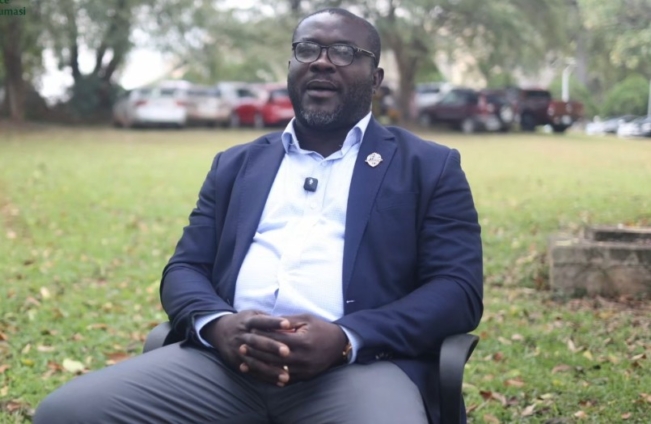
Dr. Edmund Nelson Amasah, a doctoral researcher at the Kwame Nkrumah University of Science and Technology (KNUST), says personal experience shaped his resolve to investigate what he describes as persistent regulatory failures in Ghana’s motor insurance system.
“My interest in insurance was shaped by personal experience,” Dr. Amasah said. “When my grandmother was involved in a road accident, I witnessed firsthand the fragility of Ghana’s third-party insurance system, especially for those who are uninsured or unlicensed. That experience pushed me to dig deeper into the industry and uncover what really happens behind the scenes.”
His doctoral research examines bad-faith claims denial under Ghana’s mandatory third-party motor insurance regime and argues that weak enforcement, rather than gaps in legislation alone, continues to undermine consumer protection.
Dr. Amasah said his work deliberately moved beyond textbook legal analysis, adopting a mixed-method approach that combined qualitative interviews with digital tools such as Google Forms to reach communities with limited literacy.
“To make complex insurance concepts accessible, I translated them into everyday analogies,” he said, explaining that bad faith was described as paying “five cedis instead of ten without reason,” or deducting premiums “without authorisation.”
“My goal was to help people understand and respond honestly, without feeling intimidated by technical jargon.”
The findings, he said, point to troubling contradictions at the policy level. Although Parliament has acknowledged prolonged claims delays, sometimes stretching several years the Insurance Act passed in 2021 introduced no enforceable timelines for settling claims.
At the same time, older regulations such as Legislative Instrument 1502 of 1990, which provide punitive measures for irrational claims denial or delay, remain dormant.
“I often ask myself: where is the LI?” Dr. Amasah said. “It hasn’t been repealed, but it’s not being used either.”
He also calling for the institution of an independent insurance Ombudsman that looks at the policy and helps to resolve disputes.
He argues that Ghana’s insurance ecosystem requires urgent reform, including amendments to existing laws, strict enforcement of dormant legal instruments, accessible redress mechanisms such as an independent insurance ombudsman, and sustained public education.
“Awareness alone, without regulatory change, risks washing our dirty linen in public and further undermining trust,” he said.
Latest Stories
-
GPRTU in Savannah Region to protest alleged eviction in Damongo
23 minutes -
Re: Reinsurance does not replace process — A response to the SIGA–SIC defence
38 minutes -
Gender Ministry supports Harriet Amuzu in ongoing abuse case
51 minutes -
AG joins plaintiff to scrap OSP ?: We should be mindful of the mischief in this – Bobby Banson
57 minutes -
Samson Lardy Anyenini questions willingness of Attorneys-General to prosecute political colleagues
59 minutes -
It is only fair the OSP is heard in Supreme Court case – Bobby Banson
1 hour -
Asiedu Nketia resumes Ashanti tour, second leg kicks off on Sunday
1 hour -
NLA denies salary cut claims, threatens legal action over reports
1 hour -
BoG Governor honoured for stabilising cedi, improve inflation
1 hour -
Kyebi Easter Homecoming 2026: A resounding success!
2 hours -
RNAQ divorce ruling: What the noise is hiding
2 hours -
Trade Minister applauds GUTA as a pillar of economic growth; Prez Mahama honoured
2 hours -
President’s brother’s takeover of Damang Mines is ‘untidy’ – Alhassan Tampuli
2 hours -
It’s not true that gov’t decided not to renew the lease for Gold Fields – Bobby Banson
3 hours -
Ghana to boost tomato production with 60-hectare irrigated farms and processing initiatives
3 hours