


Audio By Carbonatix
It might just be the most bizarre criticism of a US ambassador in recent memory.Harry Harris, Washington's envoy to South Korea, has been subjected to heated vitriol on social media and by anonymous netizens for his mustache.That small piece of facial hair has, as Harris put it, "for some reason become a point of some fascination here in the media."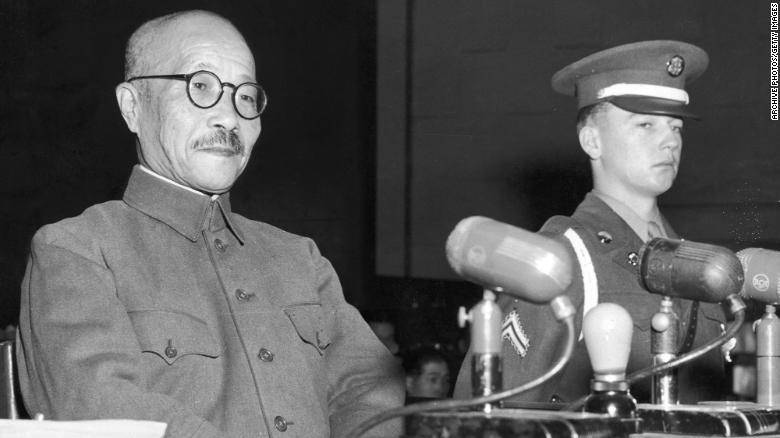 Hideki Tojo takes the stand for the first time during the International Tribunal trials in Tokyo in 1947.Harris was born in Japan to a Japanese mother and American father, who was a Navy officer, and some online commentators have pointed to Harris' heritage along with the mustache in their criticisms.But Harris isn't Japanese, he's a US citizen. And calling him out for his Japanese ancestry would almost assuredly be considered racist in the United States.South Korea is a homogenous society without racial diversity like the United States. The CIA World Factbook doesn't even list other ethnic groups living in South Korea on the country's page, instead just referring to the country as "homogenous." Mixed-race families are rare and xenophobia remains surprisingly common.Harris, who has dedicated years of his life to the service of his country, said in an interview with the Korea Times in December that the only times his ethnic background has come into play was when he criticized China for its actions in the South China Sea, and recently, in South Korea in connection to his mustache."I understand the historical animosity that exists between both of the countries but I'm not the Japanese American ambassador to Korea, I'm the American ambassador to Korea," he said. "And to take that history and put it on me simply because of an accident of birth I think is a mistake."Harris said he believes the argument that he resembles Japanese wartime leaders "cherry picks" history. He cited two mustachioed Korean independence figures, Ahn Jung-geun and Ahn Chang-ho, as proof.
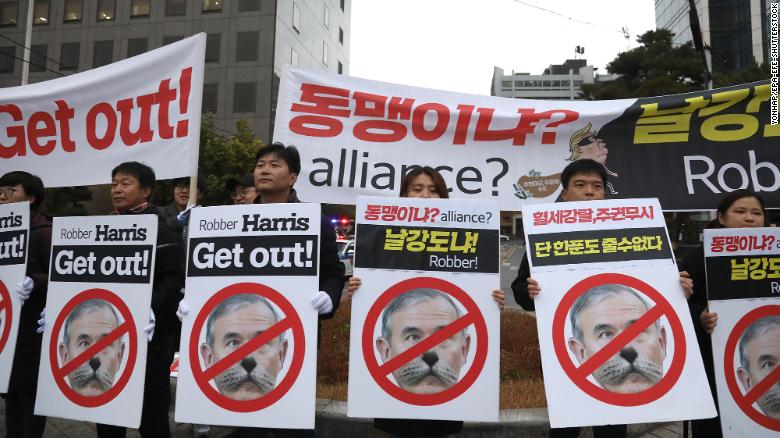 Members of Seoul Jinbo, a civic group of progressive activists, hold a rally near the residence of US Ambassador to South Korea Harry Harris in Seoul on November 11, 2019. His face is superimposed with a cat because he joked on Twitter that his cats were OK after a group of students broke into his house."I didn't grow a mustache because of my Japanese heritage, because of the independence movement of Korea or even because of my dad. I grew it because I could and I thought I would and I did," he said.Harris explained that he grew the mustache to mark a new phase in his life, after he retired as commander of the US Pacific Fleet and began working as a diplomat."I couldn't grow taller, I couldn't grow hair on top of my head, but I could grow it on front of my head and so I did that. Nothing more nefarious than that, I wanted to have a change," he said.
Hideki Tojo takes the stand for the first time during the International Tribunal trials in Tokyo in 1947.Harris was born in Japan to a Japanese mother and American father, who was a Navy officer, and some online commentators have pointed to Harris' heritage along with the mustache in their criticisms.But Harris isn't Japanese, he's a US citizen. And calling him out for his Japanese ancestry would almost assuredly be considered racist in the United States.South Korea is a homogenous society without racial diversity like the United States. The CIA World Factbook doesn't even list other ethnic groups living in South Korea on the country's page, instead just referring to the country as "homogenous." Mixed-race families are rare and xenophobia remains surprisingly common.Harris, who has dedicated years of his life to the service of his country, said in an interview with the Korea Times in December that the only times his ethnic background has come into play was when he criticized China for its actions in the South China Sea, and recently, in South Korea in connection to his mustache."I understand the historical animosity that exists between both of the countries but I'm not the Japanese American ambassador to Korea, I'm the American ambassador to Korea," he said. "And to take that history and put it on me simply because of an accident of birth I think is a mistake."Harris said he believes the argument that he resembles Japanese wartime leaders "cherry picks" history. He cited two mustachioed Korean independence figures, Ahn Jung-geun and Ahn Chang-ho, as proof.
Members of Seoul Jinbo, a civic group of progressive activists, hold a rally near the residence of US Ambassador to South Korea Harry Harris in Seoul on November 11, 2019. His face is superimposed with a cat because he joked on Twitter that his cats were OK after a group of students broke into his house."I didn't grow a mustache because of my Japanese heritage, because of the independence movement of Korea or even because of my dad. I grew it because I could and I thought I would and I did," he said.Harris explained that he grew the mustache to mark a new phase in his life, after he retired as commander of the US Pacific Fleet and began working as a diplomat."I couldn't grow taller, I couldn't grow hair on top of my head, but I could grow it on front of my head and so I did that. Nothing more nefarious than that, I wanted to have a change," he said.DISCLAIMER: The Views, Comments, Opinions, Contributions and Statements made by Readers and Contributors on this platform do not necessarily represent the views or policy of Multimedia Group Limited.
DISCLAIMER: The Views, Comments, Opinions, Contributions and Statements made by Readers and Contributors on this platform do not necessarily represent the views or policy of Multimedia Group Limited.
Latest Stories
-
Airlines cut flights and hike fares as fuel prices surge
8 minutes -
Kane inspires Bayern to first-leg advantage over Real Madrid at Bernabéu
19 minutes -
Wireless Festival cancelled after Kanye West blocked from coming to UK
27 minutes -
Wa West MP commissions five boreholes for the benefit of his constituents
27 minutes -
Havertz’s late strike hands Arsenal narrow first-leg advantage over Sporting
29 minutes -
Damang mine award: Minority not against Ghanaian participation; we’re asking for fair process – Konadu
51 minutes -
NPA to enforce stricter registration rules for petroleum tankers
1 hour -
Manhyia South MP laments decline in hospitality operations in his constituency
2 hours -
How a simple clean charcoal innovation could benefit Ghana’s climate future
2 hours -
NPA, COMAC launch Safety Week 2026 to promote risk management in petroleum sector
2 hours -
Stakeholder engagement resolves onion trade impasse
2 hours -
Gender Ministry holds staff durbar, welcomes new Chief Director
2 hours -
Unexpected illness sparked my radio career – Tommy Annan-Forson
2 hours -
Bolt Ghana awards GH¢50,000 to women entrepreneurs through “She Moves to Win” campaign
2 hours -
NRGI Country Manager questions speed of ministerial approval in Damang mining deal
2 hours