

Audio By Carbonatix
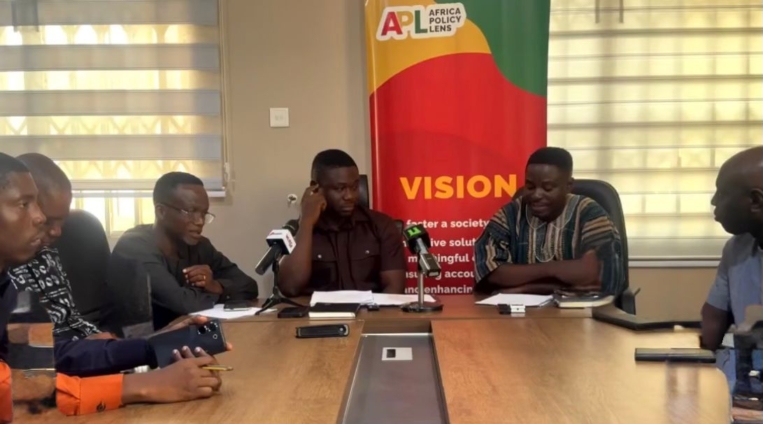
The Africa Policy Lens (APL) has criticised the decision of the government to propose a reduction of Ghana’s royalty rate in the Barari DV lithium agreement from the previously agreed 10% to 5%.
According to the APL, the previous administration, after Cabinet approval to review royalty rates for lithium and associated minerals, negotiated a 10% royalty rate with Barari DV Ghana Limited—an upward revision from the standard 5% applied in the broader mining sector.
The APL notes that the current proposal to reduce the rate to 5% is unusual, particularly because the National Democratic Congress (NDC), while in opposition, had strongly argued that the 10% rate was inadequate and should have been higher.
The government has since explained that the earlier 10% agreement was unlawful, a justification that has sparked debate.
At a press conference in Accra, the APL challenged this position, arguing that the previous negotiation was lawful and represented an improvement on Ghana’s mineral fiscal regime.
The group stated that the current approach does not appear to align with the national interest.
Quoting the law, the APL said: “Section 25 of the Minerals and Mining Act, 2006 (Act 703), as amended by Act 900 of 2015, provides that a holder of a mining lease shall pay royalty at a rate and in the manner prescribed. Act 900 repealed Act 794 of 2010, which had fixed the royalty rate at 5 percent.”
The group added that Section 6 of Act 900—known as the savings clause—preserved the previous 5% rate only for companies whose leases were already in force before the amendment.
In the APL’s view, this means that, from 2015 onwards, royalty rates for new mineral agreements were no longer fixed by law and could be determined through negotiation or regulation.
“Accordingly, the previous government acted within the law and in the interest of Ghanaians by securing a 10% royalty rate,” the APL stated.
The organisation further argued that claims of illegality against the earlier agreement are “misleading,” emphasising that Ghana’s negotiated terms are comparable to royalty regimes in countries such as Chile, Argentina, Australia and Zimbabwe.
“The analysis shows that the previous agreement aligns with international practice and remains one of Ghana’s most favourable mining arrangements to date,” the statement said.
The APL urged Parliament to uphold the original agreement and warned that reducing the royalty rate from 10% to 5% could result in significant lost revenue.
Based on its projections, the group estimates potential losses of up to US$610 million over the life of the Ewoyaa lithium project.
Latest Stories
-
UNIFIL condemns air strikes that injured Ghanaian peacekeepers in Lebanon
9 minutes -
Assembly member shot as armed robbery wave grips Agona East District
33 minutes -
Armed robots take to the battlefield in Ukraine war
1 hour -
AI-generated Iran war videos surge as creators use new tech to cash in
2 hours -
Kufuor calls for intellectual revolution to fix Ghana’s structural cracks
3 hours -
This Saturday on Prime Insight: Experts to tackle Mahama’s land transit ban on rice and ORAL progress
4 hours -
‘Tragic event’: Israeli Ambassador reacts to missile attack on Ghanaian soldiers in Lebanon
4 hours -
Huge US bomber lands at UK air base
4 hours -
Chief Imam urges unity, democratic commitment as Ghana marks 69th Independence Anniversary
5 hours -
Eternal vigilance: Akufo-Addo reflects on the price of liberty on independence day
5 hours -
Introducing Regalia Residence: Accra’s new luxury standard
5 hours -
Emirates restores flights as airspace reopens, moves toward full global operations
5 hours -
Widows’ bodies in exchange for land: A call to the state and traditional authorities
5 hours -
Ghanaian faces 20 years in US prison after $100m global romance scam bust
5 hours -
Five people are diagnosed with cancer every hour in Kenya – How Empower digital platform is facilitating early detection
7 hours