

Audio By Carbonatix
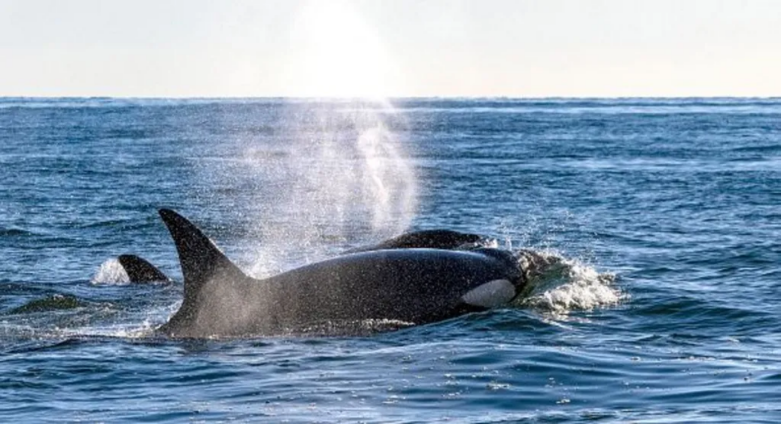
A sailing yacht has sunk in Moroccan waters in the Strait of Gibraltar after being rammed by an unknown number of orcas, Spain's maritime rescue services said.
Two people onboard the vessel, Alboran Cognac, were rescued by a passing oil tanker, after the incident at 0900 local time (0800 BST) on Sunday.
It is the latest in a series of orca rammings of vessels around the Strait of Gibraltar over the past four years.
Scientists are unsure about the exact causes of the behaviour but believe the highly intelligent mammals could be displaying "copycat" or "playful" behaviour.
Spain's maritime rescue service said the two passengers reported feeling sudden blows to the hull and rudder, causing water to seep into the vessel.
The couple alerted emergency services and were rescued by a nearby oil tanker which then took them to Gibraltar.
The yacht was left adrift and eventually sank.
Orca rammings in the Strait of Gibraltar - one of the busiest waterways in the world, with approximately 300 ships crossing daily - and off the Atlantic coast of Portugal and north-western Spain, have become increasingly common over the past four years.
Experts believe them to involve a subpopulation of about 15 orcas given the designation "Gladis".
The research group GTOA, which tracks the population of the Iberian orca sub-species, has documented nearly 700 interactions involving the species, since the attacks were first reported in May 2020.
Experts believe attacks first began after one or two orcas, which are also known as killer whales, started interacting with and damaging small sailing vessels that month.
One of the main theories that has circulated social media is that the orcas are seeking revenge for White Gladis - a killer whale supposedly hit by a boat.
That caught on when Alfredo López Fernandez, from research group GTOA, was quoted as saying a "traumatised orca" had launched the attacks.
But, according to animal behaviour experts, this might not be true.
"The idea of revenge is a great story, but there's no evidence for it," neuroscientist Lori Marino, president of the Whale Sanctuary Project previously told the BBC.
"There's never been a case of an orca harming a human being in the wild.
"If they really wanted to do damage and harm the people on the boat they could easily do that."
Instead, Lori told the BBC, it's more likely the apparent attacks "started out as play behaviour", and it's a case of copycat killer whales rather than aggression.
"We're talking about very intelligent beings, and we know that they are social learners," she says.
Scientists think the endangered mammals instead appear to be "playing" with the boats out of curiosity and copycat behaviour, rather than aggression.
Latest Stories
-
Nigeria convicts 386 Islamist militants in mass trials
48 seconds -
Djibouti president wins election with 97.8% of vote, state media says
5 minutes -
We don’t have mandate to deduct tax from rent allowance of security services personnel – Interior Ministry clarifies
20 minutes -
Ablakwa receives Presidential Special Envoy on Reparations to advance global agenda
37 minutes -
Christina Koch becomes first woman to travel around the moon on Artemis II
48 minutes -
Epstein survivors’ calls to meet King Charles and Queen harder to ignore as US visit approaches
54 minutes -
UN Secretary-General names Ghana’s Anita Kiki Gbeho as South Sudan envoy
55 minutes -
Mali withdraws recognition of Sahrawi Republic, backs Morocco’s autonomy plan
60 minutes -
Gov’t distributes over 8,500 laptops to One Million Coders project
1 hour -
Julius Debrah, ‘man to beat’ as NDC’s James Agbey dismisses Musah Dankwah’s polls
1 hour -
GPRTU in Savannah Region to protest alleged eviction in Damongo
2 hours -
Re: Reinsurance does not replace process — A response to the SIGA–SIC defence
2 hours -
Gender Ministry supports Harriet Amuzu in ongoing abuse case
2 hours -
AG joins plaintiff to scrap OSP ?: We should be mindful of the mischief in this – Bobby Banson
2 hours -
Samson Lardy Anyenini questions willingness of Attorneys-General to prosecute political colleagues
2 hours