

Audio By Carbonatix
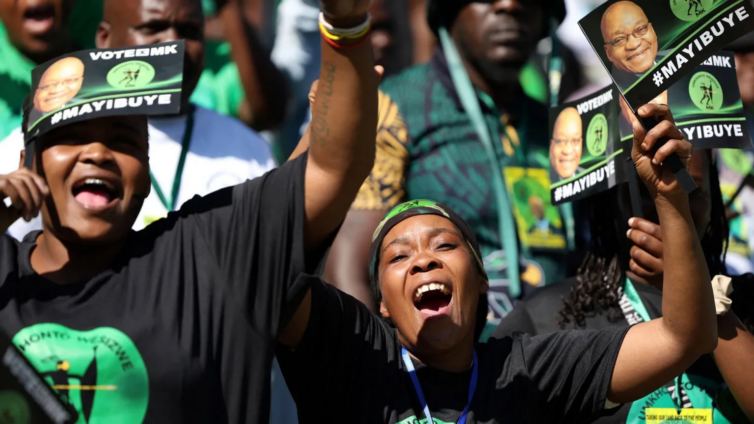
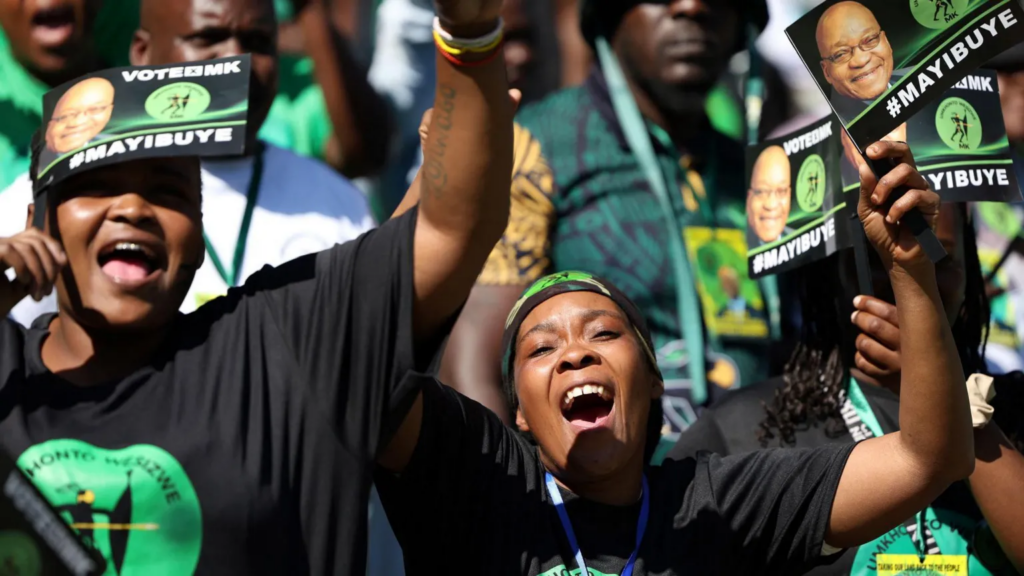
South Africa's former President Jacob Zuma put on a show of strength in the historic township of Soweto as he campaigned for votes in the build-up to the 29 May general election.
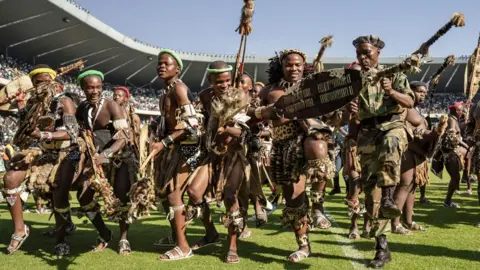
Zulu warriors marched around Orlando Stadium with their spears and shields, men in camouflage sang and danced to revolutionary songs, while some of South Africa's famous singers - including rapper Big Zulu - provided entertainment to the near capacity crowd at Saturday's rally.
For Mr Zuma's supporters a major coup was the presence of the man known as a disco king, Papa Penny.
Having announced his resignation from the governing African National Congress (ANC) last week, he has now joined the former president's new party, uMkhonto weSizwe, which translates as Spear of the Nation.
"Unite Africa. Unite South Africa," he said in a short address to the crowd, adding: "Phansi [Down with] tribalism."
Mr Zuma's supporters saw Papa Penny's presence - he hails from the small Tsonga community - as significant as it challenged perceptions that the former president's support only comes from his Zulu ethnic group, the biggest in South Africa.
But the star attraction at the rally was none other than the 82-year-old former president.
The crowd burst into chants of "Zuma, Zuma" as he walked into the stadium, while his increasingly influential daughter, Duduzile Zuma-Sambudla, knelt in front of him and hugged him before he took his seat on the stage.
She serves on what is called the "national core" of the party, recently telling The Shady PHodcast: "My father is obviously the head, and I'm the neck."
Mr Zuma's decision to hold his biggest campaign rally in Soweto was significant because it is a stronghold of the ANC in South Africa's economic heartland of Gauteng.
Soweto also has deep political symbolism as it was at the forefront of the struggle against the racist system of apartheid, which ended with the ANC's rise to power in 1994.
But now, 30 years later, the ANC risks losing its outright majority as it faces a threat from Zuma's breakaway party, as well as other opposition parties.
With this in mind, ANC leader and President Cyril Ramaphosa has been hard on the campaign trail in Mr Zuma's home province of KwaZulu-Natal.
Addressing voters on Saturday in Mandeni town, about 100km (62 miles) from the coastal city of Durban, Mr Ramaphosa said creating jobs was his priority, warning "small parties" like MK - the acronym by which Mr Zuma's party is known - that they were looking down on the ANC at their peril.
"These small parties, the MK-what-what don't really know us. They only know about us from the media. They will know us on 29 May," he was quoted as saying by the News24 website.
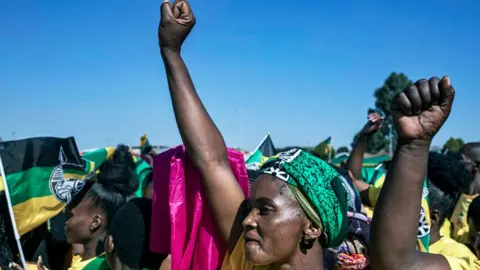
Mr Ramaphosa ousted Mr Zuma as president in 2018 after a vicious power-struggle, culminating with the former president ditching the ANC last December and making a fresh bid for power under the banner of MK.
South Africa's highest court is yet to rule on whether Mr Zuma can serve as a lawmaker in the next parliament. The electoral commission argues that the constitution bars anyone who was sentenced to more than 12 months in prison from doing so.
Mr Zuma was sentenced to 15 months in 2021 after being convicted of contempt of court for defying an order to appear before an inquiry investigating corruption during his presidency.
But his lawyers say he is entitled to become an MP as his sentence was reduced to three months after Mr Ramaphosa released him from prison in what widely seen as an attempt to placate the former president's angry supporters.
Senior MK official Visvin Reddy told the BBC that he expected the court to give its ruling this coming week. Even if it went against their leader, MK would still contest the election, with Mr Zuma's face remaining on the ballot paper, he said.
"We'll go to parliament, change the constitution, and bring him in," Mr Reddy added.
MK has set itself the target of winning a two-thirds majority in the election, though this appears to be an overly ambitious target. An Ipsos opinion poll released last month put the party's support at only 8%.
And in a worrying sign for Mr Zuma, a large section of the crowd left before he finished his lengthy speech, which dwelt on political history.
While the Ipsos poll put the ANC's support at 40% (down from the 57% it got in the 2019 election) the Social Research Foundation (SRF), which has been tracking polls on a daily basis, says the governing party has seen a surge in support in recent weeks as it steps up its campaign, the local City Press newspaper reports.
SRF head Frans Cronje said that if elections were held now, there was a likelihood that ANC could pass the 50% mark.
“According to our computer projection in the past four weeks, the ANC has been squeezing the life out of the opposition parties,” he is quoted as saying.
On the campaign trail in KwaZulu-Natal, Mr Ramaphosa urged his party's supporters to come out in large numbers to vote.
"If we win in KwaZulu-Natal and Gauteng, then we've won because those provinces have the most people," he was quoted as saying at the rally.
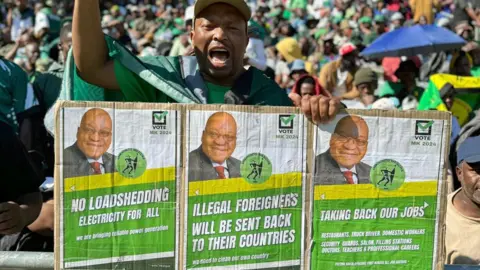
Not surprisingly, there was deep hostility towards the ANC leader at Mr Zuma's rally, with the crowd chanting "Down with Ramaphosa".
"Power must come back to the people," Mr Zuma said, in a speech delivered in the Zulu language.
Hitting out at white colonialists, he added: “People who came in ships and boats took over our country. They left us poor. We must take back the land our forefathers fought for."
A few of his supporters wore T-shirts emblazoned with images of Mr Zuma and Russia's President Vladimir Putin, pointing out that the two were among the founding leaders of Brics - an alliance of major developing countries that seeks to rival the power of Western nations.
"Putin is our friend, a friend of Zuma," MK supporter Dennis Zwide told the BBC, as he accused the West of exploiting Africa's mineral resources.
"Africa is a rich continent, but its people are suffering because of the exploitation," he added.
In its manifesto, MK has pledged to nationalise South Africa's mines and banks if it takes power, despite the fact that these policies were widely discredited after the collapse of the Soviet Union in 1991.
"We want our children to study for free, especially those from poor households because the poverty we have was not created by us. It was created by settlers who took everything, including our land. We’ll take all those things back, make money and educate our children," Mr Zuma said.
He also vowed to expel undocumented migrants, in a further sign of the populist stance he has adopted in an attempt to win votes.
To what extent he is succeeding will become clear in 10 days' time when South Africans vote in one of the most pivotal elections in the post-apartheid era.
Latest Stories
-
MTN set to deploy 5G services after winning spectrum licenses worth US$202m
32 minutes -
NPP national elections: 3,000–4,000 police to handle security, traffic in Kumasi – Karbo
3 hours -
Atta Akyea fumes as Manhyia MP is to spend another night in EOCO custody
3 hours -
SSNIT says La Beach clearance was to protect hotel investments, beaches to remain public
4 hours -
APSU congratulates St Augustine’s College after back-to-back National Investment Quiz wins
4 hours -
Renewed flood intervention at Mallam Junction raises hopes among residents, businesses
5 hours -
St Augustine’s College retain National Investment Quiz title after nail-biting grand finale
5 hours -
Education infrastructure investment will drive Banda’s development – Ahmed Ibrahim
5 hours -
Teacher unions strike: Gov’t presents fresh proposals as talks end inconclusively
6 hours -
51,000 teachers’ promotion arrears to be validated for October payment – Education Minister
6 hours -
Kwabena Boamah appointed Board Chair for Impact Investing Ghana
6 hours -
Striking teacher unions to meet Fair Wages and Salaries Commission on October 6
7 hours -
EOCO working with AG to arraign Nana Baffour Awuah before weekend court
7 hours -
Duraplast reassures customers after fire, announces October 5 reopening
7 hours -
Call off strike, gov’t will not renege on promotion arrears pledge – Haruna Iddrisu to teacher unions
7 hours