

Audio By Carbonatix
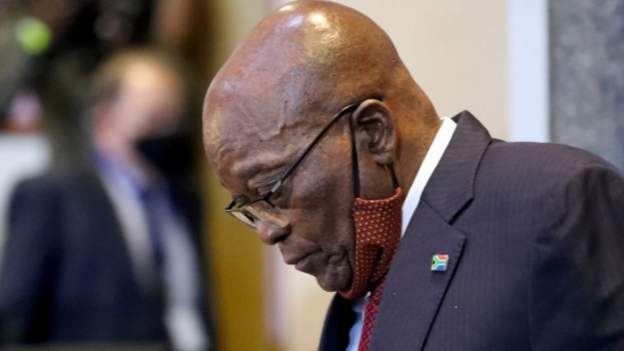
Former UN senior governance advisor, Prof. Baffuor Agyemang-Dua has lauded the South African judiciary for sentencing its former president, Jacob Zuma.
According to him, institutions in Africa have not been strong; hence the action depicts the court's power, and it is his wish all African countries will emulate the same.
“In the case of South Africa, I am impressed by the fact that the court has insisted on prosecuting the former president. It indicates perhaps the strength of the judiciary which of course will be shown in its independence in carrying out its responsibilities,” he said.
The former South African president was sentenced to 15 months in jail by the highest court on Tuesday after it found him guilty of contempt for defying its order to appear at an inquiry into corruption while he was president.
Commenting on Tuesday morning's sentencing, Prof. Agyemang-Dua told JoyNews that the action will also serve as a caution to leaders going forward.
“I think it gives a very strong, positive signal that leaders should begin to know that the fact that they become presidents or heads of state, that fact do not prevent them from accounting to the people, especially when it comes to corruption.”
According to him, leaders in most African countries rides on their past glory because “we don’t have a strong judiciary, we don’t have strong government institutions and therefore, even when they are out of power, former leaders are still regarded to be special and institutions wouldn’t want to touch them and that in itself is a problem.”
He, therefore, said “we need to have stronger institutions managed by independent-minded people."
“There’s a difference between having the institutions and having those appointed to run that institution having the courage to execute their mandate.”
He, however, noted that in most cases, the necessary institutions for good governance are in place, “yet the people that are appointed to head these institutions are simply not functioning, they don’t function, for all kinds of reasons.”
Prof Agyeman-Dua hopes other anti-corruption campaigners in other countries will take a cue from this and “begin to press on their own leaders in their various countries; this is the way we should go.”
He cited that, in Ghana, law enforcement has become a problem in the country because “we do not want to sanctions wrongdoers, even at times, wrongdoers get glorified than the victims of these wrongdoers.”
Latest Stories
-
President Mahama is not sincere with Ghanaians on LGBTQ bill matter – Hassan Tampuli
17 minutes -
Gov’t to establish Prison Industrial Hub to equip inmates with income-generating skills – Prison Service boss
36 minutes -
Alhassan Tampuli donates cement, roofing sheets to support storm victims in Gushegu
37 minutes -
Alhassan Tampuli appeals for urgent support for storm victims in Gushegu
40 minutes -
The hypocrisy must stop; pass Anti-LGBTQ+ Bill now – Alhassan Tampuli to Mahama
43 minutes -
Imprisonment should be rehabilitative, not punitive – Ghana Prisons boss at UNGA
1 hour -
Ga Adangbe traditional priests petition Mahama over McDan aviation licence revocation
1 hour -
Anti-LGBTQ Bill: NDC’s arrogance is worrying – Hassan Tampuli
1 hour -
Let’s give OSP time to mature, not to scrap it – Hassan Tampuli
2 hours -
Nigeria convicts 386 Islamist militants in mass trials
2 hours -
Djibouti president wins election with 97.8% of vote, state media says
2 hours -
We don’t have mandate to deduct tax from rent allowance of security services personnel – Interior Ministry clarifies
2 hours -
Ablakwa receives Presidential Special Envoy on Reparations to advance global agenda
2 hours -
Christina Koch becomes first woman to travel around the moon on Artemis II
2 hours -
Epstein survivors’ calls to meet King Charles and Queen harder to ignore as US visit approaches
2 hours