

Audio By Carbonatix
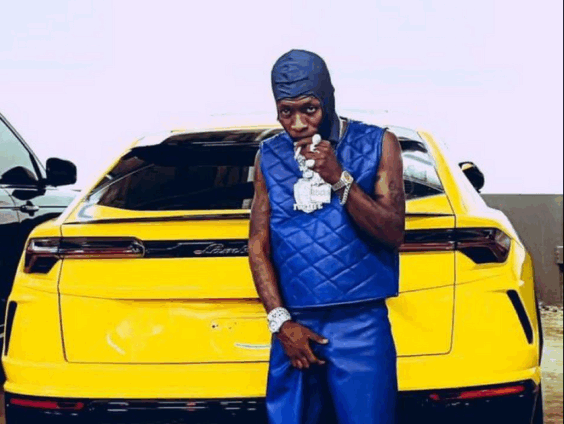
The legal defence of popular Ghanaian dancehall artiste Shatta Wale in the ongoing Lamborghini saga is "extremely weak", Head of Chambers at Clinton Consultancy, Amanda Clinton, has said.
Commenting on the development, international lawyer Ms Clinton dissected the complexities of the case, highlighting the significant legal hurdles the musician faces and the crucial role of documentation in proving his innocence.
The case centres on a yellow 2019 Lamborghini Urus, which the Economic and Organised Crime Office (EOCO) seized at the request of the U.S. Department of Justice.
The luxury vehicle has been flagged in a U.S. restitution order as a "substitute asset" to recover funds from a US$4 million fraud case involving convicted Ghanaian national Nana Kwabena Amuah.
While EOCO has not yet formally charged Shatta Wale, the focus of the investigation is on potential tax evasion, money laundering, and his claim that he purchased the car from "the street."
Shatta Wale's claim that he is an "innocent purchaser"—meaning he bought the car in good faith and had no knowledge of its criminal origins—is at the heart of his defence.
However, as Amanda Clinton explains, this defence lacks crucial evidence.
“By saying he bought the car ‘on the street’—possibly from someone called ‘Zak’—Shatta Wale is essentially asserting an innocent purchaser defence,”Ms Clinton told Citi FM on August 21. “But without credible documentation—receipt, registration, customs forms, proof of payment—that defence is extremely weak.”
The only document the artiste has produced so far is a customs form that bears the name of Nana Kwabena Amuah, the very individual at the centre of the fraud case.
This, according to Ms Clinton, does little to support his claim of legitimate ownership.
Ms Clinton believes that without strong documentation, Ghana's courts are unlikely to accept the “street purchase” story.
“Realistically, unless he produces solid documentation proving legitimate acquisition—bank statements, bills of sale, customs receipts—Ghana’s courts are unlikely to accept the ‘street purchase’ story,” she said.
Ms Clinton clarified the legal process, noting that EOCO's role is not to simply hand over the vehicle to U.S. authorities.
Under Ghana's sovereignty, EOCO must apply to a Ghanaian High Court to recognise and enforce the U.S. forfeiture order.
The court will consider several factors, including the authenticity of the U.S. order, whether the car falls under Ghana's proceeds of crime laws, and critically, whether Shatta Wale can prove he is a valid, innocent purchaser, she explained.
The case, Clinton concludes, is a significant test of Ghana's commitment to international justice and cooperation on cross-border financial crime. The final outcome will likely depend on Shatta Wale's ability to provide credible proof of ownership.
Latest Stories
-
Tyson Fury pays tribute to Anthony Joshua’s friends killed in Nigeria car crash
11 minutes -
GTA welcomes Mr Eazi’s $2m event centre investment plan
38 minutes -
Mrs Sylvia Cudjoe
49 minutes -
If gov’t walks the talk in budget, 2026 will be a good agriculture year – Dr Opoku Gakpo
52 minutes -
Enforcement of law, order in Bawku non-negotiable – Asiedu Nketia
1 hour -
Lady Mae Injects GH¢1.59m into women’s empowerment as she launches ‘Save You First’
1 hour -
Prof. Emmanuel Adinyira: When traffic decides who lives
1 hour -
May our New Year be restless: A message to the President, the people, and the continent
2 hours -
GoldBod should be fixed, not scrapped – Economist
2 hours -
We have failed as a country in road safety education – Accident Victims Support president
2 hours -
Gov’t launches 1-day expedited passport delivery service
2 hours -
Before the Bell Rings, the Buckets Rise: How climate change is stealing childhood at Wassa Agave
2 hours -
Victims of Ho Central Mosque shooting appeal to Mahama for intervention
2 hours -
Kumasi Central Prison holds maiden inmates’ fashion show, showcasing talent and rehabilitation
2 hours -
25 arrested in Obuasi security operation
3 hours