

Audio By Carbonatix
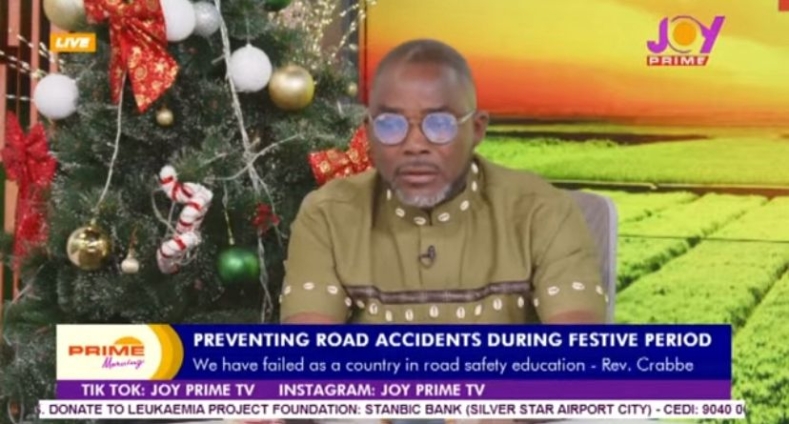
President of the Accident Victims Support Foundation, Reverend Cyril Benedict Crabbe, says Ghana has collectively failed in addressing road safety, describing the situation as a national concern that requires urgent attention.
Speaking to Joy Prime on Tuesday, December 30, 2025, Rev. Crabbe said the country’s approach to road safety has been largely reactive, focusing more on punishment than sustained education.
According to him, while enforcement plays an important role, education remains the most effective tool in reducing road crashes and fatalities.
He recalled that the introduction of motor courts in the past significantly contributed to reducing road accidents, as offenders were made to face the consequences of their actions.
However, he noted that “discipline among road users has steadily declined over the years, largely due to weak enforcement and the growing culture of indiscipline on the roads.”
Rev. Crabbe expressed concern over what he described as disturbing scenes where accident victims, particularly motor riders, are left unattended, and even some law enforcement officers look on.
He said, “Such attitudes reflect a deeper problem of apathy and lack of responsibility toward human life.”
He also supported calls by road safety experts for the establishment of driving schools across the country.
According to him, offenders should be sent to classrooms for retraining instead of being rushed to court, as education would better correct dangerous driving behaviours.
The Rev. further called for periodic training and re-certification of drivers, noting that vehicle technology and road systems are constantly evolving. He said that without continuous learning, many drivers are unable to adapt, increasing the risk of crashes.
Rev. Crabbe stressed that road safety should be treated as a national development issue, not just a transport concern.
He called on the government, law enforcement agencies, and civil society to invest resources into a holistic road safety strategy that prioritises education, enforcement and emergency response.
He added that if road safety is made a national priority and adequately funded, Ghana could significantly reduce road accidents and fatalities, saving lives and easing the burden on families and the health system.
Latest Stories
-
Kwabena Boamah appointed Board Chair for Impact Investing Ghana
2 minutes -
Striking teacher unions to meet Fair Wages and Salaries Commission on October 6
16 minutes -
EOCO working with AG to arraign Nana Baffour Awuah before weekend court
19 minutes -
Duraplast reassures customers after fire, announces October 5 reopening
27 minutes -
Call off strike, gov’t will not renege on promotion arrears pledge – Haruna Iddrisu appeals to teacher unions
29 minutes -
Committee set up to validate teachers eligible for 20% deprived-area allowance – Education Minister
33 minutes -
Five-member committee to search for new Black Stars coach after Sports Ministry-GFA meeting
1 hour -
Pinktober: Breast cancer survival exceeds 90% when detected early – Breast Society of Ghana
1 hour -
TCDA to adopt Upper West’s MATCO mango farm as northern prototype, issues warning against felling shea trees
1 hour -
‘Fear delegates’ tag: Afoko touts genuineness among delegates ahead of NPP delegates conference
1 hour -
John Boadu: The leader our party needs at this time – Amb. Edward Akwasi Boateng
2 hours -
Baffour Awuah: EOCO arrested, detained MP after hours of waiting, questioning – Afenyo-Markin
2 hours -
EOCO court warrant authorised search of Baffour Awuah’s law firm, not residence – Afenyo-Markin
2 hours -
NPP delegates conference: 3,000 to 4,000 police personnel deployed for security in Kumasi – Anthony Karbo
2 hours -
KGL Foundation commits $200,000 to support juvenile football for the next two years
2 hours