

Audio By Carbonatix
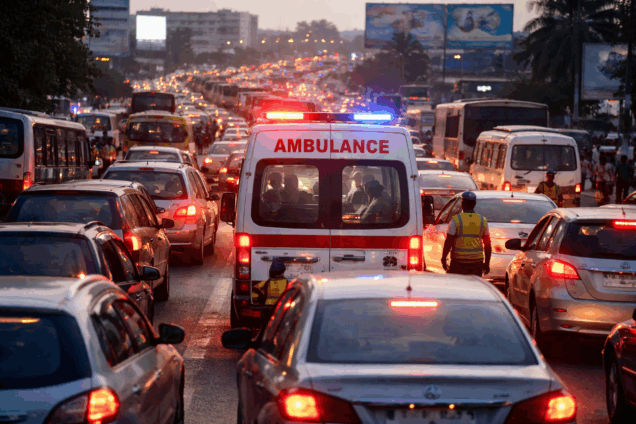
Listening to my Bishop recount his ordeal trapped in the now familiar Accra traffic while desperately trying to reach a hospital was deeply unsettling. It was not just a testimony; it was a warning. A warning that we must stop allowing ourselves to be bullied into normalising dysfunction.
Our cities are choking. Congestion is no longer a nuisance; it is a public safety emergency. When traffic stands still, lives are lost. Emergency response time is often the difference between survival and tragedy, and in our cities, that difference is too frequently decided by gridlock.
Improving emergency response efficiency must therefore be treated as a national urban policy priority. While technological innovations offer opportunities for smarter coordination, a dangerous gap persists between research, policy, and on-the-ground implementation. Dedicated emergency infrastructure remains absent, mainly, despite overwhelming evidence of its life-saving potential.
This is no longer an academic debate. Policy must now respond decisively. We need:
- Legally protected and enforceable emergency lanes on major urban corridors;
- Clear national and metropolitan standards for emergency access in road design, traffic management, and urban redevelopment;
- Institutional coordination among transport authorities, emergency services, metropolitan assemblies, and enforcement agencies;
- Targeted investment in context-appropriate intelligent transport systems that prioritise emergency vehicles; and
- Strict enforcement and public education, so emergency access is respected, not negotiated.
Our transportation engineers, planners, and scholars must work hand in hand with policymakers to deliver solutions that are practical, scalable, and grounded in our realities. Research must move beyond publications into pilot projects, regulations, and implemented systems.
Above all, we must act with urgency. Every delay carries a human cost. Avoidable deaths on our roads and in our traffic must no longer be accepted as inevitable. This is a matter of policy, planning, and political will.
It is too much and far too scary to ignore.
Emmanuel Adinyira (PhD)
Professor and Dean
Faculty of Built Environment
KNUST
Latest Stories
-
World Bank maintains Ghana’s growth rate forecast at 4.8% in 2026
1 hour -
Cedi was worst African currency in quarter 2, 2026 – World Bank
1 hour -
AI gains can lift three times as many people out of poverty in Ghana – World Bank
2 hours -
Police arrest suspect over jewellery theft during fire outbreak
4 hours -
EOCO returns Hanan’s £6,700, GH¢2,750 and devices after defence challenge
4 hours -
Opplift Youth Entrepreneurs Summit 2026 equips entrepreneurs with skills, mentorship and support
5 hours -
Rival clubs want range of punishments for Man City
5 hours -
Tear gas in Paris and Marseille as school protests grow across France
5 hours -
Kane inspires England to win over Czech Republic in UEFA Nations League
5 hours -
Finland orders halt to work on two Google data centres
5 hours -
Substitute Merino scores twice as Spain win in Croatia
5 hours -
Ronaldo wants Portugal ‘punishment’ but not retiring
5 hours -
White House defends Trump comment to let Iran ‘take out’ LA and San Diego
6 hours -
Asos confirms hackers sent ‘unauthorised’ notification to app users
6 hours -
US televangelist Jim Bakker, disgraced from sex scandal and fraud, dies at 86
6 hours