

Audio By Carbonatix
It was meant to be the simple one. No new stadiums to pour concrete for, no desert heat to engineer around, no questions about whether the host could even build what it had promised. Three wealthy North American nations, dozens of arenas already standing, the richest sporting market on earth. FIFA called the United States, Canada and Mexico the low-risk choice. The 2026 edition was billed as one of the most straightforward to organise in the tournament's history.
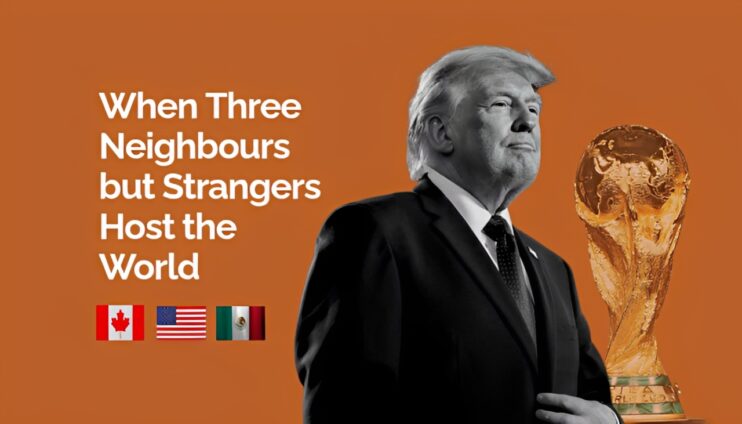
The party begins where the sport's history is thickest. The opening match pits joint-hosts Mexico against South Africa at the Azteca, the iconic venue of the 1970 and 1986 finals, with the United States and Canada joining the next day against Paraguay in Los Angeles and a playoff winner in Toronto. But beneath the mariachi and the Shakira-headlined ceremony, three neighbours who share borders, supply chains and a half-century-old trade pact are finding out how little they currently have in common.
The tournament that starts today is being staged by countries locked in a trade war, divided over immigration, and tied to a co-host that is, right now, fighting a war against one of the 48 teams in the field. Geography made them partners. Almost everything else has made them strangers.
A welcome that wasn't
The promise was unambiguous. Everyone, FIFA leadership insisted through 2025, would be welcome in all three host countries. The reality at American airports this month tells a different story.
At least one referee from Somalia and one Iraqi team staff member were denied entry at U.S. airports in recent days, and dozens of fans from countries such as Morocco have been denied travel visas, despite holding tickets. Iraqi striker Aymen Hussein, travelling to his team's base camp, offered perhaps the starkest illustration. When he entered the United States, he was held at the airport for seven hours of questioning and a phone inspection.
The most prominent casualty of the vetting regime was not a fan but an official. Omar Abdulkadir Artan, a top African referee from Somalia, was refused entry to the United States over what officials called vetting concerns, and FIFA confirmed he will not take part in the tournament. He had arrived at Miami International Airport from Istanbul and was put through additional inspection before being determined inadmissible. The loss carried a particular sting.
Artan was named Africa's top male referee in 2025, was one of seven African referees chosen for the tournament, and would have been the first Somali ever to officiate at a World Cup. The justification then escalated as the story spread. A Trump administration official told CNN the vetting had uncovered derogatory information, including association with suspected members of terror organizations, but gave no further detail. Somali authorities pushed back hard.
A government official in Mogadishu said Artan held a valid U.S. visa, and a senior adviser to Somalia's sports ministry called him one of Africa's most respected referees who deserved the support of the entire football community. Artan, now back in Istanbul, was gracious about it. He said that despite the circumstances he was in a positive mood and focused on the next challenges in his career, and wished his colleagues success at the tournament.
The structural problem sits in policy set long before kickoff. An internal U.S. State Department memo announced a freeze on visa applications from 75 countries as part of a broader review of screening and vetting procedures, requiring consular officers to assess applicants' age, health, English proficiency and likelihood of relying on public benefits.
Among the qualified nations reportedly affected were Brazil, Morocco, Haiti, Algeria, Cape Verde, Colombia, Cote d'Ivoire, Egypt, Ghana, Iran, Jordan, Senegal, Tunisia, Uruguay and Uzbekistan. Players, coaches and accredited staff were promised exemptions. Ordinary supporters got no such guarantee.
The administration's answer was the FIFA Priority Appointment Scheduling System, or PASS. Standing alongside FIFA President Gianni Infantino, the president announced the system would let World Cup ticketholders receive priority interviews to obtain visas. But governments and embassies were careful to manage expectations. A U.S. Embassy spokesperson in the UAE explained that a World Cup ticket does not guarantee a U.S. visa, that there are no special or event-specific visas for ticket holders, and that all applicants must meet eligibility requirements under U.S. law. One immigration expert was blunter, arguing the administration tried to bring in the fast-pass program too little, too late, and only acted once FIFA told them how many people weren't coming to the games.
Even fans from friendly, visa-waiver nations were caught out. Some World Cup supporters found their approval to enter the country had changed at the last minute, with previously approved ESTA applications moved back to pending. Scottish fans spoke out about ESTA problems and approvals revoked before the tournament. Moroccan organisers reported that dozens of ticket-holding fans had their visas denied without explanation.
FIFA, for its part, has kept its distance. It said it is not involved in host country immigration processes, including visa adjudications, and that a host government ultimately determines who receives a visa and who is admitted.
The war inside the tournament
No thread runs darker through this World Cup than Iran's. The team that was first to qualify is now arriving from a country at war with the host.
The United States and Israel targeted Iran in coordinated attacks that killed supreme leader Ayatollah Ali Khamenei and dozens more senior officials, prompting an Iranian response that aimed missiles at Israel and U.S. allies, including 2022 World Cup host Qatar and Saudi Arabia. The strikes began in late February. At one point Iran's sports minister announced on state television that the country could not participate, saying that because the regime had assassinated its leader, under no circumstances could it take part in the World Cup.
That it is happening anyway is its own strange diplomacy. FIFA President Gianni Infantino confirmed Iran will compete, with all three group-stage matches set for U.S. venues despite the tensions. The logistics border on surreal. The players were ultimately granted visas, but several members of the team's support staff were denied entry, so the squad based itself in Mexico and now commutes into the United States for games rather than staying in the host country. The players' own U.S. visas came through barely a week before their opener.
There is a sharp edge of symbolism, too. Iran open against New Zealand at SoFi Stadium in Los Angeles, home to one of the largest Iranian populations outside the Middle East. And a bracket scenario lingers that no organiser would have scripted. The U.S. and Iran could meet if both finish second in their groups, a match that would be played in Arlington, Texas. Iran's federation chief secured the team's participation only after attaching conditions, having watched Canada refuse entry to the federation's chief over his alleged links to the Islamic Revolutionary Guard Corps, which it designated a terrorist group in 2024.
Then, with the team finally on the ground, came the move aimed squarely at its supporters. Iran's football federation said the United States had revoked its allocation of tickets for the team's three group games, accusing the co-host of obstructing the attendance of Iranian fans under the shadow of the diplomatic row. The mechanism matters. Each of the 48 federations is entitled to receive and distribute 8 percent of stadium capacity, several thousand tickets per game, and Iran said it was now unable to provide a single ticket to its supporters.
The timing made it especially raw. The federation said its usual allocation was removed after it had already begun distributing tickets, leaving many fans, including members of the Iranian diaspora in North America who had booked flights and hotels, unable to attend. With less than three days remaining until the start of the tournament, the federation said, the United States had once again acted to obstruct the presence of Iranian supporters, calling the move contrary to the spirit of international competition and the principle of equality among participating countries, and asking FIFA to step in.
The episode threw FIFA's own past words into sharp relief. Infantino had insisted back in 2017, as the North American bid was being prepared, that any qualifying team, including its supporters and officials, must have access to the host country, or else the principle of the competition breaks down. Nine years later, the team is commuting across a border from Mexico, its staff partly barred, a fellow official from Somalia turned back, and its fans holding tickets that no longer exist.
The guns that travel advisories warn about
For many visitors, the most visceral anxiety is not bureaucratic. It is the simple question of physical safety in a country awash in firearms, and the run-up to today has not been reassuring.
In the week before kickoff, two separate attacks struck host cities. Six people were stabbed at New York's Penn Station and nine injured in a shooting near England's World Cup base camp in Kansas City, days before the opening weekend. The numbers behind those headlines are stark. Gun violence is common in the U.S., where there were more than 400 mass shootings in 2025, according to the Gun Violence Archive. By late April of this year, the country had already seen more than 126 mass-shooting incidents resulting in more than 3,100 deaths and 5,300 injuries.
The vulnerability reached the very top. A shooting that targeted President Trump at the White House Correspondents' Association dinner raised security concerns about the country's role as co-host, after a gunman armed with a shotgun, a handgun and multiple knives rushed a Secret Service checkpoint and shot a law enforcement officer. The episode prompted some fans online to question whether the United States should be hosting at all.
This is not a new worry, and rivals saw it coming years ago. When Morocco competed against the North American bid, it pointed to its very low gun circulation, amid growing calls for stricter firearms laws in the U.S. following a school shooting in Florida that left 17 dead. The concern has since hardened into official caution. The high frequency of mass shootings and permissive gun laws in some states have prompted foreign governments to issue travel advisories, raising serious concerns among international fans and media.
Security planners are spending accordingly. The Department of Homeland Security said it plans to invest $115 million in counter-drone technologies to protect World Cup games. But fan organisations say the gravest threat to their members may be the authorities themselves. Football Supporters Europe said it is extremely concerned by the ongoing militarization of police forces in the U.S., citing federal immigration crackdowns and noting that FIFA has not provided enough security information for traveling fans, who are left with little to no idea what will be allowed at venues or what to expect from police. Most striking of all, the group reported the U.S. had not yet invited visiting police delegations, or so-called spotters, which is unprecedented in the modern history of the tournament. U.S. authorities have not ruled out an ICE presence at the games.
A trade war with the lights on
Underneath the spectacle, the three hosts are not even sure they want to keep their economic marriage. The tariffs came fast in the current administration's term. Canada moved to impose 25 percent tariffs on roughly CA$155 billion of U.S. goods, with Mexico preparing similar steps, after the U.S. imposed across-the-board tariffs on its two neighbours.
The instrument that binds the three economies is now itself in question. The USMCA free trade agreement is up for a mandatory review next year, and the U.S. has signalled it is still weighing whether to keep the single long-standing agreement or pursue separate bilateral deals. The Canadian prime minister has credited that pact with shielding Canadian businesses from the worst of the tariffs.
Asked how a trade war squares with co-hosting the planet's biggest sporting event, the U.S. president was unbothered. “I think it's going to make it more exciting,” Trump said. “Tension's a good thing, I think it makes it much more exciting.” Months later, hosting the Canadian prime minister, he reversed the framing entirely and insisted there was no tension between the United States, Mexico and Canada that could hamper preparations. Both statements came from a leader who has repeatedly mused about making Canada the 51st state.
The economic stakes are not trivial, which is part of what makes the friction so costly. Infantino has said the event would draw millions of people and create 200,000 jobs, with an economic impact of $40 billion. A nation throttling tourist visas and picking trade fights with its co-hosts is, in effect, taxing its own windfall.
The embarrassments pile up
For a tournament that prides itself on hospitality, the build-up has been bruising. The home-away-from-home that base camps are supposed to provide became, for some, a gauntlet. A Team Base Camp is meant to combine a professional training facility with a high-standard hotel offering tailored meals, recovery spaces and a restful environment, the kind of frictionless welcome that lets a footballer focus on football. Iran's improvised setup, basing in one country and commuting across a militarised border into another, is the opposite of that.
The denials and detentions of officials and staff, the seven-hour airport interrogation of a player on his way to camp, the historic exclusion of a celebrated referee, the last-minute scramble over the Iranian squad's visas, the withdrawn fan ticket allocations: each is a small humiliation, and together they undercut the premise of an open, celebratory tournament before a ball has even been kicked.
The contradiction was perhaps best captured by an academic studying the event. Jules Boykoff, author of a book on the tournament, called the 2026 World Cup a massive paradox, with more teams than ever participating on one hand, and on the other a host country actively narrowing the door the world is meant to walk through.
What is at stake
The whistle will blow at the Azteca this afternoon regardless. The stadiums are full, the broadcast money is committed, and the half a billion ticket requests speak to undimmed global appetite. But this World Cup is being asked to carry more than football.
For the United States, it is a soft-power audition staged in the same season it is fighting a war abroad and running an immigration crackdown at home, a test of whether a country can declare itself open to the world while visibly closing. For Mexico and Canada, it is a question of whether co-hosting brings genuine partnership or just the obligation to absorb the fallout from decisions made in Washington. For FIFA, it is the limit of a strategy that has cultivated political power while disclaiming responsibility for what that power does to the fans and players in its care.
And for the millions who saved for years to follow their team, it is something simpler and more fragile: whether the world's tournament still belongs to the world, or only to those a host government decides to let in.
Latest Stories
-
When the Gospel Becomes a Weapon: The church, blackmail and the abuse of faith
12 minutes -
JoyNews’ Jacqueline Ansomah Yeboah selected for UK Media Excellence for Emerging Technology Fellowship
29 minutes -
Mental Health Alliance urges government to operationalise Mental Health Fund
44 minutes -
Ghana–Holy See agreement heads to Parliament after Cabinet approval
48 minutes -
Luv FM Corporate Games 2026: Kumasi Central Prisons, Amanfiman Bank win big amid fun
59 minutes -
WAFU B U17: Ghana top Group A after win over Togo
1 hour -
Ho Central Mosque reopens amid unresolved leadership dispute that led to closure
3 hours -
Minority caucus questions GH¢16.4m in Ablakwa’s SA evacuation spending, demands independent audit
3 hours -
Gender Ministry meets Nana Akua Addo’s husband over domestic violence after hospital discharge
4 hours -
UG Vice-Chancellor urges swift operationalisation of National Research Fund
4 hours -
Pope Leo to have surgery after lump found in lung
4 hours -
Joseph Cudjoe writes: Ghana must break free from the dangerous mindset that natural resources are the foundation for wealth
5 hours -
Children among 109 dead after boat capsizes off Djibouti, UN says
5 hours -
OmniBSIC Bank’s 11th health walk promotes fitness and business growth
5 hours -
2026 World Maritime Day: Danish Embassy organises “The Gulf of Guinea Speaks”
5 hours