

Audio By Carbonatix
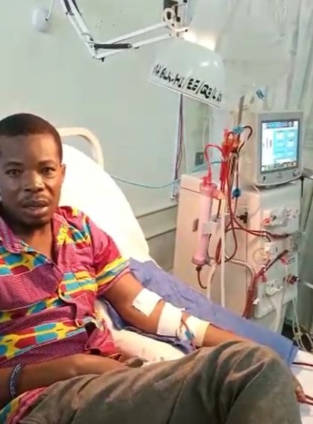
A 37- year-old trained teacher, Francis Aduna in the Volta Region is fighting for his life as a result of end-stage chronic kidney disease.
Mr Aduna who has been on a bi-weekly dialysis for the past seven months lacks funds to continue with process.
The young man who spends over thousand cedis on the dialyses weekly said the issue started when he had stomach upset and was rushed to the Sogakope government hospital only to be diagnosed with kidney disease. The condition was also confirmed at the Ho Teaching Hospital.
In an interview with JoyNews, he narrated how he constantly endures severe pains and has appealed to the general public to come to his aid in order to get a cure.
“I was diagnosed of kidney failure and my family and I have spent all we had on dialyses. Now we don’t have money and the pain is excruciating. I need financial help urgently to save my life, “Aduna pleaded
His friend and colleague who has been with him from the day he was diagnosed , Johnson Bessah Dogbey said his friend situation is now critical and so needs urgent help from the public to save his life
“We are pleading with everyone to help us save the life of our friend who is always in pains due to the disease. We don’t have money to continue with the dialyses, please help us,” Dogbey cried.
Complete and irreversible kidney failure is sometimes called end-stage renal disease, or ESRD.
When the kidneys stop working completely, your body fills with extra water and waste products. This condition is called uremia. At this stage, one will need to undergo dialysis or kidney transplant.
Your hands or feet may swell and you will feel tired and weak because your body needs clean blood to function properly.
Untreated uremia may lead to seizures or coma and will ultimately result in death.
What is Dialysis?
The two major forms of dialysis are hemodialysis and peritoneal dialysis.
In hemodialysis, the patient’s blood is passed through the dialysis machine which has filter that removes waste products.
The clean blood is then returned into the body. Hemodialysis is usually performed at a dialysis center three times per week for 3 to 4 hours at a time.
Meanwhile, peritoneal dialysis involves surgery to implant a peritoneal dialysis (PD) catheter into your abdomen. The catheter helps filter blood through the peritoneum, a membrane in your abdomen.
During treatment, a special fluid called dialysate flows into the peritoneum. The dialysate absorbs waste. Once the dialysate draws waste out of the bloodstream, it’s drained from the abdomen.
Latest Stories
-
Diplomatic community applauds Ghana’s economic turnaround
8 minutes -
UG graduates 153 PhDs as over 15,000 students receive degrees
10 minutes -
Africa’s mineral wealth must no longer be a paradox without prosperity , says Prof. Denton as UN body releases new Report
15 minutes -
Woman killed on church premises at Twifo Denyase
25 minutes -
2 arrested over alleged gang rape of Osino SHS student – Dept. Education Minister
39 minutes -
Haruna Iddrisu, Mohammed Sukparu survive road crash on Bolgatanga-Tumu Road
46 minutes -
#RoadOfPeril: Residents, commuters demand gov’t action on Kwabenya-Berekuso-Kitase road
52 minutes -
Intelligence opens doors; kindness decides what happens inside
1 hour -
Government to announce reforms to revamp cocoa sector, boost farmer payments
1 hour -
Court of Appeal orders retrial in Kennedy Agyapong–Kweku Baako defamation case
1 hour -
Thomas Partey charged with two new counts of rape
1 hour -
Polls close in first election since Gen Z protests ousted Bangladesh leader
2 hours -
Kim Jong Un chooses teen daughter as heir, according to reports
2 hours -
Production of ‘Goods and Services’ for November 2025 slows to 4.2% of GDP
2 hours -
Why you should think twice before buying a converted right-hand-drive vehicle
2 hours