

Audio By Carbonatix
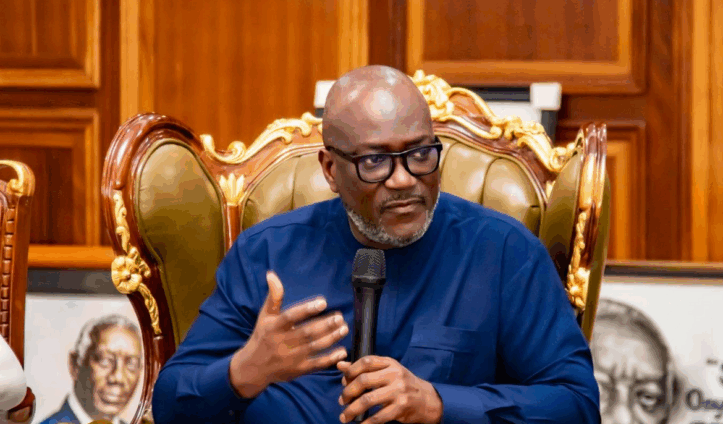
Chairman of the Constitution Review Committee, Prof Henry Kwasi Prempeh, says proposals to extend Ghana’s presidential term from four years to five are not designed to make life easier for presidents.
He said this will make the job more challenging and more demanding.
Speaking on Joy News on December 25, Mr Prempeh explained that the committee’s work showed that the current four-year term creates serious management and timing problems at the start of a new administration.
“So you come in, you are supposed to appoint everybody. The new Council of State has to be convened before you appoint; consult them, then appoint. So it takes forever,” he said.
He noted that the committee identified early delays as a recurring problem. “And so we sorted out some of those things right to free up time so that this management issue doesn’t happen,” he added.
Beyond administrative challenges, Prof Prempeh said comparative evidence strongly influenced the committee’s thinking.
“We also gathered evidence that actually, Ghana is among a dwindling number of countries that still do four years, especially new democracies and in Africa,” he said.
He pointed out that the regional and global trend has shifted. “Most do five. In our region, some do seven. Benin and Liberia, I think, do six years, Nigeria and Ghana, do four years” he said, adding that “we are always matching together lockstep.”
According to him, the data was precise. “We realised that the evidence we’re gathering was that the global norm now has shifted from four to five in presidential systems, and that in our own region, five is the norm,” he said.
Mr Prempeh said the committee accepted that no single number is perfect. “Since any number is arbitrary, then let’s be guided by comparative best practice,” he said.
He explained that the five-year proposal was not about generosity to incumbents. “If the world is moving towards five, then maybe makes sense five, then makes a good number actually to use,” he said.
Addressing concerns about longer tenure, he said the logic of voter behaviour was central to the proposal.
“People tell us, Oh, when their term is coming to an end, oh, give us another term. We didn’t have enough time,” he said.
But he argued that voters already treat four years differently. “A Ghanaian voter might accept that four years is not enough and give you a second term to finish your work,” he said.
He stressed that five years changes that calculation. “But if you have five years, it is going to be difficult to convince a voter that five years was not enough,” he said.
From the committee’s perspective, he said, the longer term raises the bar for performance. “So our thinking is that actually five years is tough on the incumbent, and may very well lead to a result where fewer people get a second term,” he said.
Mr Prempeh was blunt about voter expectations. “If you have not performed well in five years, Ghanaians are not really going to entertain the thought of letting you stay,” he said.
He added that the current system has created an unhealthy pattern. “The four, four was becoming like a tradition, like everybody gets eight,” he said.
Under a five-year system, he believes that pattern could change. “This time, we may be getting more presidents getting five,” he said.
He dismissed fears of automatic ten-year presidencies. “So it’s not like you just multiply five by two and say, hey, 10 years, there is too much,” he said.
According to him, winning a second term under a five-year presidency would be far from easy. “No, the 10 is going to be difficult to get,” he said.
Latest Stories
-
Ghana to begin camping with 12 athletes after Accra Open Championships – Bawa Fuseni
16 minutes -
Anthony Joshua declines showdown with Tyson Fury but admits they ‘probably’ clash next
29 minutes -
Tyson Fury dominates Makhmudov, calls out Joshua next
48 minutes -
I have supported highway authority financially to fix roads in my constituency – A Plus
2 hours -
US, Iran fail to reach peace agreement after marathon talks in Pakistan
2 hours -
ECG kicks off Phase Two of transformer upgrades at Lashibi; brief outages expected
3 hours -
Port crises loom as 11,000 drivers threaten four-day strike
4 hours -
A source of excellence across generations – Vice President Opoku-Agyemang lauds Mfantsipim
5 hours -
(Photos) Mfantsipim School launches historic 150th anniversary
5 hours -
Knights and Ladies of Marshall group backs Catholic Bishops’ stance on anti-LGBTQ+
6 hours -
Bright Simons writes: All the Filla in the Ibrahim Mahama/E&P – Gold Fields Saga
6 hours -
Monetise Idiocy In Ghana
6 hours -
The Ghanaian prophet and the mysterious death of his scottish wife Charmain Speirs
7 hours -
Nearly 400 sentenced in Nigeria for links to militant Islamists
8 hours -
Ghana’s recovery supported by gold strength despite global oil price pressures – Standard Bank Research
8 hours