

Audio By Carbonatix
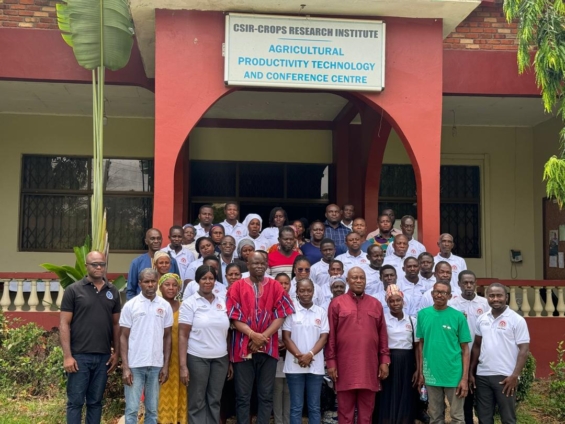
Sixty farmers from Boadi and Barekese in Kumasi are receiving training on traditional leafy vegetables.
The training facilitated by the Crops Research Institute and the Plant Generic Resources Research Institute of the Council for Scientific and Industrial Research (CSIR-PGRR) aims at integrating indigenous leafy vegetables in the diet of Ghanaians.
Speaking at the educational workshop at the Crops Research Institute in Kumasi, Director of the Plant Generic Resources Research Institute, Dr Daniel Kotey highlighted the benefits of traditional leafy vegetables in combating climate change.
“We are working with farmers to cultivate indigenous leafy vegetables and these are very important crops that constitutes a large section of our diet. And our indigenous leafy vegetables in combating climate change and also promoting healthy diets and food and nutrition security in the country,” he said.
He also indicted that the integration of the indigenous leafy vegetables assures the consumption of nutritious foods as it does not require insecticides to ward off pests like exotic crops.
“Some of these farmers are having to throw away the materials they have been collecting in favour of cabbage and other exotic crops that the general public likes.
“For some of these farmers they cultivate on very restricted areas so year in year out they have the same lands and once you do that you accumulate a lot of pests and diseases and when these pests infests the farmers they usually spray against these diseases and these chemicals they spray have adverse effects on the individual and the environment.
“So the diversity we are evaluating with the farmers contain useful genes that are able to tolerate pests and diseases, so it means the farmers do not have to spray against these pest and diseases,"he said.
Principal Research Scientist at the Crops Research Institute, Dr. Patricia Pinamang Acheampong spoke on some issues that the farmers face in cultivating these vegetables.
“These leafy vegetables are cultivated on low lands and these lands are being filled with buildings so it is a big issue,”she said.
Director of the Crops Research Institute, Prof Moses Brandford Mochiah appealed to stakeholders to support the Plant Genetic Resources and Research Institute with funding to perform their duties.
“The CSIR-Plant Genetic Resources and Research Institute is the national institute mandated to collect, characterize, evaluate, document, conserve, distribute and utilise plant genetic resources from Ghana and abroad.
”For these efforts to reach their full potential, adequate resources and support are indispensable. I, therefore urge the governments and policymakers, our donor partners and other stakeholders to prioritise national funding for Plant Genetic Resources and Research Institute, dedicated to germplasm conservation and research,” he said.
Latest Stories
-
What everyone should know about C-sections
1 hour -
Health Ministry engages Ga Mantse ahead of Free Primary Healthcare launch
2 hours -
We can tackle multiple priorities – Sam George defends Anti-LGBTQ Bill push
2 hours -
Statement: Ghana Chamber of Mines’ Response to Claims in Joe Jackson’s “Ananse Stories about the Economy of Ghana”
2 hours -
GES opens 2026 teacher recruitment for licensed B.Ed graduates
2 hours -
Ghana must value skilled trades, build resilient learners — Ibn Chambas
3 hours -
Ghana must rethink education around relevance, resilience and responsibility — Ibn Chambas
3 hours -
Prince Harry faces defamation lawsuit from charity he co-founded
3 hours -
South Korea deploys thermal cameras to track escaped zoo wolf
3 hours -
Calls for royal meeting with Epstein survivors grow ahead of US visit
3 hours -
Ibn Chambas advocates blend of technology and human values in education
3 hours -
UMA improves healthcare access in Asutifi North with GH₵700k ‘Kim Taylor Legacy’ Walkway
3 hours -
Scholarships Authority and Fanaka University offer sponsorship for procurement and supply chain studies
3 hours -
Bisa Kdei drops new single ‘Go N Look’ featuring Medikal
3 hours -
Benin facing rising terrorism in north as French military presence faces growing criticism
3 hours