

Audio By Carbonatix
A post-election survey by the Ghana Institute of Management and Public Administration (GIMPA), in collaboration with the Konrad Adenauer Stiftung (KAS), has revealed that 81.6% of voters blame the New Patriotic Party’s (NPP) defeat in the 2024 general elections on economic mismanagement, with 47.3% specifically pointing to the high cost of living as the leading cause.
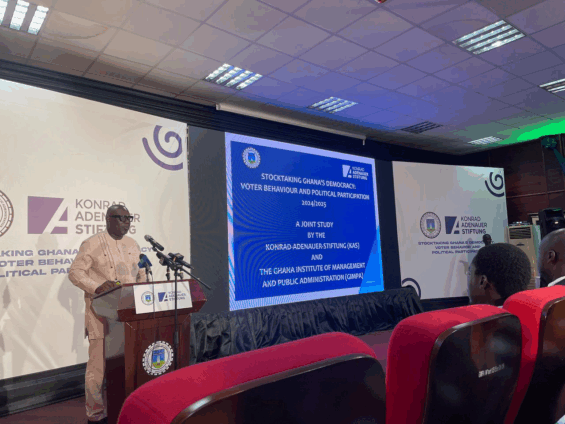
The findings were presented by Dr Joseph A. Darmoe, Director of Programmes at KAS and a Senior Lecturer at GIMPA, during the launch of the report titled “Stocktaking Ghana’s Democracy: Voter Behaviour and Political Participation”, held at GIMPA in Accra on 3 June 2025.
The nationwide survey, conducted between 8 and 20 May 2025, sampled 16,988 registered voters across all 276 constituencies using a multi-stage probability sampling method. The study was conducted through computer-assisted personal interviews (CAPI) and recorded a 99% confidence level with a 1% margin of error.
Key Findings:
Among respondents who blamed the NPP’s defeat on economic mismanagement, 47.3% identified the high cost of living as the dominant concern.
8.7% cited corruption as a key factor in their decision to vote out the party.
Other issues mentioned included the E-levy, arrogant or disrespectful conduct by party representatives, and the betting tax.
Concerns over LGBTQ+ matters were considered, but only by a small fraction.
The data also reveal that 73.5% of voters based their decision on party programmes and manifestos, rather than personal loyalty or ethnic affiliations.
When it came to reasons for choosing a presidential candidate:
46.2% voted based on personal admiration for the candidate.
16.7% were influenced by tribal or ethnic loyalty.
13.8% said their vote was intended to punish the NPP government.
11.6% admitted to voting in exchange for financial inducement.
Additionally, the survey showed that 90.5% of voters live and vote in the same constituency, suggesting that local conditions strongly shape electoral decisions.
The findings point to a maturing electorate increasingly driven by economic realities and policy impact rather than traditional political affiliations.
Latest Stories
-
Livestream: The Law discusses Supreme Court @150
33 minutes -
MTN Momo staff walk to promote wellness and fitness
50 minutes -
Assafuah: Sedina Attionu’s return from Nevada will test government’s commitment to accountability
54 minutes -
How GRA’s Modified Taxation Scheme is boosting revenue compliance & SMEs competitiveness
1 hour -
Stonebwoy Can Do It: A call to unite behind 2026 BHIM Fest
2 hours -
World Shea Expo returns to Tamale for 2026 edition
2 hours -
Prioritise cocoa sector with better prices, timely payments-Annoh-Dompreh urges NDC
2 hours -
Lands and Mines Watch Ghana endorses Heath Goldfields’ mining capacity
2 hours -
Gbintiri residents protest alleged diversion of 24-hour market project
3 hours -
Justin Bieber headlines Coachella with nostalgia-fuelled set
3 hours -
Ukraine and Russia accuse each other of hundreds of ceasefire violations
3 hours -
Asha Bhosle: The sound of Bollywood dies aged 92
3 hours -
Fire destroys section of 4-bedroom apartment at Tantra Hill
3 hours -
Safe city: Unnoticeable protection
3 hours -
North East Regional Police Commander raises alarm over burning of checkpoints
4 hours