

Audio By Carbonatix
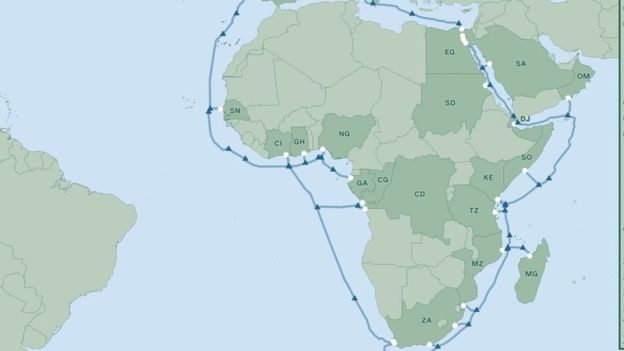
Facebook is teaming up with telecoms companies to build a 37,000km (23,000-mile) undersea cable to supply faster internet to 16 countries in Africa.
Its length - almost equal to the circumference of the Earth - will make it one of the longest, it said.
It is part of a long-running bid by Facebook to take its social media platform to Africa's young population.
Ready for use by 2024, it will deliver three times the capacity of all current undersea cables serving Africa.
"When completed, this new route will deliver much-needed internet capacity, redundancy, and reliability across Africa, supplement a rapidly increasing demand for capacity in the Middle East, and support further growth of 4G, 5G, and broadband access for hundreds of millions of people," said Facebook in a blog.
Africa lags behind the rest of the world when it comes to internet access, with four in 10 people across the continent having access to the web, compared with a global average of six in 10.
But the continent represents huge opportunities for technology firms and businesses with its population of 1.3 billion.
The cost of the 2Africa project - which will connect Europe and the Middle East to the continent - has not been disclosed but Bloomberg reported it could be close to $1bn (£820m).
Sub-sea cables carry the vast majority of the world's inter-continental data. They can handle much more data and offer faster transmission at a lower cost compared with other methods.
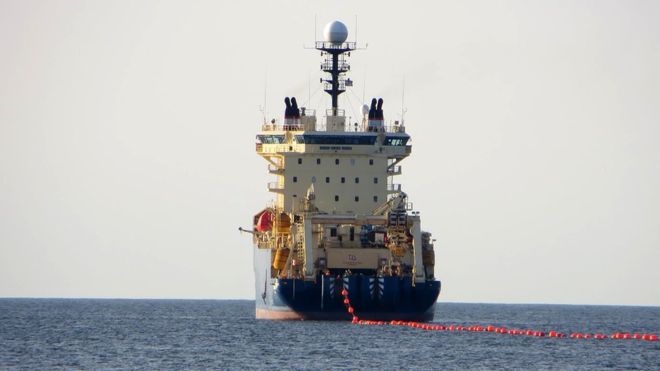
The cable - which will be built by Nokia Oyj's Alcatel Submarine Networks - will run along the bottom of the Atlantic Ocean, the Indian Ocean, the Mediterranean Sea and the Red Sea.
It will be buried deeper than previous systems for greater protection against external damage from things such as ships' anchors.
The fibre-optic cables will have double the capacity of older ones, making use of Spatial Division Multiplexing (SDM1) technology.
Facebook is teaming up with Johannesburg-based MTN Group, Telecom Egypt, Vodafone and Orange SA.
Vodafone said it would pave the way for developing digital businesses on the continent.
"We need to ensure that there is enough internet capacity to not only get people online, but to help build a modern digital society that includes services that require a large amount of data transfer, such as cloud computing or video," said Nick Gliddon, director of Vodafone Carrier Services.
As well as helping businesses, it will also improve healthcare and education, he added.
Latest Stories
-
Ivory Coast’s delayed cocoa crop could mean congested ports ahead of EU rules, sources say
39 minutes -
African Union to launch African credit rating agency in October, adviser says
48 minutes -
Gold drifts higher, eyes on Fed Chair Warsh’s comments
56 minutes -
Trump officials threaten Kennedy Center demolition if court blocks renovations
1 hour -
Two German airport workers die of malaria after ‘mosquito arrives on plane’
1 hour -
We should look at the balance – Small-scale miners defend local gold refining
1 hour -
Meta’s $18bn settlement may hasten reckoning for social media on child safety
2 hours -
Xbox boss ‘thinking about affordability’ of next-gen console
2 hours -
How Dolly Parton’s business savvy helped her succeed far beyond the charts
2 hours -
Unexpected chat between OpenAI agents led to Hugging Face hack
2 hours -
Nvidia revenue doubles on continued AI demand
3 hours -
US drug agency approves breakthrough treatment for pancreatic cancer
3 hours -
Thinking Machines Lab co-founder Barret Zoph joins Google
3 hours -
Son of Uganda’s president says he will stand for top job in 2031
3 hours -
We’re already subsidising gov’t – Chamber of Mines flags extra cost of Ghana’s local content push
4 hours