

Audio By Carbonatix
"I want to give people inspiration to protect the environment; plant trees, and make it a pleasure to maintain them."
Those are the words of Catholic priest at Damongo Archdiocese in the Savannah region, Father Dr. Clement Aapengnuo, who seeks to supply finest noni fruit trees to Ghanaians.
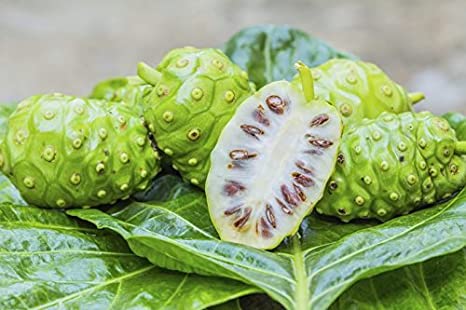
Noni tree - native to Southeast Asia and Australasia, is a source of phytonutrients, known to boost the immune system as well as repair cellular damage.
They have anti-inflammatory, anti-viral, and anti-bacterial compounds.
Fr. Aapengnuo says the tree is a potential income generator that can give cultivators in rural areas, at least, 300 cedis in a month.
"If you have three of the trees and every month you fill ten bottles at 10 cedis that's 300 cedis. That is basic salary for some people," he says.
In just a few years of planting the tree, he says it is only appropriate to share what is good with Ghanaians.
The Noni tree, known scientifically as Morinda citrifolia grows in shady forests, as well as on open rocky or sandy shores of rivers.
It matures in about 18 months, and begins to bear between 4 and 8 kg of fruits every month.
"The amazing thing about this tree, it fruits all year round even in the dry season. So pluck and pluck the fruits."
The oval-shaped of 10-18 centimeters in size, is also known as cheese fruit or even vomit fruit, due to its pungent smell when ripening.
"Just on the same branch, you would have some flowering while others are fruiting. So there is a constant supply."
The tree is tolerant of saline soils, drought conditions, and secondary soils.
It can grow up to 9m tall, with large, simple, dark green, shiny and deeply veined leaves.
Besides its ability to beautify the environment and provide oxygen, a variety of products from the fruit can be found on the consumer market.
"Now we have got an outlet. When you do you package it nicely and put it in a small bottle."
They come in the form of beverage, powder and other cosmetics as well as oil.
But in Damongo people know it in bevergare.
"I was surprised to see that a lot of people in Damongo know the noni and buy it" adding that, it has economic values.
Morinda citrifolia is attractive to weaver ants, which make nests from its leaves.
These ants protect the plant from some parasitic insects.
The smell of the fruit attracts fruit bats, which aid in seed dispersal.
A type of fly, Drosophila sechellia, feeds exclusively on the fruits.
Fr Aapengnuo says his work as a catholic priest puts him in a better position to protect the environment and change lives.
He wants to grow more seedlings and distribute to interested Ghanaians to also rape the benefit.
Beyond that, the sustainable environmental activist wants to see a world of great opportunity in safety for all.
Latest Stories
-
Foreign Affairs Ministry requests special audit of evacuation spending since 2017 to date
22 minutes -
Livestream: Newsfile discusses Ghana Jollof case, cocaine shipment, COVID audit, constitutional reforms
43 minutes -
SA Evacuation Exercise: Detailed breakdown of the GH¢27.18m spent on chartered flights
54 minutes -
Foreign Affairs Ministry submits 200-page report to Minority on GH¢49.7m South Africa evacuation
1 hour -
US and Denmark reach deal over Greenland after Trump annexation threats
1 hour -
Ghanaian nurses set for US opportunities as GEA brokers Columbus partnership
1 hour -
Time to list Uncle Ebo Whyte in Guinness Book
2 hours -
Mahama orders review of SHS menu as Education Minister assures students of adequate food
4 hours -
Trump says he is banning CNN and Politico from White House
4 hours -
Government reviews GH¢25,000 citizenship fee after diaspora concerns
4 hours -
Leadership Skills and Public Policy Priorities for Inclusive and Resilient Africa: An integrated Ubuntu perspective
4 hours -
Daily Insight for CEOs: Employee engagement as a leadership responsibility
5 hours -
Publicly funded, privately controlled! The multi-million-cedi Astroturf Exposé
5 hours -
NCD burden rising as Ghana struggles with prevention, awareness and long-term care – Health Expert
6 hours -
Patient safety must extend across entire NCD care journey – FOCOS Hospital’s orthopaedics chief
7 hours