

Audio By Carbonatix
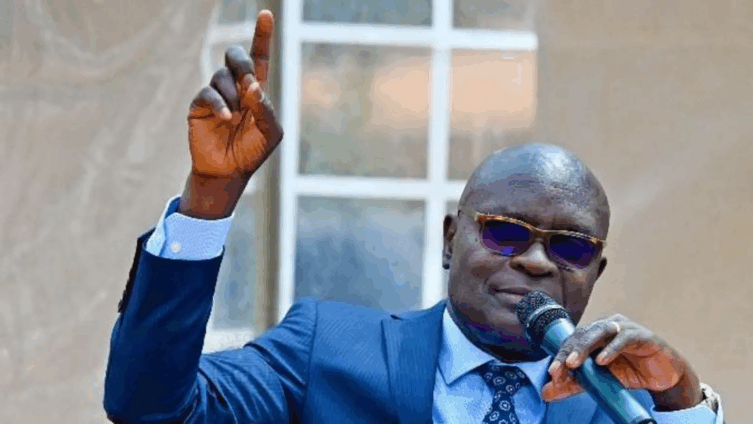
The head of Uganda's electoral body says he has received threats warning him against declaring certain presidential candidates the winners of Thursday's election.
Simon Byabakama said he would not be intimidated by such threats from senior state officials, whom he did not name.
He was responding to a BBC question about a widely shared video which shows a presidential assistant saying the electoral commission would never declare opposition candidate Robert Kyagulanyi, popularly known as Bobi Wine, as president, even if he were to win.
"Some people say if you don't declare so-and-so as president, you will see. I tell them that I am not in the business of donating votes," said Byabakama.
President Yoweri Museveni, 81, who has ruled the country for nearly four decades, is seeking a seventh term in office.
Bobi Wine, a 43-year-old pop star turned politician, is Museveni's main challenger, seeking to unseat him for the second time after finishing runner-up in the 2021 polls.
Six other candidates are also in the race, with about 21.6 million registered voters.
Campaigning has been marked by the disruption of opposition activities, including the detention of activists and the breaking-up of rallies by police.
At the Electoral Commission headquarters in the capital, Kampala, Byabakama said he was not worried about threats from what he called "idle people".
"You can see from my demeanour that fear is a word that does not exist in my vocabulary," said the poll chief, adding that only the will of voters and the law would guide the process.
In the video shared by the Daily Monitor newspaper on social media last week, Yiga Kisakyamukama, the special presidential assistant for service delivery and monitoring, was captured saying Museveni would never leave power through the ballot.
"Don't expect, don't even think, that Simon Byabakama would announce Bobi Wine. President Museveni, who is in the chair, will remain in the chair. Never think that Museveni would leave power through voting. No, no, no - don't waste our time," Kisakyamukama was heard saying.
But Byabakama said Uganda's law, not individual opinions or threats, would determine the outcome of the presidential election.
"The law says that the candidate who receives more than 50% plus one of the total valid votes cast is the president of Uganda. It is the voters who determine how many votes a candidate gets. What the voters have said is what I will declare to the nation," he added.
The poll chief said he would declare the results within 48 hours of the close of polling, in accordance with the country's laws.
Responding to concerns about the heavy military presence in the streets, Byabakama said security forces were deployed to maintain peace and stability during the electoral process and should not intimidate voters.
He also acknowledged opposition concerns about some polling stations being located within military premises, saying the commission was investigating the reports.
"If we find that it is true, we shall take the necessary measures to address it," he added.
On Tuesday, the authorities cut internet access and limited mobile services across the country in order to curb "misinformation, disinformation, electoral fraud and related risks".
The network outage has heightened concerns about repression in the run-up to the vote, and has been described by the UN human rights office as "deeply worrying".
Election chief Simon Byabakama ordered the use of the national voters' register where biometric machines failed to function.
The problems appear to have affected both areas seen as pro-government as well as those thought to be opposition strongholds.
Casting his vote in his native Rwakitura Village in the western Mbarara region, President Museveni said he had also experienced difficulties.
"I put my thumbprint on the machine but it did not accept it. However, the machine accepted my face instantly. The machine works," he said.
Asked if he would accept the election outcome, the president said: "This is one of the manipulations - we have to find out why, what was the problem?"
"We are now verifying whether this was deliberate," he added.
Latest Stories
-
2028 Olympic Games qualification ‘really tough’ – Black Queens coach Björkegren
5 minutes -
GRFU, GOC Women’s Commission hold breast cancer awareness, expresses gratitude to Sunda International Ghana
8 minutes -
COCOBOD raises GH¢3.4bn as Cocoa Capital PLC lists inaugural commercial paper on GFIM
25 minutes -
No Party Card, just a Party Microphone! A Ghanaian story of Elections, Referees and Convenient Amnesia
27 minutes -
Minority welcomes suspension of teachers’ strike, demands timely payment of promotion arrears
38 minutes -
Customary ownership accounts for 80% of land; it complicates land administration – Lands Commission
38 minutes -
NRSA to auction vehicles of non-subscribers who fail to pay towing charges within 21 days
45 minutes -
WAFU B U17: Black Starlets target AFCON slot after booking semi-final place
50 minutes -
Ghana faces $6.1bn debt-service burden from 2027 to 2029 due to Akufo-Addo’s DDEP – Haruna Iddrisu
57 minutes -
GoldBod targets 150 hectares of forest reclamation in 2027
1 hour -
Despite substantial accommodation capacity, room demand still weakens – GSS report
1 hour -
No amount of foreign exchange is worth a lost forest – GoldBod
1 hour -
Chelsea’s defensive crisis: Alonso’s system, missing pieces, or individual errors?
1 hour -
Digital VAT collection to cover mobile payments, not just bank cards – GRA
1 hour -
John Darko denies role in SIC settlement after EOCO interrogation
2 hours