

Audio By Carbonatix
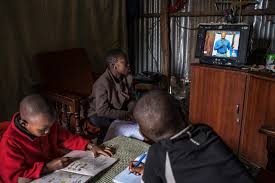
Five-year-old Kenyan student Miguel Munene sits between his parents, holding their hands as he watches cartoon characters teaching him to pronounce “fish”.
The television has replaced Munene’s teachers and classmates after the government shut schools indefinitely in March to curb the spread of the novel coronavirus. They are closed until at least January.
Many children don’t have the option to learn online - the United Nations children’s agency UNICEF says at least half of sub-Saharan Africa’s schoolchildren do not have internet access.
So some, like Munene, watch a cartoon made by Tanzanian non-profit organisation Ubongo, which offers television and radio content for free to African broadcasters.
“Other programmes are just for fun, but Ubongo is helping children,” Miguel’s mother Celestine Wanjiru told Reuters.
“He can now differentiate a lot of shapes and colours, both in English and Swahili.”
In March, programmes by Ubongo - the Kiswahili word for brain - were broadcast to an area covering about 12 million households in nine countries, said Iman Lipumba, Ubongo’s head of communications. That rose to 17 million in 20 countries by August.
“The COVID-19 pandemic has really forced us to rapidly grow,” Lipumba said.
A group of artists, innovators and educators set up Ubongo TV in Tanzania in 2014. It has received around $4 million in grants since, and earned $700,000 from YouTube, product sales, character licensing, and co-production of programmes.
For Munene and other schoolchildren, programmes like Ubongo’s are their only option to learn for now.
Kenya’s education ministry says schools can only reopen when the number of COVID-19 cases drops substantially.
Kenya has had over 36,000 confirmed cases and more than 620 deaths, health ministry data showed.
“You have the kid with you all the time so when you have such programmes, they are a big help,” Patrick Nyaga, Miguel’s father, a security guard, told Reuters.
But television cannot completely replace teaching.
“The way the children learn through programmes is different (from) the way they interact with others and teachers,” Nyaga said. “We are hoping that they open soon.”
Latest Stories
-
T-bills auction: Government exceeds target marginally; yield on 91-day bill remains unchanged
11 minutes -
GPL 2026/27: 10-man Aduana hand Kotoko defeat in Kumasi
22 minutes -
GPL 2026/27: Medeama ease past Basake Holy Stars
55 minutes -
Appiah Adomako writes: Why DVLA must stop treating every expired licence holder as delinquent
59 minutes -
Localization must transfer decision-making power, not just project responsibilities
1 hour -
Modernising Ghana’s traditional markets through the 24-Hour Economy markets initiative
1 hour -
New economy will boost local production and create jobs – Finance Minister
1 hour -
Real-Time VAT on cross-border digital services – not a new tax and does not violate double taxation principle
2 hours -
Digitalisation, AI key to Ghana’s tourism transformation – GHATOF
2 hours -
Stronger GTA-private sector partnership needed to grow tourism – GHATOF
2 hours -
Amazon eyes Ghana for broadband expansion after talks with Mahama
3 hours -
National Investment Quiz 2026: Six schools qualify for quarter-finals
4 hours -
‘Do not let Russia pay for its madness with lives of your people’ – Zelensky to Ghana, 46 other countries
4 hours -
6,079 promotion cases fully processed and paid – CAGD says amid nationwide teachers’ strike
4 hours -
Teacher unions to meet government Monday over nationwide strike
4 hours