

Audio By Carbonatix
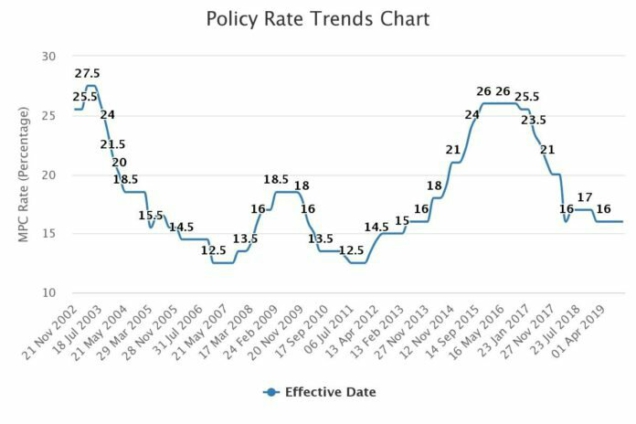
The policy rate- the rate at which commercial banks borrow from the Bank of Ghana- will remain unchanged at 14.5%, at least until after the first quarter of next year, Fitch Solutions has disclosed.
This means cost of borrowing will stay largely same during the period.
The Bank of Ghana cut its base lending rate by 1.5 percentage points to 14.5% in March 2020, the first time in 14 months. The move was to stimulate spending in the Ghanaian economy and increase money supply.
Senior Country Risk Analyst for Sub Saharan Africa, William Attwell told Joy Business that there will be some monetary policy easing getting to mid-next year when economic growth picks up.
“Interest rate decisions in Ghana could come, that’s of course, till then the Bank of Ghana will hold rate [policy rate] steady. The most recent inflation is still outside of the Central Bank’s target so we would expect that ratings will hold for some time being”
Furthermore, he said “looking ahead to next year though as the Central Bank is likely to encourage recovery to gather pace next year, we would expect a bit of monetary policy easing during mid-2021,” he said.
September 2020 MPC Report
The Bank of Ghana cited risks to inflation and growth as the reason to keeping its base lending rate unchanged in September 2020.
“The Committee’s view is that risks to the immediate outlook for inflation and growth are broadly balanced and decided to keep the policy rate unchanged at 14.5%”, it said in a statement.
It however emphasized that he drivers of economic growth are returning to normal with prospects for a good recovery, adding, monetary and fiscal policies have been supportive, providing the necessary underpinnings for the economy to withstand the negative output shock arising from the covid-19 pandemic.
Interest rate development
Interest rates on the money market saw mixed developments as rates on short to medium term instruments eased between Quarter Two and Quarter Three, but generally tightened at the longer-end.
On a year-on-year basis, the 91-day Treasury bill rate declined to about 14.0% in August 2020 from 14.7% a year ago.
Similarly, the interest rate on the 182-day instrument declined to 14.1% from 15.2%.
With the exception of the 6-year bond, yields on the 7-year, 10-year, 15-year, and 20-year bonds all increased.
Presently, treasury yields are hovering around 14.5%
Latest Stories
-
Walter Mosley visits W.E.B. Du Bois Centre in Accra: A New York Secretary’s homecoming story on where Du Bois spent his final years.
1 hour -
MTN set to deploy 5G services after winning spectrum licenses worth US$202m
4 hours -
NPP national elections: 3,000–4,000 police to handle security, traffic in Kumasi – Karbo
6 hours -
Atta Akyea fumes as Manhyia MP is to spend another night in EOCO custody
6 hours -
SSNIT says La Beach clearance was to protect hotel investments, beaches to remain public
7 hours -
APSU congratulates St Augustine’s College after back-to-back National Investment Quiz wins
7 hours -
Renewed flood intervention at Mallam Junction raises hopes among residents, businesses
8 hours -
St Augustine’s College retain National Investment Quiz title after nail-biting grand finale
8 hours -
Education infrastructure investment will drive Banda’s development – Ahmed Ibrahim
8 hours -
Teacher unions strike: Gov’t presents fresh proposals as talks end inconclusively
9 hours -
51,000 teachers’ promotion arrears to be validated for October payment – Education Minister
9 hours -
Kwabena Boamah appointed Board Chair for Impact Investing Ghana
9 hours -
Striking teacher unions to meet Fair Wages and Salaries Commission on October 6
10 hours -
EOCO working with AG to arraign Nana Baffour Awuah before weekend court
10 hours -
Duraplast reassures customers after fire, announces October 5 reopening
10 hours