

Audio By Carbonatix
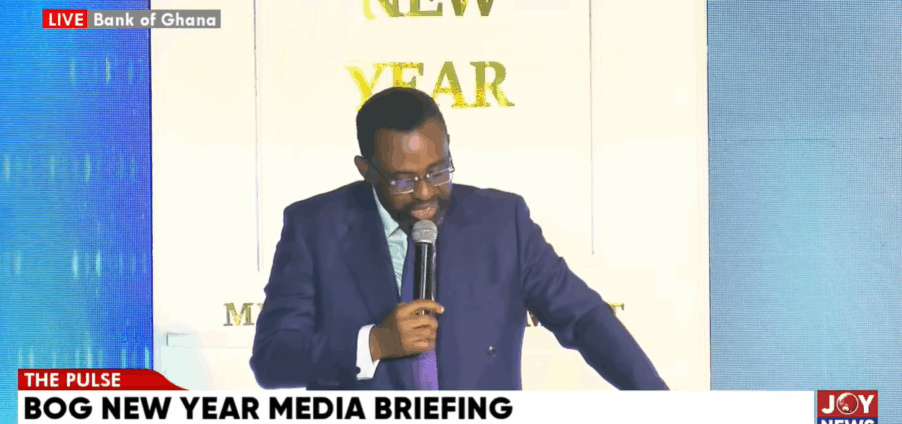
The Governor of the Bank of Ghana (BoG), Dr Johnson Asiama, has announced plans to strengthen the Bank’s relationship with the media.
Speaking at a New Year media briefing on Friday, January 16, Dr Asiama said the Bank of Ghana is committed to deepening its partnership with journalists as part of efforts to improve public understanding of economic issues.
“As we look into 2026 and beyond, we are committed to deepening our collaboration with you, the media,” he said.
He announced that the Bank will expand its media training programmes and introduce a dedicated forum for editors, producers, presenters and behind-the-scenes media professionals whose work shapes news content.
“We will expand our media training programmes, and we will introduce a dedicated forum for editors, for producers, for presenters, and the many behind-the-scenes professionals whose work shapes the news and content that we consume,” he stated.
In addition, Dr Asiama revealed plans to introduce a new internal recognition scheme to reward excellence in economic journalism. “We will launch an internal recognition initiative. We are calling it the Governor’s Economic and Financial Story of the Year,” he announced.
He said the initiative is aimed at encouraging accurate, insightful and creative reporting on economic issues and the work of the Bank of Ghana across both print and digital platforms.
“This initiative aims to inspire creativity and innovation in storytelling,” he said, urging media houses to take part. “I want to encourage all of you to take up this challenge, and may the best media house emerge victorious.”
As an incentive, the Governor disclosed that the winning journalist will be sponsored to attend the IMF–World Bank Meetings.
Dr Asiama assured journalists that the Bank’s Communications Department will continue to engage openly and proactively with the media.
“The bank will continue to engage proactively on all media-related matters, ensuring that our friends in the press feel welcomed, that they feel supported, and that they are confident whenever called upon to help us share our messages with the public,” he said.
Dr Asiama noted that policy decisions often come with difficult trade-offs and directly affect ordinary people. He said this makes accurate and responsible reporting even more important.
“Behind every policy decision are real people. We are talking about households that are managing rising costs. We are talking about businesses that are navigating uncertainty, and we are talking about workers who are concerned about jobs and also concerned about their incomes.”
According to him, while difficult choices are sometimes unavoidable, the Bank’s duty is to act in the long-term public interest.
“No decision is taken by us lightly. Our responsibility is to act in the long-term public interest, even when the short-term choices are difficult.”
Latest Stories
-
Caveman Watches partners with Mfantsipim School for 150th anniversary
1 minute -
We’ll pursue GH¢15m defamation suit against Sammy Gyamfi to its logical conclusion- Afenyo-Markin’s lawyers
2 minutes -
Martin Kpebu urges Afenyo-Markin not to return to court over Sammy Gyamfi lawsuit
11 minutes -
GRA submits preliminary report on drug shipment case to Mahama – Commissioner-General
38 minutes -
Sammy Gyamfi using ‘procedural roadblocks’ to dodge defamation case? – Afenyo-Markin’s lawyers
40 minutes -
The illusion of a good deal: Why some everyday money-saving habits may be costing you more
55 minutes -
Family seeks autopsy, police investigation into death of student 12 days after Abomosu SHS enrolment
1 hour -
Trade Minister urges employers to leverage industrial opportunities to create jobs
1 hour -
Asantehene plants trees to commence Jimi Watercourse Rehabilitation destroyed by galamsey
2 hours -
15 arrested, 6 trucks impounded over sandwinning activities on Kumasi-Accra Expressway
2 hours -
OFFICIAL: Vinicius will miss El Clásico, suspended four games
2 hours -
Prayer vigil held after four arson attack murders
2 hours -
GRA fully recovers $154k legacy debt owed by foreign entities between 2022 and 2024
2 hours -
Kwesi Pratt Jr warns bus preachers are adding to passengers’ stress with accident prophecies
2 hours -
MTN Ghana to spend $1.1bn in 3 years, build 500 new sites as MoMo hits 44% Growth
2 hours