

Audio By Carbonatix
The Bank of Ghana's domestic gold-buying scheme run in tandem with the state-owned Ghana Gold Board racked up losses of GH¢22 billion, equivalent to 1.5% of gross domestic product, in a single year, the International Monetary Fund said, a figure far larger than earlier estimates that had already stirred political controversy.
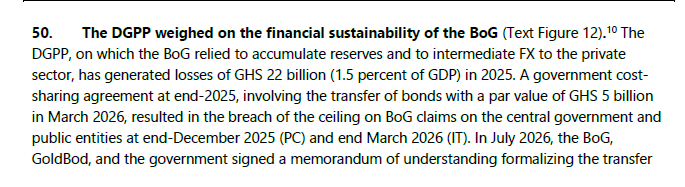
In its latest report accompanying the sixth and final review of Ghana's $3 billion Extended Credit Facility, the Fund said the Domestic Gold Purchase Programme (DGPP), on which the central bank had relied to accumulate reserves and channel foreign exchange to the private sector, generated losses of GH¢22 billion, or 1.5% of GDP, in 2025.
The disclosure sharpens a debate that has run for months over who should bear the cost of Ghana's flagship gold strategy, and marks a steep escalation from the $214 million loss the IMF first flagged in December for the nine months to end-September 2025.
The $214 million figure, disclosed in the Fund's fifth review, covered only trading losses on artisanal and small-scale doré gold transactions plus GoldBod off-taker fees through the third quarter of 2025, and was put at roughly 0.2% of GDP.
The Bank of Ghana disputed that number at the time, and the scale of the losses continued to climb as the central bank closed its books on the year. The gross loss on the doré gold trade with GoldBod ultimately reached the GH¢22 billion cited by the Fund, about $2 billion at prevailing rates, before offsets from a government intervention and gains on bullion sales reduced the net hit reported in the central bank's audited accounts.
The programme's damage did not stop at the trading losses. The IMF said the DGPP losses, coupled with higher costs of open-market operations and exchange rate valuation losses from a sharply appreciating cedi, pushed the Bank of Ghana's equity position deeper into negative territory, to minus 6.7% of GDP at the end of 2025.
The gold losses had direct consequences for Ghana's IMF programme. A government cost-sharing agreement at the end of 2025, involving the transfer of bonds with a face value of GH¢5 billion in March 2026, breached a ceiling on central bank claims on the government, a performance criterion under the loan programme, at end-December 2025 and again at end-March 2026.
Ghanaian authorities requested, and Fund staff supported, a waiver for the missed target, which the IMF described as a minor deviation that did not reflect a weakening of the underlying policy stance.
As a corrective step and a prior action for completing the review, the Bank of Ghana, GoldBod and the government signed a memorandum of understanding in July formalising the transfer of the gold programme from the central bank to GoldBod and eliminating the related quasi-fiscal activities.
Doré gold purchases have been conducted by GoldBod since April 1, and from July 1 the government assumed 100% of the programme's costs, replacing the central bank. GoldBod, established by act of parliament in April 2025, now handles the entire chain from financing and purchasing to assaying and exporting artisanal gold, with costs to be reported transparently on the national budget.
The IMF said the change limits the central bank's role to that of fiscal agent, removing its exposure to incremental gold-related losses. But it cautioned that state involvement in gold buying remains a liability, noting the programme will remain a fiscal risk as long as state-led domestic gold purchases continue.
Containing GoldBod's costs is now central to limiting those risks. Under the DGPP, the Fund said, the central bank incurred losses equal to 15.3% of gross gold purchases, about half stemming from buying gold at the more expensive forex-bureau exchange rate. Authorities lowered that to 11.7% in the first quarter of 2026, but the memorandum of understanding mandates a cut to 5%, which the Fund said would require narrowing the forex spread, streamlining the supply chain and enhancing competition among service providers.
The IMF report disclosed that an external auditing firm is conducting a special audit of the programme from its inception, with results expected in the third quarter of 2026.
The Fund also pressed for a credible plan to recapitalise the Bank of Ghana, whose balance sheet has been weakened by past monetary financing, the 2022 domestic debt restructuring and quasi-fiscal activities. Authorities have committed to full recapitalisation by 2032, to be formalised in an agreement with the finance ministry, a step the Fund called critical to restoring the central bank's financial autonomy but one that will require a sustained fiscal effort.
Gold has become the backbone of Ghana's external accounts, with artisanal and small-scale exports surging to $10.9 billion, or 9.5% of GDP, in 2025. But the IMF warned the sector still faces smuggling, near-zero fiscal revenue after the 2025 removal of a withholding tax on unprocessed minerals, and severe environmental degradation from illegal mining that is becoming a persistent drag on growth.
Latest Stories
-
Pickford ‘almost caused crash’ with careless driving
20 seconds -
Author and former politician Jeffrey Archer dies aged 86
11 minutes -
No education reform can succeed without teachers – Education Ministry
20 minutes -
Gauff condemns racist abuse after China Open win
36 minutes -
Medvedev disqualified for hitting spectator with ball
45 minutes -
Oliseh scores twice in late comeback win for France
54 minutes -
Pentagon stops using Anthropic AI tools after blacklisting company, BBC told
1 hour -
From despair to dance: Family of nurse Salomey Baffoe rejoices after GH¢100k bail granted
2 hours -
Kejetia Phase III pricing talks loom as government moves to restart stalled works
2 hours -
Nchiraa Yam festival: Two killed, 14 injured as police restore calm
2 hours -
I draw inspiration for my songs from Reggae music – Lyrical Joe
2 hours -
AI must not replace human judgment in public spending – BoG Governor
2 hours -
Ghana should withdraw from 2027 AFCON – Kojo Addae Mensah
3 hours -
Team Ghana departs Accra for Angola ahead of Karting Africa Trophy
3 hours -
AIT President Prof Clement Dzidonu urges lifelong learning as AI reshapes work and education
3 hours