

Audio By Carbonatix
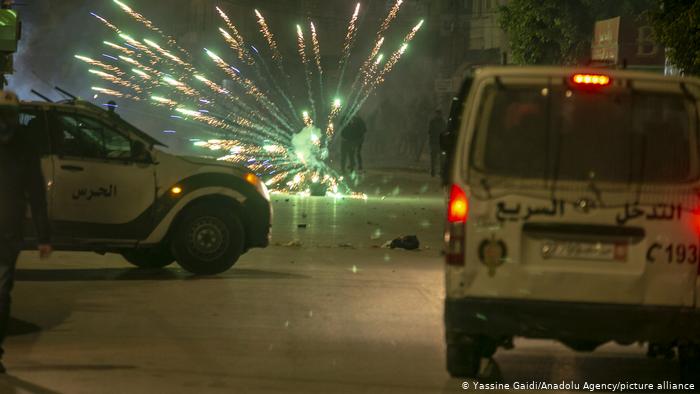
Tunis and at least five other Tunisian cities saw violent demonstrations linked to the 10-year anniversary of the Jasmine Revolution that ousted the country's longtime ruler.
Tunisian security forces arrested dozens of young people during consecutive nights of disturbances in several cities, a government spokesman said Sunday.
The protests took place as Tunisia marks the 10th anniversary of the revolution that toppled the late President Zine El Abidine Ben Ali and sparked the Arab Spring uprisings.
Where did the clashes take place?
Violent protests took place in several areas of the capital, Tunis, and the seaside city of Sousse, among others.
Interior Ministry spokesman Khaled Hayouni told the AFP news agency that dozens of young people, mostly aged between 14 and 17, were held after they took to the streets. He accused them of intending to loot and vandalize shopfronts and cars overnight.
الناطق الرسمي باسم الادارة العامة للأمن الوطني وليد حكيمة "القوات الامنية قامت بإيقاف 242 شخصا في كامل تراب الجمهورية ، تورطوا في أعمال تخريب ومحاولات استيلاء ونهب املاك عامة وخاصة الليلة الماضية" #وكالة_وات
— Agence Tunis-Afrique-Presse (@AgenceTAP) January 17, 2021
AgenceTAP put the number arrested at 242, citing a spokesman for the National Security Directorate.
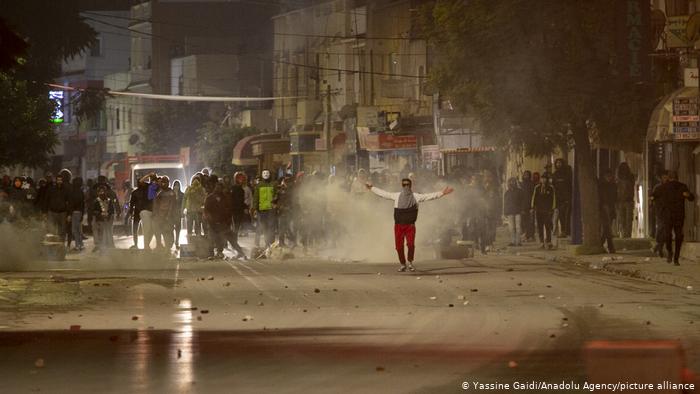
Witnesses in Sousse said security forces fired tear gas to disperse hundreds of angry protesters who blocked roads and burned tires.
There were also night protests and riots in the north of the country.
Tunisia is set to exit a four-day lockdown amid a sharp rise in coronavirus cases. The country has been under a nighttime curfew since October.
What's driving the protests?
A decade after the Jasmine Revolution, Tunisia has made a smooth transition towards democracy, but its economy remains on the verge of bankruptcy.
Tunisia's GDP shrank by 9% last year, consumer prices have spiraled and one-third of young people are unemployed.
The key tourism sector, already on its knees after a string of deadly jihadi attacks in 2015, has been dealt a devastating blow by the coronavirus pandemic.
Tunisia has been rocked by months of anti-government protests.
According to the Tunisian Forum of Economic and Social Rights, more than 1,000 demonstrations took place in November alone.
Months of sit-ins have paralyzed oil and phosphate production for months, putting holes of billions of dollars in the country's budget.
The protests pose a challenge for the government of Hicham Mechichi, who on Saturday reshuffled the cabinet, installing new interior, justice and energy ministers.
Latest Stories
-
Government has improved sanitation in one-and-a-half years — Salaga South MP
4 hours -
Nkwanta North Assembly to appear before Parliament over DACF sanitation spending
4 hours -
Mourinho prints out ‘red card’ incidents after Real lose derby
5 hours -
Atletico beat 10-man Real in feisty Madrid derby
5 hours -
Twelve Tribes of Israel Ghana to mark 40 years with anniversary celebration
5 hours -
GPL 2026/27: Hearts held by Bechem as Kotoko, Samartex share spoils
6 hours -
My Story (Kwaku Antwi-Boasiako)
6 hours -
We expect growth rate to re-accelerate in second-half of 2026 – IC Insights
6 hours -
The ungodliness and unrighteousness underlying the National Cathedral mess!
6 hours -
T-bills auction: Government fails to achieve target; yield on 91-day-bill remains unchanged
6 hours -
It’s Ghana’s shame to denigrate Nkrumah when the whole world honours him as African of the Century – Asiedu Nketiah
6 hours -
No other nationalist can compare to Nkrumah – Asiedu Nketiah
6 hours -
Collateral Registry: Foreign banks accounted for GH¢19.9bn of secured credit in quarter 2, 2026
6 hours -
This government should expect scrutiny – Asiedu Nketiah
7 hours -
Two-year-old girl dies in domestic fire at Cantonments
8 hours