
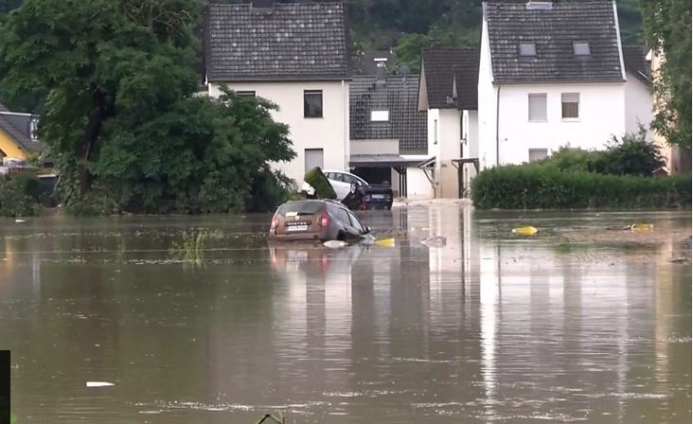

Audio By Carbonatix
At least 80 people have died and hundreds more are unaccounted for in Germany after some of the worst flooding in decades.
Record rainfall in western Europe caused rivers to burst their banks, devastating the region.
Belgium has also reported at least 11 dead after the extreme weather, which political leaders have blamed on climate change.
German Chancellor Angela Merkel has pledged full support for the victims.
Armin Laschet, the premier of North Rhine-Westphalia, blamed the extreme weather on global warming during a visit to a hard-hit area.
"We will be faced with such events over and over, and that means we need to speed up climate protection measures... because climate change isn't confined to one state," he said.
Experts say that climate change is expected to increase the frequency of extreme weather events, but linking any single event to global warming is complicated.
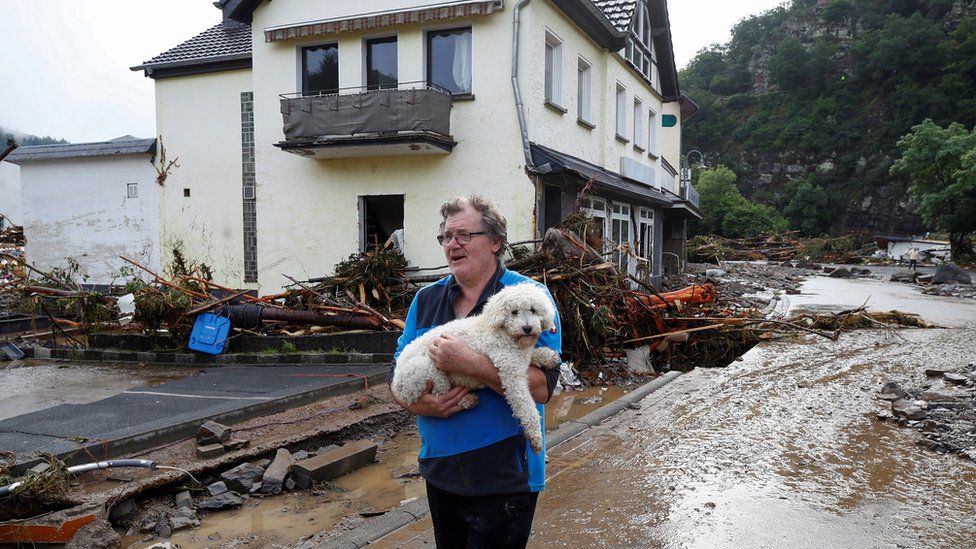
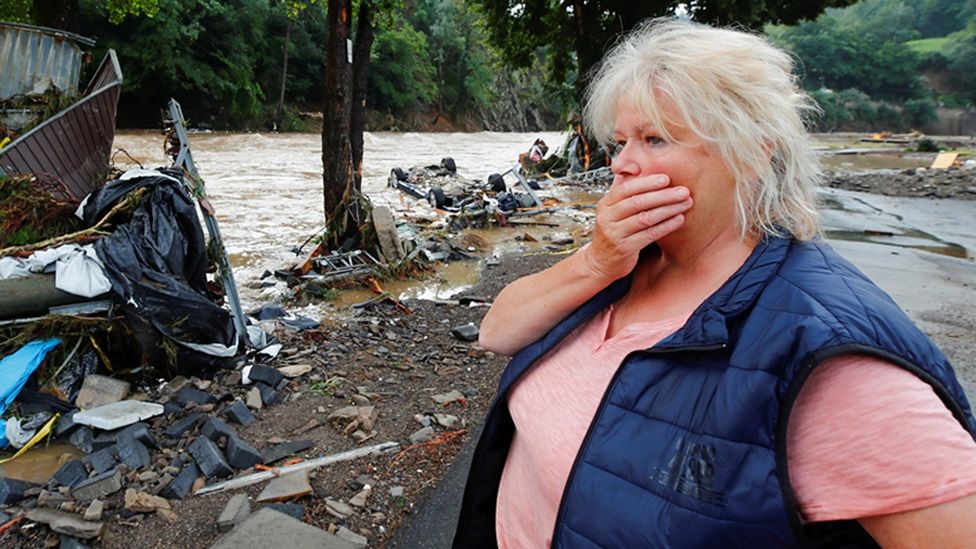
The German states of Rhineland-Palatinate and North Rhine-Westphalia were worst hit, but Belgium and the Netherlands are also badly affected, with further flooding in Luxembourg and Switzerland.
In the district of Ahrweiler, hundreds of people are unaccounted for, the authorities say. A spokeswoman for the local government said mobile networks had been put out of action, making it impossible to contact many people.
The village of Schuld (population 700) was almost entirely destroyed.
More heavy rain is forecast across the region on Friday.
🌧 La crue de la Vesdre atteint une ampleur dramatique à Verviers dans l'est de la Belgique ce matin ! Certaines rues sont noyées sous près de 2 mètres d'eau ! (© Katia Bogaert) pic.twitter.com/yDGNgflP1y
— Météo Express (@MeteoExpress) July 15, 2021
Meanwhile, in the town of Pepinster, 10 houses collapsed after the River Vesdre burst its banks.
Almost 2,000 people were forced to evacuate in the town of Chaudfontaine, Belgium's Le Soir newspaper reported.
Rail services in the southern half of Belgium have been suspended because of the extreme weather.
In the Netherlands, the province of Limburg has been left heavily flooded following downpours overnight.
Forecasts suggest more heavy rain is due in much of western Europe on Thursday and Friday.
Experts say that climate change is expected to increase the frequency of extreme weather events, but linking any single event to global warming is complicated.
Armin Laschet, the premier of North Rhine-Westphalia, blamed the extreme weather on global warming during a visit to a hard-hit area.
"We will be faced with such events over and over, and that means we need to speed up climate protection measures... because climate change isn't confined to one state," he said.
Latest Stories
-
Government has improved sanitation in one-and-a-half years — Salaga South MP
2 hours -
Nkwanta North Assembly to appear before Parliament over DACF sanitation spending
2 hours -
Mourinho prints out ‘red card’ incidents after Real lose derby
3 hours -
Atletico beat 10-man Real in feisty Madrid derby
3 hours -
Twelve Tribes of Israel Ghana to mark 40 years with anniversary celebration
3 hours -
GPL 2026/27: Hearts held by Bechem as Kotoko, Samartex share spoils
4 hours -
My Story (Kwaku Antwi-Boasiako)
4 hours -
We expect growth rate to re-accelerate in second-half of 2026 – IC Insights
4 hours -
The ungodliness and unrighteousness underlying the National Cathedral mess!
4 hours -
T-bills auction: Government fails to achieve target; yield on 91-day-bill remains unchanged
4 hours -
It’s Ghana’s shame to denigrate Nkrumah when the whole world honours him as African of the Century – Asiedu Nketiah
4 hours -
No other nationalist can compare to Nkrumah – Asiedu Nketiah
4 hours -
Collateral Registry: Foreign banks accounted for GH¢19.9bn of secured credit in quarter 2, 2026
4 hours -
This government should expect scrutiny – Asiedu Nketiah
5 hours -
Two-year-old girl dies in domestic fire at Cantonments
6 hours