


Audio By Carbonatix
A not-for-profit international development organisation, SNV Netherlands Development Organization, has organized two stakeholders’ dialogue meetings for players and regulators in the renewable energy sector under its Renewable Energy Development and Acceleration Project (REDAP).
The meetings were meant to spark discussions and address demand and supply-side challenges aimed at promoting compliance, accountability, transparency, and quality services delivery.
The event which took place in Accra and Kumasi saw in attendance business owners in the Micro Small and Medium Enterprises (MSMEs) in the renewable energy sector, officers from the Business Resources Centers (BRC) and representatives from national regulatory and licensing authorities including the Registrar General’s Department, Energy Commission, CSIR, Ghana Export Promotion Authority (GEPA), Ghana Standards Authority (GSA), and Environmental Protection Agency (EPA).
Opening the dialogue in Kumasi, Odjobi Kwakye, the Project Manager of REDAP underscored the need to address the key systematic challengers that impede the growth of renewable energy enterprises.
Some of these systematic challenges, he recounts, permeate the areas of management and governance, business models, financial and accounting management systems and product quality.
Others pertain to the lack of solid data and the skill to understand target markets, weak business development skills, low demand, and weak skills to broker linkages.
It is against this background that REDAP, according to the Project Manager, aims at improving “access to efficient and suitable finance for sustainable energy businesses and users through the development of tailored financial products.” “Other objectives” he adds “include building a pipeline of viable and sustainable energy MSMEs through business and market development support as well as increasing demand for sustainable energy services by initiating demand activation and brokering linkages.”
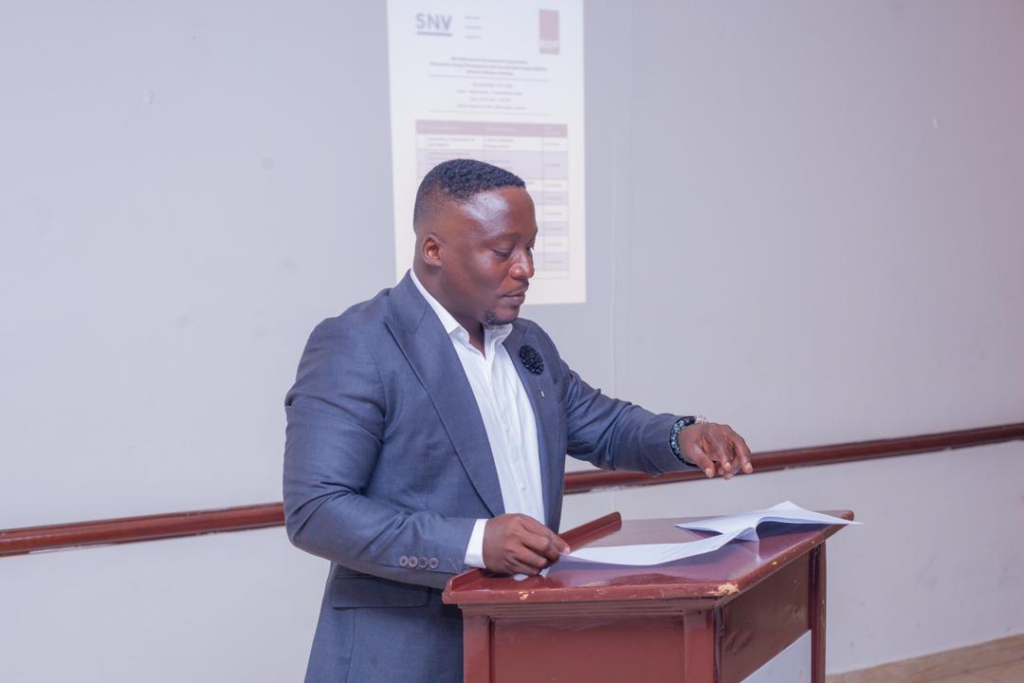
According to the REDAP Project Manager “addressing these issues require tailored and innovative interventions advanced by a collaborative support system involving relevant government and private sector actors.”
Also taking turns to address the gathering, representatives from regulatory and licensing authorities shed light on their functions and working processes.
Acting Director of the Ghana Standards Authority in charge of the Middle Belt Directorate, Dr. Samuel Frimpong, educated participants on the Authority’s core mandate of standardization and licensing.
He also highlighted some of the many benefits of standardization which include the fact that standards facilitate trade by “making products competitive on the international market.”
“Standards also provide information and guidelines for the manufacture of goods and the provision of services thereby ensuring efficiency and quality output” he added.
An Inspector from the Energy Commission, Prosper Ahmed Amuquandoh, took the participants through some of the core functions of the Commission which include “Regulation and the Promotion of Renewable Energy and Electrical Engineering Technologies.”
He further explained that the Energy Commission as a regulatory body undertakes its regulatory duties through “inspection and licensing, inspection and enforcement as well as quality of service monitoring.”
REDAP is 1-year pilot project which commenced in October, 2020 and was expected to end in October 2021 but has been extended to 31st December, 2021.
REDAP is being jointly implemented by Rural Development Fund (RDF) and SNV Netherlands Development Organization (SNV).
It is envisaged that Financial Institutions (FIs) shall be identified to complete the partnership. The project supports global efforts at climate change mitigation and adaptation.
It also supports the efforts of the Ghanaian government in achieving the sustainable energy access targets as outlined in the Renewable Energy Master Plan (REMP, 2019).
Latest Stories
-
NAGRAT urges gov’t to communicate early if September deadline cannot be met
26 minutes -
We trust government to meet September deadline on teachers’ promotions – NAGRAT
38 minutes -
“We dare not fail” – Gov’t promises to honour teachers’ promotion pay deal
44 minutes -
The GH¢19.8 billion mirage: Inside Ghana’s state enterprise turnaround
52 minutes -
Luv FM High School Debate: KNUST SHS and Osei Adutwum SHS set up thrilling final after dramatic semi-finals
59 minutes -
KNUST AI Coordinator urges structured adoption of AI in teacher education
1 hour -
Nepal rescuers blast hillside in search of hydropower workers as families wait anxiously
1 hour -
Teachers who pass promotional exam to get January 2026 start date after gov’t resolves promotion dispute – Dr Apaak assures
2 hours -
NSMQ 2026: St. John’s School rally from slow start to book semi-final spot
2 hours -
Promotion pay row: Gov’t gives teachers September 2026 to complete salary adjustments
2 hours -
Financial irregularities plummet by 62.9% as state tightens fiscal controls
2 hours -
DVLA to expand mobile services to underserved communities in Ghana’s Eastern Corridor of the Northern Region
2 hours -
GUTA urges GPHA to act swiftly to end Tema Port congestion to avert rising business costs
2 hours -
Port congestion could undermine 24-hour economy policy – GUTA
2 hours -
NSA opens three-day window to resolve national service biodata mismatches
2 hours