

Audio By Carbonatix
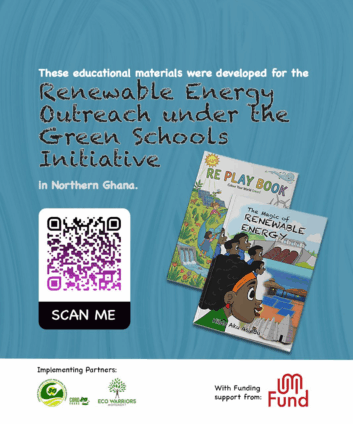
As Ghana deepens its commitment to clean energy and climate education, a quiet but powerful transformation is taking place in classrooms across Northern Ghana, one that begins with stories, colours, and play. Under the Green Schools Initiative, a set of child-friendly educational materials has been developed to introduce renewable energy concepts to pupils in a simple, engaging, and culturally relevant way.
The Green Schools Initiative is a project implemented by Opportunities and Rural Development (CORD Ghana) in partnership with the Eco Warriors Movement, with support from the UMI Fund. The project seeks to promote the adoption of clean energy and climate education in Northern Ghana. Through this project, selected basic schools in the Northern Region benefited from the installation of solar panels and the provision of solar rechargeable bulbs to support teaching and learning activities.
Building on these broader goals of the Green Schools Initiative, the newly developed educational materials focus specifically on children at their formative learning stages. The approach is intentional: to introduce renewable energy early, in ways children can understand, enjoy, and remember.
The educational material comprises a simple storybook designed to introduce renewable energy through storytelling. Rather than technical explanations, the story uses familiar settings, everyday experiences, and relatable characters to explain where energy comes from and how renewable sources like the sun can power homes, schools, and communities. By anchoring learning in a local context, the story helps children see renewable energy not as a general or foreign idea, but as something connected to their own lives.
Complementing the storybook is an interactive playbook, developed to make learning both fun and practical. The playbook includes colouring pages and crossword puzzles that reinforce renewable energy concepts introduced in the story. Through the colouring pages and word searches, children are encouraged to actively engage with what they are learning, turning climate education into an enjoyable experience rather than a classroom obligation.
Education experts have long emphasised that children learn best when they are actively involved. By combining storytelling with play-based activities, the materials cater to different learning styles while stimulating curiosity, creativity, and critical thinking. This method not only improves understanding but also builds positive emotional connections with environmental learning.
Introducing renewable energy concepts at an early age is particularly important. The knowledge and values children are exposed to during these formative years often shape their worldview, attitudes, and decision-making later in life. When sustainability and clean energy become part of a child’s early orientation, they are more likely to grow into environmentally conscious adults who value innovation and responsible resource use.
Beyond awareness, the long-term vision of these materials is transformative. Early exposure to renewable energy concepts can inspire future innovators, technicians, policymakers, and entrepreneurs within the green economy. As Ghana positions itself to capitalise on green job opportunities, nurturing this interest from childhood lays the foundation for economic empowerment and sustainable development.
The ripple effects also extend beyond the classroom. Children often become messengers of change within their families and communities, sharing lessons learned at school and influencing household attitudes towards clean energy and environmental protection. In this way, the materials support community-level awareness while strengthening national climate goals.
By using stories and play to teach renewable energy, the Green Schools Initiative demonstrates that climate education can be effective without being overly complex. Instead, it can be joyful and practical.
Latest Stories
-
Yaw Ampofo Ankrah hasn’t taken or received any money to facilitate visas – Lawyer insists
16 minutes -
World Cup visa scandal: Senyo Hosi urges focus on constitutional accountability
16 minutes -
La Beach demolition: Senyo Hosi condemns lack of consultation
27 minutes -
Russian glide bomb attack on Zaporizhzhia kills at least 15 people
42 minutes -
Jinapor warns underperforming energy sector CEOs of consequences, says no protection for failure
44 minutes -
Fire destroys head of tipper truck on Lower Volta Bridge
48 minutes -
Palmer signs new Chelsea contract until 2034
49 minutes -
World Cup visa scandal: Mahama will act on corruption allegations – Abass Nurudeen
51 minutes -
Abass Nurudeen accuses Minority of ‘scandal scavenging’ over World Cup visa controversy
53 minutes -
US Embassy recognised NSA, GFA and GTA as separate entities for visa applications – Sports Minister’s aide
59 minutes -
Only 30% of Ghanaian teachers satisfied with their jobs – CAPCOE data reveals
1 hour -
Communities affected by construction of Akosombo Dam urge government to speed up compensation process
2 hours -
World Cup visa scandal: Sports Ministry not shielding anyone – Sports Minister’s special aide
2 hours -
World Cup visa scandal: Over 30 people misrepresented as GTA board members to US Embassy – Vincent Assafuah alleges
2 hours -
Fire destroys wooden structure near Yesu Mo Villa at Bush Road
2 hours