

Audio By Carbonatix
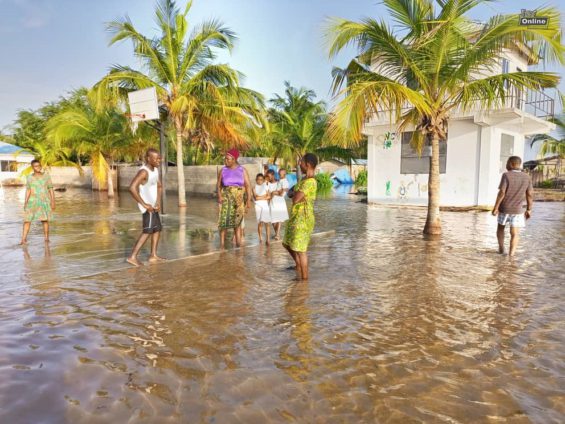
Rising sea levels are an increasing concern in West Africa, and many people in Ghana have already been forced to leave their homes and livelihoods.
In the wake of the tidal surge that hit over 15 communities in the Anloga District and Ketu South Municipality of the Volta Region, an interview with a scientist from the University of Ghana reveals how even slight sea-level rises linked to climate change could significantly increase the devastating effects of tidal waves.
George Ayisi, spokesperson for Ghana's National Disaster Management Organisation, in a media engagement on how dire the latest situation was said; "In Keta district, we have 1,557 individuals displaced and 239 houses affected. In Anloga district, we have 1,394 displaced and 134 houses affected, and in Ketu South we have 1,027 displaced and 149 houses affected."
"This is the third tidal wave this year, but it's the heaviest...it's getting worrying, look at the numbers, it affected a lot of people," he added.
"Sea levels are rising," he believes, "therefore it's clearly tied to climate change."
Ghana has a 550-kilometer coastline, with figures hinting at a quarter of the country's population residing near the sea.
Dr. Philip-Neri Jayson Quashigah, a researcher with the the Institute for Environment and Sanitation Studies at the University of Ghana who research focuses on understanding coastal morphodynamics in an interview with me said coastal communities that are currently regarded as safe won’t be in the future if sea level rise predictions hold.
Global scale of sea level rise
Dr. Philip-Neri Jayson Quashigah said human activities like burning coal and oil, logging tropical forests have raised atmospheric concentrations of heat-trapping gases, causing the world to warm.
Ocean waters warm as the temperature rises, and as the temperature rises, they expand.
For the first 75 to 100 years after the commencement of the Industrial Revolution, thermal expansion was the primary cause of global sea level rise, while its relative importance has decreased as the melting of land ice has accelerated.
“Globally, the climate is changing and the effects are all over. For example, if you take he global temperature, it is rising. Why, is it rising? It’s because of industrial activities. We are emitting greenhouse gases into the atmosphere that traps the heat that should normally escape into the atmosphere. And as it’s being trapped it’s warming the air beyond what it’s supposed to be.”
He adds that globally, land ice-glaciers, ice caps, and ice sheets is shrinking at a faster rate in response to rising temperatures, adding water to the world's oceans. As the rate of ice loss has accelerated, Dr. Quashigah said the contribution to global sea level rise has increased from a little more than half of the total increase.
But how could Africa, which is the least of the contributors to this phenomenon, responsible for less than four per cent of the global volume of carbon emissions, sadly suffer the most because its agrarian and resource-driven economies are peculiarly susceptible to the effects of climate change, and its capacity to withstand its shocks is weak?
The situation in Ghana
At the local level Dr. Philip Neri-Jason Quarshiegah explained how even slight sea-level rises linked to climate change could significantly increase the devastating effects of tidal waves at the fishing communities in Ghana.
“In Ghana, we are already seeing the global impact and the truth is that it will continue and what makes it extreme is we cannot handle what is coming because the sea level is rising and most fishing communities are around the coast, with most being poor communities."
Lack of historical data
The marine scientist lamented the lack of historical data to guide fellow scientists come up with model sturctures that will inform their enginerring designs in salvaging the situation.
He believes a continuous collection of data could help predict some these outcomes.
“We also don’t have enough historical data to do some proper modelling and so we feel the impact more. One of the things we have to be seriously thinking about is continuously collecting data.”
‘Climigration’: Time for coastal communities to move?
What happens when extreme events become more common as a result of climate change, potentially rendering some communities uninhabitable? This subject has sparked a fresh wave of global research on "climigration." Climigration is the deliberate relocation of entire communities to safer areas.
It takes a lot of convincing to persuade a community to relocate. Extreme events, on the other hand, cause social, economic, and physical disruption in communities. Buildings and infrastructure, as well as community cohesion and morale, have been harmed. Many lives may be lost, and many more will be forever changed.
Dr. Quarshiegah made me understand that relocation will be the best call albeit financial challenges and residents resolve to heavily rely on fishing for their economic gains.
The situation according to the marine scientist requires heavily invested research to devise the best solutions to mitigate the growing canker.
Fallout from COP26
Clearly, a collecting approach could quicken out victory in this fight.
The United Nations Climate Change Conference has come and gone.
The Conference of Parties (COP26), which started in Glasgow, Scotland, was followed by dire warnings from scientists about an impending global calamity.
COP26, which was postponed for a year due to the COVID-19 pandemic, must keep alive the goal of limiting global warming to 1.5 degrees Celsius over pre-industrial levels, which scientists predict will avert the worst impacts.
In order to limit global temperature rises, progress on climate financing, and address the issue of loss and damage in developing countries, we must expedite action on climate change and commit to more ambitious reductions in greenhouse gas emissions.
Latest Stories
-
Burundians scramble to leave Kenya ahead of crackdown on unregistered traders
25 seconds -
Wontumi campaign team endorses John Boadu in NPP national chairmanship race
34 seconds -
At least two people dead after Russian strikes on Kyiv
5 minutes -
Adu-Boahene trial: Court gives defence until Sept. 25 to file no-case submission
8 minutes -
Daily Insight for CEOs: Profitability beyond revenue growth.
12 minutes -
‘Jordan Ayew can have an impact here’ – Sheffield United boss Chris Wilder
16 minutes -
Education Ministry to digitise SHS placement complaints system
22 minutes -
Argentina to file criminal case against oil company operating in Falklands
23 minutes -
Black Stars captain Jordan Ayew signs for Sheffield United
25 minutes -
Canada braces for prolonged trade war as counter-tariffs on US take effect
35 minutes -
60 SHS girls develop smart solutions to flooding, waste, parking and water challenges
40 minutes -
Media must continue to shine light on illegal mining—Lands Minister
46 minutes -
NPP challenges Sam George over rural telephony record, demands data
51 minutes -
Mahama Ayariga proposes peak-hour dedicated lanes for Aayalolo buses
54 minutes -
Amrahia Dairy Farms property owners petition Mahama over alleged demolition of properties
59 minutes