

Audio By Carbonatix
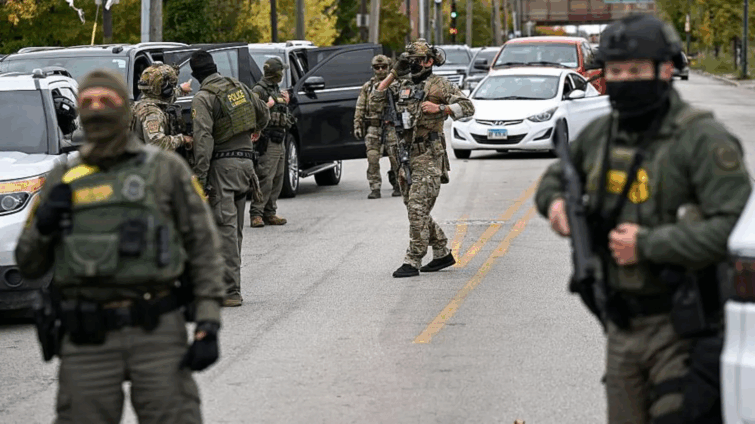
The US Supreme Court has rejected the Trump administration's bid to deploy National Guard troops in the Chicago area, despite objections from local and state officials.
In an unsigned order, the top court said the president's authority to federalise the National Guard likely applies only in "exceptional" circumstances.
The National Guard consists primarily of state-based troops that typically respond to major issues like natural disasters or large protests.
The ruling marks a rare departure for the conservative-majority court, which has largely sided with the Trump administration in recent months. Illinois Governor JB Pritzker called it "a big win for Illinois and American democracy".
The Chicago deployment is part of a series of efforts by the Trump administration to subdue protests against federal immigration raids in primarily Democrat-led cities, including New Orleans, Portland and Washington DC.
Trump argues that his use of troops is necessary to quell violence in Democratic-controlled cities, crack down on crime and support his deportation initiatives.
But two lower courts ruled against Trump's assertion that the protests in the Chicago area constituted a "rebellion or danger of rebellion" against the US.
The president appealed against it in the Supreme Court and argued that its decision to deploy the National Guard was not subject to court review.
On Tuesday, the justices left the lower court's ruling in place.
"At this preliminary stage, the Government has failed to identify a source of authority that would allow the military to execute the laws in Illinois," the justices wrote in a 6-3 ruling. Justices Clarence Thomas, Samuel Alito and Neil Gorsuch dissented.
The Supreme Court's move largely keeps the status quo in one of the nation's largest cities.
While the president has been deploying troops to major US cities for months - despite legal challenges - this is the first time the top court has ruled on the efforts.
Chicago was previously the focus of the administration's troop efforts, but in November, many of those troops were moved to New Orleans - ahead of Mardi Gras - and Minneapolis.
Latest Stories
-
Power restoration fault suspected in Kumasi Central Market fire
2 hours -
The 7-foot giant of Ngleshie Amanfro: Seven-foot Ghanaian Ephraim Saawa dreams of joining the national basketball team
3 hours -
Government promises support for Kumasi Central Market fire victims
3 hours -
Vibes The Movie: Big Ghun’s Ghanaian film earns five nominations at 2026 REFFA
3 hours -
MamaCare CEO warns unresolved conflicts among health workers could undermine maternal and neonatal care
4 hours -
Health professionals urged to translate medical knowledge into practice to save mothers
4 hours -
Conflicts among care providers linked to maternal, neonatal deaths – Expert
5 hours -
GIS marks 10th TIME conference, champions improved teaching practices
5 hours -
BRICS Or Balance? What Ghana’s bid really means
6 hours -
GPRTU wants full TRAFFITECH-GH implementation to start in 2027
6 hours -
Mahama announces plans to import electric wheelchairs for PWDs
6 hours -
KGL U17 Colts 2026: Western beat Prempeh Elite Academy to set up final final with Greater Accra Region
7 hours -
Late Solanke strike salvages 10-man Spurs draw at Man United
7 hours -
Gender Ministry to monitor welfare of Nana Akua Addo’s children amid domestic violence case
7 hours -
Benedict Okyere Yeboah: Ghana’s football problem goes beyond sacking a coach
7 hours