

Audio By Carbonatix
Last week, the Rent Control Department officially directed private hostel operators to suspend proposed increases in hostel fees for the 2026/2027 academic year pending consultations.
In simple English, the situation has become so serious that government itself has now entered the student accommodation group chat carrying whistles and peacekeeping equipment.
And honestly, one cannot blame them.
In the Republic of Uncommon Sense, hostel fees around our universities have stopped behaving like ordinary rent. They now carry themselves with the confidence of imported goods at the marina.
You go to inspect one tiny room somewhere near campus and suddenly the hostel manager starts speaking like a real estate consultant from Dubai.
“Very strategic location,” he says proudly.
Meanwhile the “strategic location” simply means the place is close enough for trotro horns, nightclub speakers, and drunk people arguing over football to disturb your sleep academically until dawn.
The room itself is so small that if you stretch properly after waking up, you may accidentally slap the wall and apologize to it immediately afterward.
Yet the amount being charged can finance a modest wedding engagement, one funeral cloth contribution, and still leave enough money for fuel from Kumasi to Accra.
Even “bedspace” has become an economic philosophy in Ghana.
Imagine paying thousands of cedis simply for permission to sleep beside somebody you have never met before in your life.
The person may snore like a faulty generator, pray aggressively at midnight, or watch TikTok videos without earphones until 2 a.m., but once you have paid, your destiny has joined theirs academically.
As the Ghanaian proverb says, “When the drumbeat changes, the dance must also change.” Unfortunately, in this economy, it is the hostel owners beating the drum while students and parents dance under financial pressure until their knees begin negotiating surrender.
There was a time when gaining admission into university was itself the difficult part. Once the admission letter arrived, the whole family relaxed small. Church aunties started saying, “God has done it.” Uncles who had ignored your existence for three years suddenly became motivational speakers advising you to “learn hard and focus on your future.”
Today, however, admission is merely the trailer. The real horror movie begins when accommodation enters the conversation.
That is when students join twelve different WhatsApp hostel groups simultaneously and begin refreshing links with the desperation of people chasing embassy appointment slots. That is when parents suddenly begin speaking in tongues over MoMo balances.
Then after three sleepless days of searching, one room appears online with the caption:
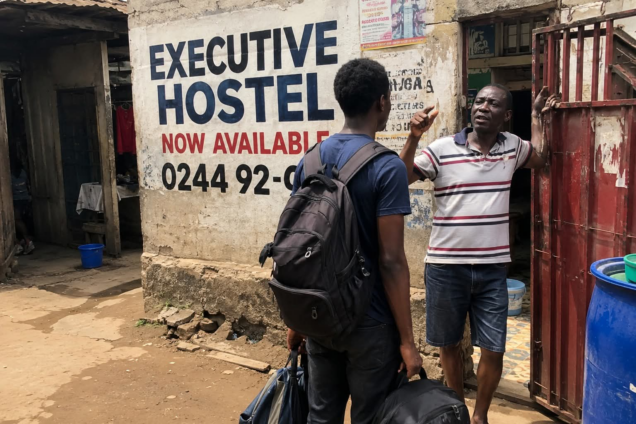
“Executive Hostel. Few Rooms Left.”
Executive hostel.
Meanwhile the room looks like it was originally designed for storing abandoned Coca-Cola crates behind a provision shop before somebody discovered capitalism.
And the students too have become experienced negotiators.
“Please, is water flowing?”
“Yes.”
“WiFi?”
“Yes.”
“Stable electricity?”
At this point the landlord begins laughing like a politician during campaign season.
But beneath the jokes sits something painful.
Very painful.
Some parents are genuinely suffering quietly trying to keep their children in school. Market women are joining susu groups they cannot afford while some fathers now answer phone calls from university children with the same fear people reserve for unknown international numbers.
“Daddy… there’s small pressure.”
In Ghanaian family economics, “small pressure” can collapse an entire monthly budget.
Yet let us also tell ourselves the uncomfortable truth many people are afraid to say loudly.
When education becomes financially brutal, survival begins negotiating with morality.
Many brilliant young women are not entering prostitution because they lack intelligence, ambition, or discipline. Some are being cornered there by economic pressure, by hostel fees, by feeding costs, by transport fares, and by the silent humiliation of constantly begging relatives for money that does not exist.
Some students are carrying lecture notes in the daytime and carrying emotional trauma at night.
But in the Republic of Uncommon Sense, society often waits patiently for the girl to fall before suddenly remembering morality.
The same people who ignored the economic conditions will later gather online to insult her character, while the men financing these exploitative arrangements continue walking around society wearing respectability like expensive perfume.
As another old Ghanaian saying reminds us, “The child who is not embraced by the village will burn it down to feel its warmth.”
A nation cannot continuously make education financially violent and then act surprised when desperation starts making decisions on behalf of young people.
Hostel owners too will argue that cement prices are up, electricity is up, water bills are up, and inflation is up.
True. But at this rate, some hostels may soon require bank statements, guarantors, passport pictures, and recommendation letters from the IMF before allocating somebody half of a bunk bed close to a window.
The tragedy is that universities continue admitting thousands more students while affordable accommodation disappears like dumsor timetable promises.
And now even the Rent Control Department has entered the scene blowing whistle like an exhausted football referee, which means the madness has officially become too loud to ignore.
A generation that cannot comfortably sleep cannot peacefully dream.
And if a nation makes survival more expensive than education itself, then one day we may wake up and discover that many are called to the university, but in the Republic of Uncommon Sense, accommodation has elected only a few.
Latest Stories
-
‘I don’t hire coaches, and I don’t fire coaches’ – Kofi Adams
57 minutes -
NPP sets up 31 voting centres to speed up national executive elections
1 hour -
Demolition begins at La Pleasure Beach amid heavy security presence
2 hours -
Senyocue: Highlife will dominate global music in the next 20 years
2 hours -
Innovare Limited congratulates Ahantaman Community Bank PLC on ISO/IEC 27001:2022 certification urges others to follow suit
2 hours -
Today’s front pages: Friday, October 2, 2026
2 hours -
GPL 2026/27: Opoku Agyemang strike sends Kotoko third after Karela win
3 hours -
Government ‘cannot dissolve’ GFA – Sports Minister Kofi Adams
3 hours -
“Every genre we create doesn’t have to be ‘Afro’ something” – M.anifest
4 hours -
GMTF marks first anniversary with lifesaving equipment for 9 more hospitals
4 hours -
NAIMOS seizes 10 excavators in raid on illegal mining sites blocking River Pra’s flow
4 hours -
Pump prices may stay unchanged as government holds TOR, Sentuo prices
4 hours -
Akra Reads! 2026: Ladé Wosornu poetry contest expands to JHS
4 hours -
K9 dog sniffs out 72lbs of prohibited Ghanaian food items at JFK
4 hours -
If family planning is our choice, why isn’t it in our budget?
4 hours