

Audio By Carbonatix
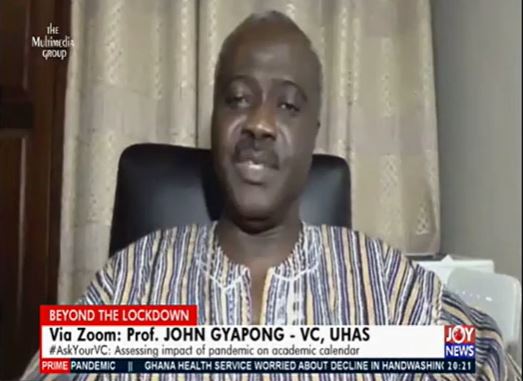
The Vice Chancellor of the University of Health and Allied Sciences (UHAS) Prof John Owusu Gyapong says closing down universities across the country will be a last resort for many school heads.
According to him, though the possibility of universities closing down due to the UTAG strike has been discussed in the various universities, it is being delayed for as long as possible.
Meanwhile, he says due to the strike action universities may have to pay double for expenses which would ‘definitely’ affect their bottom line.
Speaking on JoyNews’ Pm Express, he explained that “In terms of losing the inflows per se, one would not expect that to happen because if you have a 100 students and everybody were supposed to pay a 100cedis, the fact that there are some disruptions doesn’t mean that students will not pay their fees.
“They’ll pay their fees so you’ll get your [ten] thousand cedis, however, as we speak now all our bills for Municipal services and all that are being paid for. Every other week I get a bill on cleaning material for our hostels and all that.”
“The students are living there, they’re not doing what they’re supposed to be doing but we have to be doing all the cleaning and the other services that we have to provide. Then the strike is over and then the students come back and then again we have to pay for that bill again.
“So we end up paying double. But you cannot ask the students to pay double fees, so clearly there’s some loss of money through unexpected expenditure,” he said.
Professor Gyapong stated that a key reason why the universities have refused to close down is to avoid inconveniencing students that travel far distances just to get to school.
He said a school closure could present some cost of travel and risk of travel challenges.
“The issue has been that there has been a lot of talking behind the scenes, engaging UTAG, engaging the Ministry of Education and the Ministry of Employment, and that almost always you get the impression oh it’s almost over, we’re at the end. But it never happens you know. So we also need to be very careful.
“I mean, look, here in Ho, I have students who have come all the way from Wa, from Tamale, from Sekondi, from all over the country. And then you ask them to go home. The cost and the risks involved are quite challenging.
“I know those who live pretty close would have gone home to go and live with their parents to save on the little money that they’re supposed to use to take care of themselves, but it’s a decision that we make after a lot of consideration,” he said.
“We want to ensure that there is minimum infliction of undue challenges to the students in particular and that is the reason why we’re hastening slowly as far as closing the universities are concerned,” he added.
Latest Stories
-
GNPC Explorco advances Voltaian Basin drilling preparations with 13.5km access road
1 minute -
Minority calls for dedicated sanitation fund to improve waste management in Ghana
25 minutes -
Cabinet approves facility manager for Borteyman Sports Complex – Kofi Adams
51 minutes -
Sanitation is improving; critics may be ‘living in another world’ – Salaga South MP replies Bekwai MP
58 minutes -
Government must do more to tackle sanitation crisis – Bekwai MP
58 minutes -
World Cleanup Day: GFF begins sanitation education in local communities
1 hour -
EU Ambassador, IGP discuss stronger cooperation on policing and security
1 hour -
Africa Nations Volleyball Championship: Ghana set up quarterfinal clash with Cameroon after beating Chad
2 hours -
Meet Dr Benjamin Appiah Osei — Ghana’s three-time tourism awards winner
2 hours -
UEFA & CONCACAF demand Fifa pays $10m to all 211 members
2 hours -
Inter fight back again to snatch draw at leaders Roma
2 hours -
Suzuki proves worthy replacement for Martinez at Villa
2 hours -
Brighton humbling ‘a big lesson’ for Arsenal – Arteta
2 hours -
Arsenal handed first loss by brilliant Brighton
3 hours -
VIDEO: Akwatia MP ‘clashes’ with Kofi Bentil over 3.9-tonne cocaine seizure
3 hours