

Audio By Carbonatix
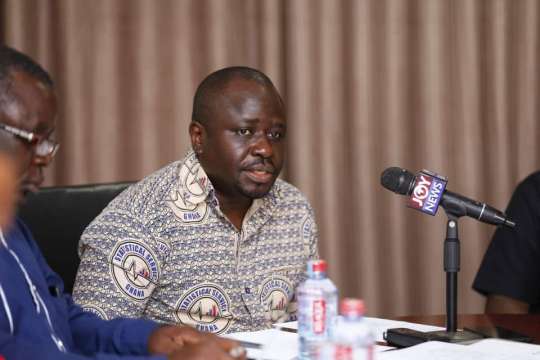
The Ghana Statistical Service (GSS) has revealed that it spent ¢6 million in conducting its corruption perception report recently released.
According to the GSS, a component of the expenditure was from United Nations Office on Drugs and Crime (UNODC).
This was revealed by the Government Statistician, Prof Samuel Kobina Annim.
Speaking on the JoyNews’ AM Show on Friday, July 29, they can do the research with ¢5 million on their own.
“In total, we spent about ¢6 million on this survey but obviously this had a component of the expenditure from UNODC side because of the technical support they provided but once we are doing this by ourselves, we think something around ¢5 million will suffice,” he said.
Prof. Annim also said they will engage with the Finance Minister to see how often this research can be done.
“We have already started conversations on that unfortunately the conversations are from our development partners but what are going to do together with CHRAJ is to approach the Minister for Finance to see what government can do in terms of whether every year or every two years.”
The said report by the GSS together with CHRAJ and UNODC ranked the Ghana Police Service as the most corrupt institution in the country.
According to the survey, more than 17.4 million bribes were paid in 2021 with Police officers topping the list of officials who take bribes with 53.2%.
Meanwhile, the Inspector General of the Ghana Police Service, Dr. George Akuffo Dampare in a five-page letter to GSS and CHRAJ on Wednesday, July 27, questioned the methodology used to conduct the survey.
“Our discomfort, therefore, is the use of selective ranking methodology to project the outcomes in a manner that puts an unfair focus on the Police Service with all the others in your corruption index escaping public scrutiny,” the IGP said.
Dr. Akuffo Dampare explained that per the Police’s analysis of the report, the research could have been influenced by “a historically pervasive stereotyping of the Police Service.”
“The Service has almost now become the default institution of choice for such research and has therefore encouraged a deep-seated public stereotype over the years.”
Latest Stories
-
Global InfoAnalytics poll puts John Boadu, Justin Kodua and Titus Glover ahead in NPP executive race
32 minutes -
Ghana to establish skills development university with $50m from German support package
38 minutes -
Baffour Awuah under EOCO investigation over alleged financial loss and money laundering – Deputy AG
44 minutes -
How healthy is Ghana’s health sector?
50 minutes -
HACSA Tech4Girls graduates 80 young women with digital and technology skills
51 minutes -
Arrest of Manhyia South MP should involve Parliament, not police station – Kpebu
1 hour -
Two Nigerians sentenced to 189 months in US prison over $2.4m cyber fraud
2 hours -
Cristiano Ronaldo leaves Portugal’s training camp after rift with Head Coach
2 hours -
Ghana Energy Awards opens nominations for landmark 10th anniversary edition
2 hours -
Aayalolo contra-flow: Are we treating the symptom instead of the disease?
2 hours -
GTEC orders Colleges of Education to begin 2026/2027 admissions despite fees approval delay
2 hours -
Legal reforms must solve real problems, improve justice – Bagbin
2 hours -
Ofori-Sarpong named Alumni President of the Year, honoured for PRESEC dormitory project
3 hours -
Germany commits $132m to Ghana for skills development and training university – Pelpuo
3 hours -
‘Influence should go beyond visibility’ – Taadi Banyinba GH launches The TB Impact
3 hours