

Audio By Carbonatix
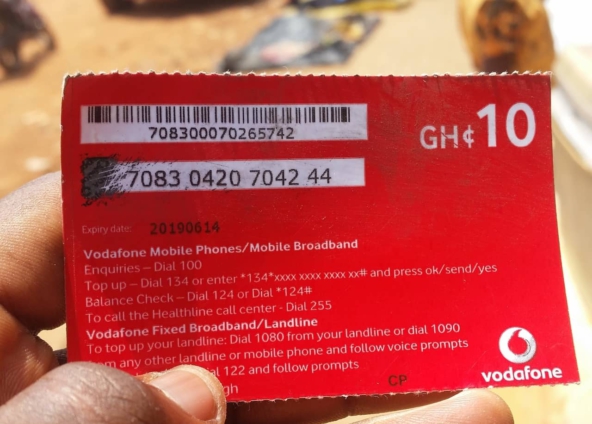
James is busy every day. As an experienced credit vendor based in Accra, he tells me that the little tote bag slung around his shoulders used to be packed with scratch cards. Those days are now long gone. "Right now, the Vodafone scratch cards are not in the system anymore.
If you want to buy credit, I will either do a credit transfer for you or you buy it yourself from your Vodafone Cash wallet," he tells me as he serves a customer with practised ease.
James’ observations are not only true for Accra. The reality is similar nationwide. Digital top-up methods have gradually replaced the traditional Vodafone scratch cards.
This remarkable journey began two years ago when the telecommunications provider launched a concerted campaign to digitise its customers’ top-up processes. Vodafone Ghana’s efforts have paid off today.
Starting from scratch
"Digitalising the top-up process was a key part of our strategy for two main reasons," explains Samuel Sarpong, Vodafone Ghana’s Sales and Distribution Manager, a key architect of the effort to modernise Vodafone’s top-ups.
"First, we wanted to improve the experience of our customers by offering convenience. For example, to buy a scratch card, you would need to find an agent and hope that they have the exact denomination of cards you need. Otherwise, you’d need to buy a lot of cards just to get the amount you want. A lot of times, customers would misplace the cards or accidentally scratch off one or more digits."
Samuel went on to explain how bad weather affected a customer’s ability to buy scratch cards in person. "The moment it rained, customers would have to brave the elements to get scratch cards from agents and vendors."
Digital top-ups got rid of all these inconveniences.
"The second reason," continued Samuel, "is our commitment to reduce our environmental footprint and become more sustainable. Vodafone Ghana aims to use natural resources responsibly, and we have made significant commitments to reduce our carbon emissions and help protect the environment."
Despite the small size of the scratch cards, it took over [PV1] 350 million pieces of paper a year to produce them. Not to mention the ink, plastic, and other materials involved in the manufacturing process. Also, once the card was used, it was often improperly discarded, contributing to litter and environmental damage. Almost overnight, digitalising this process brought these problems to an end and reduced Vodafone Ghana’s carbon footprint.
Along came a pandemic
COVID-19 took the world by surprise, heralding an era of uncertainty. For Vodafone Ghana and many other organisations worldwide, the pandemic underscored the urgent need to deliver services to customers in safe, contactless, and reliable ways. However, it also changed customer behaviour in one fundamental way.
"During the pandemic, safety was at the forefront of our customers’ minds and ours, too," explained Angela Mensah-Poku, Vodafone Ghana’s Director of Digital and Commercial Operations.
"Customers became more open to using our digital platforms, which sped up our digitalisation efforts," she said.
Slowly, the brand’s digital top-up services became more popular. But that was just the beginning. Vodafone Ghana needed to drive adoption. This meant ensuring that vendors always had access to credit and customers always had convenient ways to top up electronically. Among other strategies, Vodafone explored partnerships with banks and third-party payment platforms.
"We also sped up self-top-ups through Vodafone Cash, using incentives to reward customers for choosing digital airtime purchases. You may have noticed some of our competitors trying to follow suit in recent times," Samuel quipped.
The new status quo and beyond
Vodafone Ghana’s digital drive has been so successful that, as of 2022, they have entirely pulled out of all scratch card production.
"Today, 99.5% of our reloads are digital. There are still scratch cards in the system, but those are the last of them. We are not printing anymore except in emergencies," Samuel said.
Vodafone Ghana has made tremendous progress toward achieving its Planet agenda. Through this platform, the company aims to fight climate change by empowering customers, businesses, and governments to reduce their environmental footprints through its digital technologies.
"Digital airtime purchases are one way we’re doing that," explained Jacquelyn Makumator, Vodafone Ghana’s Sustainability Manager. "We are rolling out our plan to power our exchanges with renewable energy. Through this project, Vodafone Ghana has already saved approximately 60,322 KWh of power. We rely on robotics to handle recruitment and an artificial intelligence (AI) chatbot, TOBi, to manage customer enquiries, and internally for our HR processes. We are using machine learning to deliver our Made4Me offers, using digital learning platforms like Instant Schools to connect educators and learners all over the country and we’ve used technology to help our disabled customers connect with our customer service through our SuperCare platform."
Vodafone Ghana is looking to the future with optimism, with a focus on digitalisation. "For us, digitalisation is not just a part of our operations—it’s a commitment that has allowed us to innovate our offerings," said Patricia Obo-Nai, Chief Executive Officer of Vodafone Ghana. "I believe that there is much more possible and much more to come," she concluded.
Latest Stories
-
He entered at eight. He is now 16: Ghana’s children growing up in prayer camps
1 hour -
‘Development must not always begin from Accra’ — Anwelle Foundation launched in Jirapa
1 hour -
PKO trio eye victories at Odwira Festival
4 hours -
346 Ghana Navy recruits pass out after 26 weeks of intensive training
4 hours -
Newsfile to discuss EOCO-MP arrest, drug trafficking, speech arrests and $235m water debt
4 hours -
JoyNews gets results as listeners raise GH¢40,000 to help 17-year-old student with cerebral palsy attend SHS
5 hours -
Vice President calls for stronger local pharmaceutical production to reduce medicine imports
5 hours -
The brewing tension at KNUST; Beware the Ides of October….
6 hours -
Health Ministry moves to integrate traditional medicine into mainstream healthcare
6 hours -
550 pupils in Kintampo South get educational lifeline as ‘Seeds of Hope’ reaches farming communities
6 hours -
Opoku Mensah urges Christian Council, House of Chiefs to speak up on democratic freedoms
7 hours -
Teacher unions’ strike: Minority demands immediate payment of teacher arrears, 20% deprived area allowance
7 hours -
The Accra-Kumasi Expressway: Building it right
7 hours -
Beyond gold exports: Building value and economic resilience from Ghana’s gold
7 hours -
2027 AFCONQ: Ghana under pressure as Gambia beat Somalia 2-1
7 hours