

Audio By Carbonatix
While delivering the much anticipated 2023 budget, Ghana’s Finance Minister, Ken Ofori-Atta, unmasked the nature of Ghana’s debt portfolio, saying the country is finding it difficult to carry a debt burden worth $48.9 billion as of September 2022.
Debt restructuring is the only gateway to access the projected $3 billion IMF bailout package. Barely five days after Ofori-Atta confirmed the debt operation exercise, international credit rating agency Moody’s dropped Ghana’s long-term sovereign bonds ratings.
On 4 December 2022, the government finally announced a debt operation exercise called “Domestic Debt Exchange”, which outlined the nature of debt restructuring for domestic creditors. The Finance Minister indicated that domestic bondholders would be asked to exchange their instruments for new ones under the programme. However, the impact of the domestic debt exchange on investors holding government bonds, particularly small investors, individuals, and other vulnerable groups, will be minimised; hence treasury bill holders will be paid the full value of their investments on maturity.
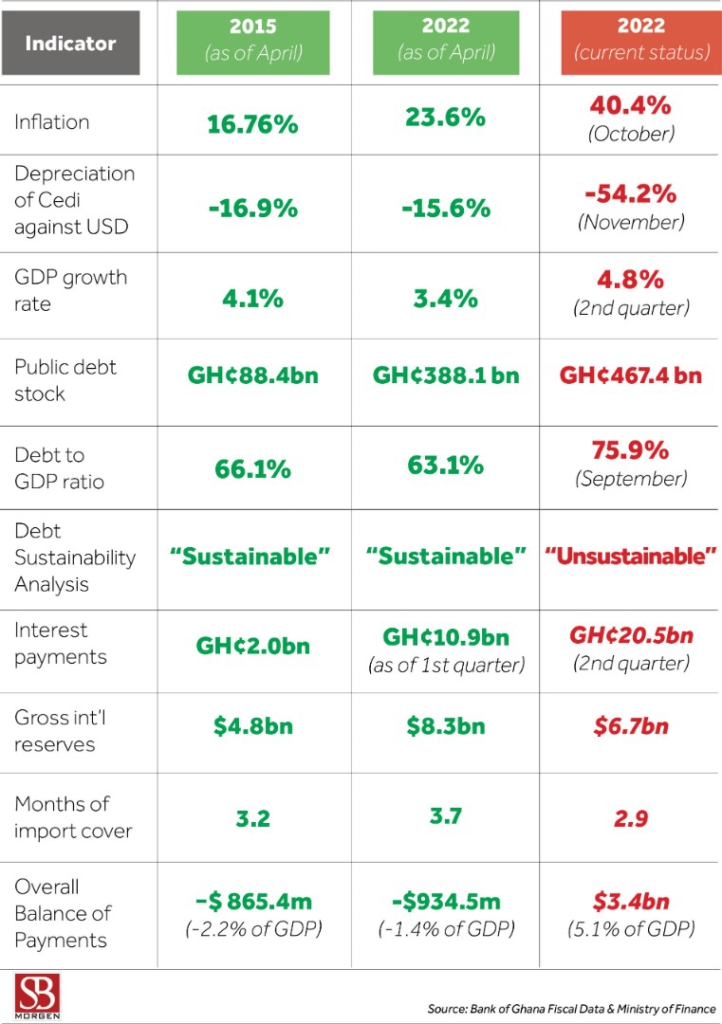
20 years after Ghana received a total relief of approximately US$3.7 billion, equivalent to US$ 2.2 billion in Net Present Value terms, from all its creditors, it is back in the IMF ‘programmes market’ hoping to shop for another bailout packet worth $3 billion. According to the fund, “in cases where a country’s debt is assessed as unsustainable, the IMF is precluded from providing financing unless the member takes steps to restore debt sustainability, including by seeking a debt restructuring from its creditors.” Like the country’s 16th IMF programme in 2015, the government has decided to freeze public-sector employment next year to reduce expenditure. The monetary policy rate has also been hiked from 24.5% to a record 27% to deal with the over 40% inflation rate.
As Ghana walks the path to its 17th IMF bailout, precipitated by a debt sustainability problem, the country will experience the immediate impact, such as losses to investors, shaking of the financial industry, potential bank collapses and stifling of production due to how expensive it will be to procure financing. Added to these is the long-term effect of losing confidence in the Ghanaian government’s security. It will be hard for a government that has defaulted on domestic debt in the currency it prints to convince investors to buy its securities in international currencies that it does not control. This will take at least a decade to restore.
Latest Stories
-
NPP Delegates conference: The wisdom of the masses will prevail – Napo
11 minutes -
NPP Bosome Freho Constituency Chairman reportedly arrested over ballot paper incident
33 minutes -
Happy 76th Birthday to the Daily Graphic!
58 minutes -
Amin Adam celebrates Prof. Alhassan Musah on appointment as KAAF University Vice-Chancellor
1 hour -
Mahama reaffirms commitment to Volta development at Asogli Te Za
1 hour -
Bawumia urges NPP aspirants to accept results, reunite party after elections
1 hour -
Double fibre cut disrupts Telecel services, 72,754 subscribers affected
2 hours -
Bawumia demands probe into financiers behind Ghana-linked cocaine shipments
2 hours -
Spain beat Czech Republic to maintain winning run
2 hours -
Ronaldo ‘greatest symbol’ of Portugal – Fernandes
2 hours -
NPP election: We thank NDC for making the attempt; we never expected them to show up – Karbo says after boycott
2 hours -
Tennessee prison chief to resign after Christa Pike’s failed execution
3 hours -
Free SHS suffering under NDC gov’t- Dr Bawumia
3 hours -
NSA cannot manage all Ghana’s sports facilities alone – Ampofo Ankrah
3 hours -
MoH announces mop-up recruitment for health professionals
3 hours