

Audio By Carbonatix
Ghana’s cedi, the world’s second-worst performing currency this year, is heading for more pain after the country missed a self-imposed deadline to restructure its bilateral debt and move closer to tapping foreign aid.
Finance Minister Ken Ofori-Atta wanted to reach a restructuring agreement with bilateral creditors by the end of February to help qualify for a $3 billion International Monetary Fund program.
So far, Ghana has only partially completed the domestic-debt part of the exchange program.
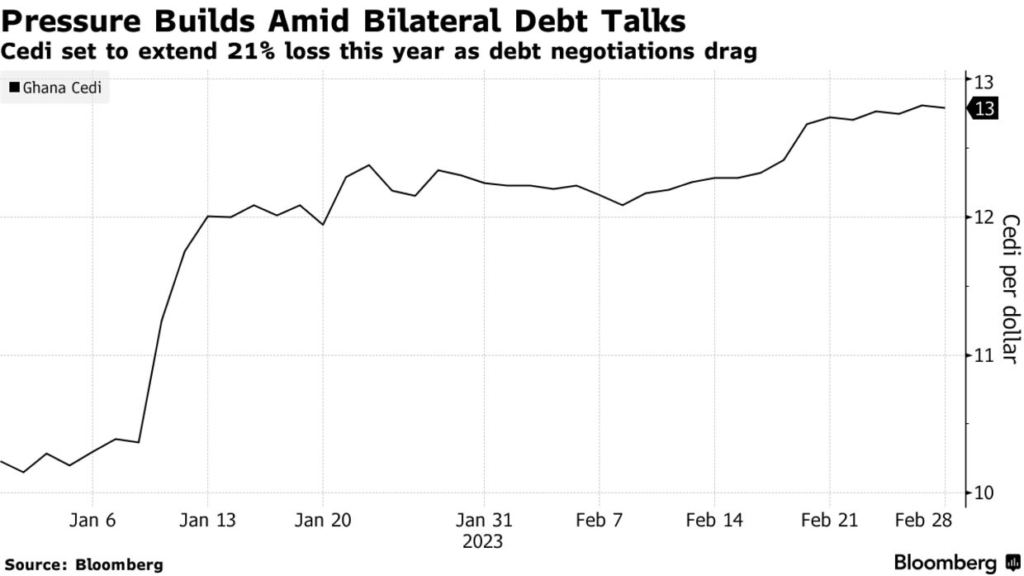
The cedi has slumped 21% against the dollar in 2023, the worst performer among more than 100 currencies tracked by Bloomberg after the Lebanese pound.
Still, the missed deadline doesn’t automatically derail the talks.
Rather, it highlights the difficulties Ghana faces as it tries to reduce its debt load and contend with critics ranging from international bondholders to local trade unions.
“For the foreseeable future the cedi will continue to be volatile until we are able to make substantial progress on the external debt restructuring front,” Kweku Arkoh-Koomson, an economist at Databank Group, said by phone.
“The IMF deal is what will cause a clear stability in the cedi.”
Ghana is trying to restructure most of its public debt, estimated at ¢576 billion ($45 billion) at the end of November.
Local bondholders have been asked to voluntarily exchange ¢130 billion of debt for new bonds that will pay between 8.35% and 15% interest, compared with an average of 19% on old bonds.
Ghana stands to ask external creditors to write off as much as 50% of the debt it owes them — far higher than the 30% the government initially considered, S&P Global Ratings said in a report Tuesday.
“Uncertainty on when the rest of the restructuring will be completed” is influencing cedi volatility, said Courage Boti, an economist at Accra-based GCB Capital Ltd.
“To the extent that those things are hanging in the balance now — in that timelines are not very certain — the volatility of the cedi will continue.”
To date, local investors have exchanged ¢87.8 billion, or 67.5% of bonds under restructuring, for new securities, against an overall target of 80%.
The country will have to reorganize obligations owed to local pension funds to complete the domestic exchange, a move that’s running into criticism from trade unions.
The government aims to start “substantive” discussions with international bondholders and their advisers in the coming weeks, Ofori-Atta said last month, offering eurobond holders some losses while seeking to reschedule payments on bilateral obligations.
Latest Stories
-
CIIG 6th Insurance Excellence Awards highlights need to protect professional standards
23 seconds -
GEXIM Bank’s interest income surges 90% to GH¢153.9m – SIGA report
1 minute -
Man trapped beneath loaded truck after it overturns at Kibi
2 minutes -
African Union backs Sudanese-led dialogue to end conflict
3 minutes -
VRA reverses GH¢106m loss to record GH¢88m profit in 2025
5 minutes -
University of Memphis has not terminated scholarship deal with GSA – Director-General
12 minutes -
Ken Blege announces global release of ‘He Found Me’ album
19 minutes -
The transfers to watch before window closes
27 minutes -
Nana Kwadwo Osei Bonsu I installed as Odikro of Tepa Ankaase in Ashanti Region
38 minutes -
FDA, National Security arrest suspect over sale of cigarette-shaped sweets
40 minutes -
Sammy Awuku challenges GMA over MV Sankofa’s seaworthiness and clearance
41 minutes -
ECG can move from losses to profit with prudent management, stable economy – SIGA DG
44 minutes -
ECG, Graphic and three other SOEs recorded losses every year from 2021 to 2025 – SIGA
46 minutes -
COCOBOD revenue surges to GH¢48.6bn, returns to GH¢5.1bn profit in 2025
48 minutes -
The jury’s options in Lindsay Clancy’s murder trial
48 minutes