

Audio By Carbonatix
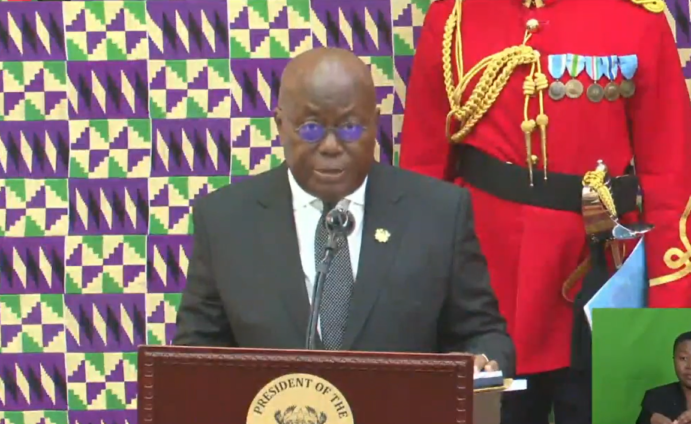
President Akufo-Addo says the freedom of speech in the country currently has reached a very high level.
He said the country has achieved a feat where citizens are allowed to express their opinions on national issues without any fear.
The President said the attractiveness of this feat now allows foreign diplomats to even discuss issues of their host country.
According to him, these diplomats are now able to make pronouncements in Ghana that Ghanaian diplomats cannot dare make in their countries of origin.
“It is interesting to note that freedom of speech has reached such high levels to the extent that some diplomats are able to join in the discussion and make pronouncements on issues Ghanaian diplomats cannot make in their countries of origin,” President Akufo-Addo said when he delivered the 2023 State of the Nation Address on Wednesday, March 8.
The government has already assured media practitioners of its commitment to prioritising press freedom in the management of the country’s democracy.
Reading a speech on behalf of the President as the guest of honour at the 26th GJA Awards held in Accra on November 12, Florence Oboshie Sai-Coffie, says the president wants the media to play its part towards economic recovery as the world faces turbulent economic downturns.
“All agencies of mass media shall at all times be free to uphold the principles and objectives of this constitution and shall uphold the responsibility and accountability of the government to the people of Ghana.”
“We truly believe that in search for solutions for the challenges, the media must be prioritised. Indeed, you are to help with amplifying the vibrant voices of the public and help us to find a pathway that takes us to economic recovery,” she said.
What is Ghana’s current press freedom rating?
Although Ghana is considered a standard for democratic stability, it ranks 60th in the world for press freedom, dropping from an initial 30th position.
This is Ghana’s lowest-ever ranking in 17 years after it ranked 66th and 67th in 2005 and 2002 respectively.
The latest report is out of 180 countries assessed, with Ghana recording a decline in its indicative points from 78.67 per cent to 67.43 compared to last year.
Latest Stories
-
La Beach demolition: Senyo Hosi condemns lack of consultation
8 minutes -
Russian glide bomb attack on Zaporizhzhia kills at least 15 people
23 minutes -
Jinapor warns underperforming energy sector CEOs of consequences, says no protection for failure
24 minutes -
Fire destroys head of tipper truck on Lower Volta Bridge
29 minutes -
Palmer signs new Chelsea contract until 2034
30 minutes -
World Cup visa scandal: Mahama will act on corruption allegations – Abass Nurudeen
32 minutes -
Abass Nurudeen accuses Minority of ‘scandal scavenging’ over World Cup visa controversy
33 minutes -
US Embassy recognised NSA, GFA and GTA as separate entities for visa applications – Sports Minister’s aide
40 minutes -
Only 30% of Ghanaian teachers satisfied with their jobs – CAPCOE data reveals
51 minutes -
Communities affected by construction of Akosombo Dam urge government to speed up compensation process
1 hour -
World Cup visa scandal: Sports Ministry not shielding anyone – Sports Minister’s special aide
2 hours -
World Cup visa scandal: Over 30 people misrepresented as GTA board members to US Embassy – Vincent Assafuah alleges
2 hours -
Fire destroys wooden structure near Yesu Mo Villa at Bush Road
2 hours -
NDC threatens sanctions over oversized campaign posters, gives aspirants 5 days to comply
2 hours -
Star Oil paid GH¢2.7bn in taxes, levies in nine months of 2026
3 hours