

Audio By Carbonatix
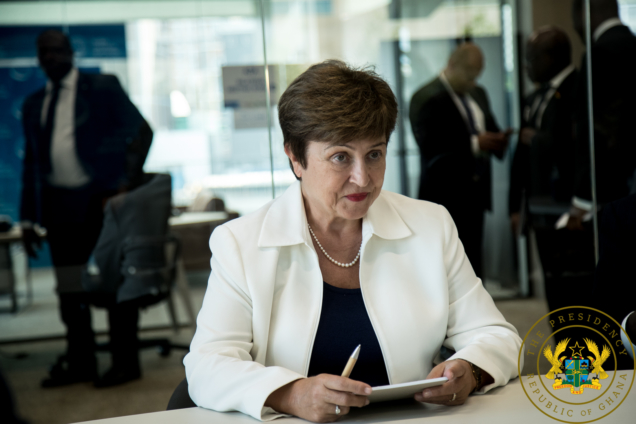
International Monetary Fund (IMF) chief Kristalina Georgieva said she told China’s new top economic official, Li Qiang, they must accelerate work to reach debt restructuring agreements for countries like Zambia, Ghana and Ethiopia.
Georgieva, who met with Li and other top Chinese officials during a visit to China last month, said on Thursday she found Li very approachable and pragmatic.
She said he assured her that he wants China to play a constructive role in resolving debt relief cases.
“The truth is, and I was ... very straightforward on that, it takes far too long for that (debt) resolution,” she told an event hosted by Meridian House and Politico.
“Yes, China has multiple institutions that deal with that, that makes it complicated domestically, but they have to speed up their participation.”
The United States and other Western countries have faulted China for causing delays in setting up restructuring agreements for heavily indebted countries that have asked for help under the Common Framework set up by the Group of 20 major economies.
Georgieva noted China had been helpful in reaching a debt relief deal for Chad, and also Sri Lanka, a middle-income country that was not eligible for help under the G20 framework, and she encouraged China to show progress on other cases.
About 60% of low-income countries are already in or at risk of debt distress, and about 25% of emerging economies are at high risk and facing “default-like” borrowing spreads, Georgieva said.
Georgieva said that during her visit Chinese officials underscored their commitment to multilateralism, opening up China’s economy for more trade, and debt restructuring.
The IMF this week said rising geopolitical tensions and the resulting fragmentation of the global economy could increase financial stability risks, reducing cross-border investments, asset prices, payment systems and banks’ ability to lend.
The global lender has long warned of increased costs, economic friction and GDP output losses associated with the global economy’s fragmenting into geopolitical blocs, with U.S.-led democracies on one side and China and other autocratic states on another. Those concerns have been heightened since Russia’s invasion of Ukraine.
Georgieva said Chinese officials also worried about fragmentation, but their foremost concern was securing jobs at home, with a target of creating 12 million jobs this year.
Latest Stories
-
UHAS halts semester exams over administrative, logistical issues
2 hours -
ECG announces planned maintenance outages in parts of Ashanti Region
2 hours -
Sexual harassment has no place in educational institutions – Education Ministry
2 hours -
The growing culture of vacation classes in Ghana: Should students rest or continue schoolwork?
3 hours -
E.P. Church secures radio frequency, prepares to launch Bremen Radio
4 hours -
Two dead and hundreds evacuated as twin fires break out on Greek island
4 hours -
EPCG clears over GH¢11.7m in debt as outgoing moderator calls for tighter controls on borrowing
4 hours -
Mövenpick Ambassador Hotel Accra marks 15 years of premium hospitality
4 hours -
T-bills auction: Government exceeds target by 88%, interest rates tumble
4 hours -
Western North: Confusion erupts over NPP chairmanship election results
5 hours -
Bawumia congratulates newly elected NPP regional executives
5 hours -
Bawumia urges unity after NPP regional elections ahead of 2028
5 hours -
Russia says at least seven killed in largest Ukrainian attack of 2026
5 hours -
Ghana and Netherlands sign pact to combat illicit drugs and drug markets
5 hours -
Akandoh warns Boards against interfering in day-to-day management of health institutions
6 hours