

Audio By Carbonatix
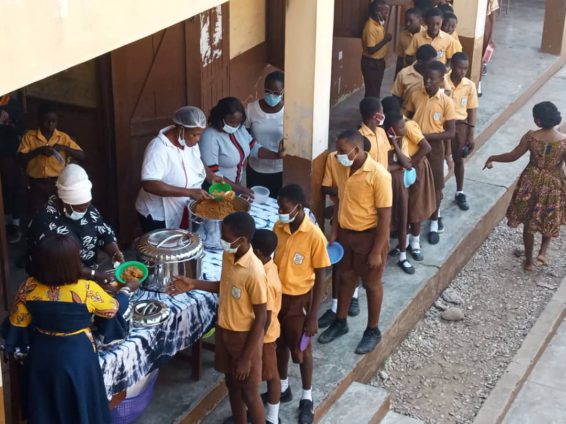
A Medical Sociologist and Public Health Expert, Rev. Prof. Yaa Adobea Owusu, has said that the proposed amount of increment for meals provided under the School Feeding Programme is not enough to offer nutritious meals to the pupils.
Speaking on Upfront on JoyNews, she stated that one of the initial goals of the programme was to provide nutritious meals for the school children, adding that if they could not afford it at home, the school would be a place to eat well.
Prof Owusu noted that with the current economic crisis, GH¢1.20 is not enough for caterers to prepare nutritious meals.
“I think that we need to very much appreciate the jump the government has made from 97 pesewas to GHS1.20. That will be a huge jump especially also taking into cognizance our current situation. But when you look at the realities of how things sell in the market and the fact that these caterers also have to earn a living - they would be employing people - that money is still not enough to give nutritious food to the children.”
“I don’t think that given the present situation whether in rural or urban areas, that money although very much appreciated is able to deliver nutritious food for a child,” Prof Owusu added.
This comes after the government announced an increment of cost per meal, per child from 98 pesewas to ¢1.20.
The Minister for Gender and Social Protection, Lariba Zuweira Abudu, who announced this, said they are in talks with the Ministry of Finance to see how best the amount can be reviewed.
But the caterers have vehemently rejected the proposed increment noting that it is woefully inadequate to feed the children.
Speaking on Adom FM’s morning show, Dwaso Nsem on Tuesday, President of the School Feeding Caterers’ Association, Charlotte Asante, explained that the caterers are struggling to feed the pupils with good meals due to the hikes in the prices of food.
Meanwhile, Prof Owusu believes that the use of mostly imported products, which goes against one of the initial goals of the programme, has contributed to some of the challenges the programme is facing.
The public health expert indicated that, at the launch of the programme, 80% of the products used were expected to be sourced locally or within the communities.
“But, in the literature we just reviewed, right now we have less than 20% of the food that goes into school feeding coming from our local products. We see a lot of imports which doesn't help us, and it is far more expensive.”
She urged the government to review the programme and look into providing caterers with more locally produced goods. This, she said, would not only help in reducing cost, but also benefit farmers and other producers in the country.
Latest Stories
-
Big Chef Season 5: Two contestants face exit in Jollof Challenge
15 minutes -
SIGA’s ‘massive turnaround’ claim not borne out by data – Bright Simons
22 minutes -
Nhyiaeso Chief assures support to end encroachment on utility corridors in Kumasi
23 minutes -
Two lorry station masters arrested over alleged plot to kill creditor over ₵91k debt
55 minutes -
SIGA’s claim on highest audited proportion inaccurate – Bright Simons
56 minutes -
Money bouquets, spraying and dancing on cash unlawful – BoG warns
1 hour -
Sam George pushes for nationwide 4G upgrade of rural telephony sites
1 hour -
Local Government Ministry to support MMDAs to deliver gov’t agenda
2 hours -
At least five killed in Sudan’s South Kordofan in attack by rebel group
2 hours -
“Music is so stressful” – Headless YouTuber on why he won’t return
2 hours -
Cleveland police chief proud of force but being ‘let down’ by funding
2 hours -
Black Sherif drops new 6-track EP ‘Sun Sherif’
3 hours -
GTA partners Africa’s Brain Bank for Medical City groundbreaking
3 hours -
How to check 2026 WASSCE results on mobile phone
3 hours -
President Mahama is a professional comedian – DKB
3 hours