

Audio By Carbonatix
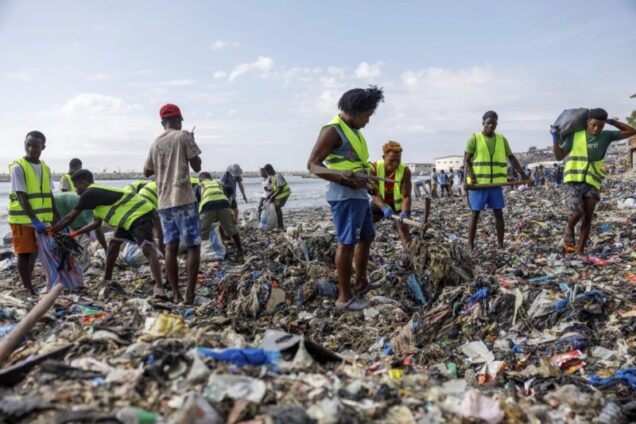
Experts from the University of Ghana’s Institute of Statistical, Social and Economic Research (ISSER) are urging government to treat waste management as a major economic growth strategy, not merely a public health concern.
In a recent paper titled “The High Cost of Improper Waste Management and Poor Sanitation on Ghana’s Economy,” the researchers argue that improved sanitation infrastructure could unlock billions in economic gains, create thousands of jobs, and enhance environmental sustainability.
Citing World Health Organization data, the authors estimate that for every US$1 invested in sanitation, a country can earn up to US$5.50 in returns through higher productivity, reduced healthcare spending, and lower mortality. Applied to Ghana’s GDP, a one-percent investment — roughly US$883 million — could yield an economic return of US$4.86 billion.
“Proper waste management is not just about keeping our cities clean,” the report states. “It’s about protecting lives, saving money, and creating a healthier, more productive economy.”
The study highlights success stories from around the world where waste recycling, composting, and renewable energy recovery have boosted employment and supported the shift toward a circular economy. It estimates that the global waste management industry, valued at US$1.4 trillion in 2024, is expected to reach US$2.4 trillion by 2033, offering vast opportunities for countries like Ghana to participate in the green economy.
In addition to its economic value, proper sanitation has direct public health benefits. The authors point to Ghana’s October 2024 cholera outbreak as an example of the devastating consequences of neglect. Such crises force government to redirect funds from productive sectors to emergency responses, while lost workdays and medical costs drain household and national resources.
The paper also warns that Ghana’s sanitation funding model is unsustainable. Despite collecting over GHS 500 million annually through the Sanitation and Pollution Levy, less than 5% of those funds are reinvested in sanitation projects. The researchers called on government to demonstrate “strong political will” by ring-fencing a greater portion of these revenues for waste management infrastructure and innovation.
Beyond public investment, the authors advocate private sector participation and the adoption of modern recycling technologies to close funding gaps and improve efficiency. “Cleaner cities attract tourists, investors, and jobs. Waste can be turned into wealth — if managed properly,” they assert.
Ultimately, the ISSER team concludes that sanitation reform offers a rare win-win for Ghana’s economy, public health, and environment: “Investing in waste management is not a cost; it’s an opportunity for Ghana to build a more sustainable, prosperous, and resilient future.”
[Credit: Prof. Peter Quartey, Prof. Ebo Turkson, Prof. Yaa Adobea Owusu, Dr. Kwame Adjei-Mantey & Dr. Ralph Armah, Institute of Statistical, Social and Economic Research (ISSER), University of Ghana]
Read the full paper below:
Latest Stories
-
Judges’ conference forces further adjournment of Salomey Baffoe case
8 minutes -
GRA assures Tullow of collaboration to settle $393m tax liability without disrupting its petroleum operations
38 minutes -
South Korea demands apology from Pyongyang for landmine blasts that injured three
41 minutes -
Carlos Queiroz not the sort of coach Black Stars need – Nii Lante Vanderpuye
1 hour -
AFCON 2027Q: ‘Our Black Stars team is gone’ – Former Sports Minister
2 hours -
Prof. Prempeh calls for public review of draft constitutional reform bills
2 hours -
AFCON 2027Q: ‘I have never seen a poor performance from Black Stars like against Gambia’ – Nii Lante Vanderpuye
2 hours -
Bawumia backs insurance sector reforms after engagement with IBAG
2 hours -
Nigeria set to launch National Digital Address System 9 years after Ghana showed the way
2 hours -
Policy rate decision takes time to reflect in lower lending rates – BoG
2 hours -
Western Regional Minister applauds Karpowership’s role in Ghana’s power sector
3 hours -
Playback: Road safety crises: Where are we getting it wrong?
3 hours -
Enterprise Life celebrates 25 years of protecting families and building trust
3 hours -
ICC London rules in favor of Ghana against Tullow over $400m tax charge
3 hours -
We are disappointed in ICC’s ruling over our corporate income tax assessment in Ghana – Tullow Oil
3 hours