

Audio By Carbonatix
While other countries are trying to restrict migration, the German parliament has passed a radical new law to attract migrant workers to Germany.
That means less red tape and lower hurdles for migrant workers from outside the European Union.
A Canada-style points-based system will take into account age, skills, qualifications and any link to Germany.
Criteria will be lowered for salary, educational level and German language ability.
This would make it easier for migrants to come to Germany with, or even without, a job offer. Incentives include being able to bring not only spouse and children, but also parents.
This is a major shift in policy for Germany. For decades German governments have resisted the idea that Germany is a country of migration.
The first generation of so-called "guest workers" from Turkey in the 1960s were seen as exactly that: "guests" who were supposed to help the economy and then leave.
Conservative-led governments in particular, including Angela Merkel's administration, struggled with the idea of a society open to migrant workers - despite the fact German society is increasingly diverse. More than a quarter of the population in Germany is either foreign-born or has at least one foreign-born parent.
After years of low unemployment German business leaders are sounding the alarm about the lack of workers. The problem is exacerbated by an ageing population: baby-boomers born in the 1960s will soon start heading for retirement.
Ministers warn that millions of job vacancies already need filling, and describe the labour shortage as the biggest risk facing the German economy.
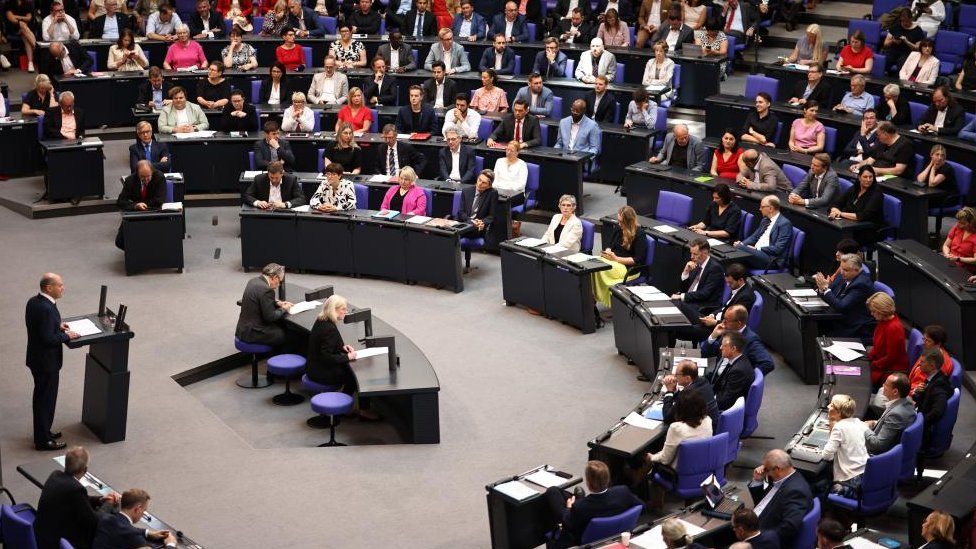
When Olaf Scholz's centre-left Social Democrat SPD party beat Mrs Merkel's conservatives in 2021, the new SPD-Green-liberal coalition made easing migration rules one of its flagship policies.
This coalition has been plagued by rows between the Greens and the business-friendly liberals over climate change policies. But both parties do agree on migration: the liberals want workers for the economy; the Greens more human rights in migration policy.
But Friday's parliamentary debate about the law was ferocious. Conservatives voted against the bill, outraged that the new law would allow some rejected asylum seekers already here to find work.
The far-right AfD also voted no, saying that Germany was not a country of "immigration" but rather a "homeland", reflecting the party's increasingly nativist view of what it means to be German.
The AfD does not reflect mainstream society's view that Germany needs migrant workers. But despite this, or maybe because of it, the party is reaching unprecedented numbers in the polls.
In the latest ARD Deutschland Trend, the party reached 19% this week, the highest it has ever scored in this poll. Chancellor Olaf Scholz's SPD party has slumped to 17%.
The political climate in Germany is polarised and febrile when it comes to migration. The government wants it, the economy needs it and parliament has now voted for it. But will all voters accept it?
Latest Stories
-
Mahama demands permanent UN Security Council seat for Africa
9 minutes -
Mahama calls for structural repair after UN slavery resolution
13 minutes -
Mahama condemns Gaza carnage, backs Palestine and two-state solution
17 minutes -
Fund Accra-Kumasi Expressway with private capital, not state funds — Alan Kyerematen urges gov’t
21 minutes -
TUC calls for stronger funding and labour representation in TVET system
22 minutes -
GES threatens removal of SHS heads over illegal fees
27 minutes -
Youth power to explode at 2026 Global Changemakers Summit in Accra
34 minutes -
SIU community remembers Kofi Akamani at vigil as memorial fund is announced
35 minutes -
Shot and killed in the US: Who was Dr Kofi Akamani?
44 minutes -
Sosu challenges EOCO’s basis for attempted arrest of Manhyia South MP
50 minutes -
KMA plans to convert Adum railway enclave into cargo truck terminal
52 minutes -
2026/27 cocoa season: COCOBOD engages international trading partners in London
1 hour -
Fire contained at Dansoman’s Dayspring School, no casualties reported
1 hour -
Nyankyerenease gets furnished CHPS compound to improve healthcare access
1 hour -
Sky Train trial moves to defence as Asamoah, Ameyaw-Akumfi file witness statements
1 hour