

Audio By Carbonatix
Getting water from the ground is capital intensive and laborious.
Climate change has also worsened the reliability of these groundwater systems.
The Kwame Nkrumah University of Science and Technology (KNUST), is therefore employing artificial intelligence to predict water availability in the ground.
The project is dubbed Rapid Assessment of Groundwater Availability (RAGA).
According to the Principal investigator, Dr. Cyril Boateng of the Department of Physics, the project will build an AI-based system for groundwater which can be accessed by the public through their smartphones and computers.
“We seek to develop an innovative web-based artificial intelligence driven open-source framework to predict groundwater availability in Ghana.
“We intend to achieve this aim by building a database of spatio-temporal hydrogeological, and climate variables; developing AI algorithms and workflows for integration of varied data sources and prediction of groundwater availability and developing an open-source web-based application for rapid groundwater availability assessment to be used by stakeholders and the general populace,” he explained.
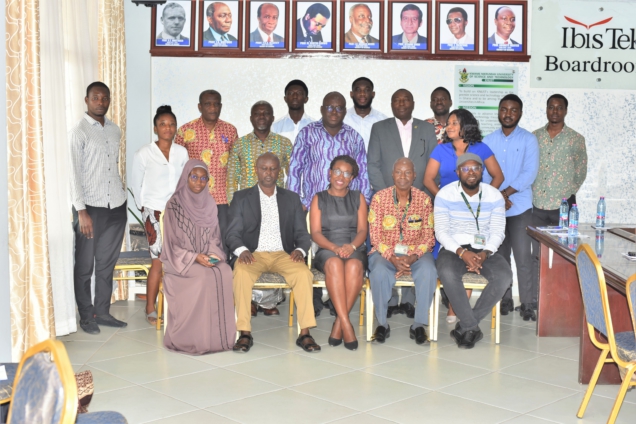
Partners in the 1-year project include, Departments of Physics, Meteorology and Climate Science, Computer Science and Geological Engineering of KNUST. Also involved are the Water Resources Commission and the CSIR-Water Research Institute.
Provost of the College of Science, Prof. Leonard Amekudzi is happy the project will build the profile of early-career researchers and foster research collaboration.
“The project is seeing the College of Science collaborating with the College of Engineering, CSIR among others. The project team is mainly made up of early-career researchers and it’ll therefore build their capacities,” he said.
Prof. Amekudzi added: “The project will contribute to KNUST’s agenda of carrying out impactful research since water accessibility has become critical in the face of the illegal mining menace.”
The project is part of the Responsible Artificial Intelligence Network for Climate Action in Africa (RAINCA) Hub.
The hub is funded by the Canadian International Development Center (IDRC) through three institutions, namely the West African Science Service Center on Climate Change and Adapted Land Use (WASCAL), the Regional Universities Forum for Capacity Building in Agriculture (RUFORUM), and AKADEMIYA2063.
Latest Stories
-
Mahama returns from Angola after AU extraordinary summit
29 minutes -
Ghana qualifies for quarterfinals of Africa Volleyball Nations Cup after beating Zambia
39 minutes -
WAFU B WCLQ: Ampem Darkoa Ladies come from behind to beat Edo Queens
1 hour -
Photos: National Youth Authority Festival
1 hour -
Bawumia commissions St Jude’s Catholic Church he funded to completion at Weija
1 hour -
Government defends new beer exercise rates; sliding scale has not been abolished
1 hour -
Bolgatanga Assembly denies blanket ban on events beyond 8pm
2 hours -
Photos: Ghana Immigration Service removes 1,055 street beggars from Accra, Kumasi streets
2 hours -
‘He always comes to our aid’ – Fr. Campbell recounts Bawumia’s support for Church, poor
2 hours -
Remittances drop marginally year-on-year to US$3.65bn in half-year 2026
2 hours -
T-bills: Government exceeds target by 139%, interest rates tumble
2 hours -
Why Chelsea need more than a new goalkeeper to be title challengers
2 hours -
Outlook of Ghana’s external sector remains positive for second-half of 2026 – BoG
2 hours -
Prisoners freed early are returning to jail at rapid rate, governors tell BBC
2 hours -
Two charged after €2.3 million worth of drugs seized in Dublin
2 hours