

Audio By Carbonatix
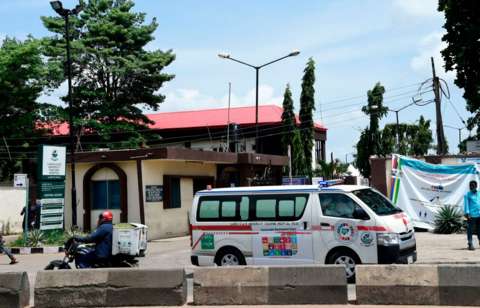
Services in government hospitals in Nigeria dried up on the first day of a strike called by public service doctors, with patients facing difficulties in accessing healthcare.
It came as the president of the resident doctors’ union told the BBC that his members had exhausted all options available to them to resolve the crisis.
At the Aminu Kano Teaching Hospital in Kano, the largest city in the north-west, people were told to take their sick relatives home as no doctor was available to attend to them.
Khadijah Hassan brought her husband who was involved in a car accident to the hospital at midnight on Wednesday but doctors declined to attend to him.
The patient was left lying down in the hospital corridors. “What are we going to do? We will have to sit here in the hospital till the doctors resume work,” she said.
Khadijah’s case was not much different from Ishiaku Musa, who had brought his elder brother from neighbouring Yobe state to the teaching hospital in Kano 12 days ago.
He had been suffering from migraine headaches. He told the BBC that although his brother’s condition had not improved, they were given prescriptions and asked to leave because of the strike.
In the capital Abuja, the local chapter of the union said they were waiting for a statement from the national body before joining the strike, so patients were being attended to.
At the University of Port Harcourt Teaching Hospital in the southern Nigerian city of Port Harcourt, doctors were seen handing their patients over to the few consultants available.
At the commercial hub of Lagos, doctors were still attending to patients who were admitted but no new patients were allowed.
Resident doctors, who make up the largest percentage of doctors in Nigeria’s tertiary hospitals, say they are on strike until the government meets their demands over salaries and welfare.
The medics are demanding the immediate payment of salary arrears owed to them and a new hazard allowance, as well as a training fund.
Nigeria has a fragile healthcare system and strikes by resident doctors could have a major impact on medical services in government hospitals across the country.
Latest Stories
-
Baffour Awuah: EOCO effected an arrest, detained MP after hours of waiting, questioning – Afenyo-Markin
8 minutes -
EOCO court warrant authorised search of Baffour Awuah’s law firm, not residence – Afenyo-Markin
24 minutes -
NPP delegates conference: 3,000 to 4,000 police personnel deployed for security in Kumasi – Anthony Karbo
25 minutes -
KGL Foundation commits $200,000 to support juvenile football for the next two years
41 minutes -
UNDP invites Mahama Ayariga to Northern Peace Conference in Tamale
46 minutes -
Afoko can give NPP ‘new identity’ ahead of 2028 to overcome NDC – Political scientist, Dr Amakye-Boateng
1 hour -
2 injured amid gunshots during raid at Nawara Mining office at Nsuapemso
1 hour -
St Augustine’s College retains 2026 National Investment Quiz title
1 hour -
KNUST Nursing and Midwifery School staff recognised at 2026 Health Ministry Excellence Awards
1 hour -
JoyNews’ Esther Esi Nkrumah selected for UK Media Excellence for Emerging Technology Fellowship
1 hour -
Five NDC youth organisers in Western Region pay courtesy call on Armah-Kofi Buah
2 hours -
NACOC demands tighter port controls to prevent Tema Harbour drug trafficking
2 hours -
Ghana’s startup ecosystem must build sustainability into innovation – Ghana Hubs Network
2 hours -
Friday’s beachfront demolition was carried out at Labadi Beach Hotel’s request, not for flood mitigation – Stan Dogbe
2 hours -
LA 2028: Mukarama returns to Black Queens squad for Olympic Games qualifiers
2 hours