

Audio By Carbonatix
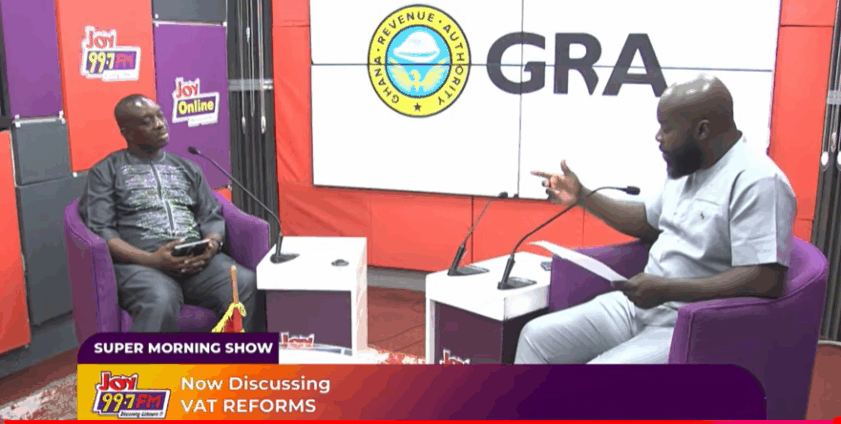
Chief Revenue Officer at the Domestic Tax Revenue Division Free Zones Unit of the Ghana Revenue Authority (GRA), Dominic Adamnor Nartey, says Ghana’s new standard VAT system allows businesses to deduct input taxes and should not automatically lead to higher prices for consumers.
He explained that under the revised VAT Act 2025 (Act 1151), businesses can recover taxes paid on purchases before selling their goods, a change he says corrects misconceptions that the shift to a 20% VAT rate will increase the cost of goods and services.
Speaking on JoyFM’s Super Morning Show on Thursday, February 19, Mr Nartey broke down how the pricing structure works under the new tax regime, contrasting it with the previous 4% flat rate system.
According to him, under the former flat rate scheme, traders were not allowed to deduct input tax from the VAT paid when purchasing goods, forcing them to treat the tax as part of their production cost.
“If you were a flat rate trader before this amendment, you were not entitled to deduct input taxes,” he said. “When you buy from others, you pay VAT, and that VAT becomes part of your cost before you add your margin and charge the 4%.”
He illustrated the process using a hypothetical example, explaining that a trader who buys an item for GH¢100 and pays GH¢15 VAT would add the GH¢15 to the cost before calculating profit and applying the flat rate tax.
However, he said the new standard VAT system changes this approach by allowing businesses to deduct the input tax, preventing it from increasing the final cost of goods.
“Now that you are a standard rate taxpayer, the law allows you to deduct all inputs that you incur in the form of VAT,” he explained. “You don’t add the input tax to your cost. You add your margin to the original cost and then charge the 20%.”
Mr Nartey further clarified that even after charging the 20% VAT, businesses do not pay the full amount to the tax authority but rather remit the net value after deducting the input tax already paid.
“You are not going to pay the entire 20% to GRA. You deduct the input tax you paid and pay the difference,” he stated.
The explanation comes amid public debate following the passage of the VAT Act 2025, which replaced the 4% flat rate with a 20% standard VAT system. The reform has generated concerns among traders and consumers who fear the new rate could increase prices and affect business operations.
But Mr Nartey maintained that when properly applied, the new system removes tax distortions and improves efficiency in Ghana’s tax framework without necessarily raising prices.
Latest Stories
-
Mfantsipim @150: Ace Anan Ankomah leads project to preserve school’s musical heritage
21 seconds -
Gov’t launches rCOMSDEP in Ahanta West, Mpohor Fiase to promote responsible community mining
2 minutes -
AI is forcing professionals to rethink how they deliver value – Hubtel CEO
5 minutes -
Daily Insight for CEOs: Strengthening the CEO’s Leadership Legacy
6 minutes -
Jimmy Aglah’s ‘When the River Testified’ approved by NaCCA as Supplementary Reader
14 minutes -
Hubtel willing to contribute to Ghana’s proposed AI fund – CEO
19 minutes -
Nkrumah family pays tribute to Gamal, says he died after prolonged illness
28 minutes -
Police arrest eight suspects in anti-narcotics operation at Okaishie Drug Lane
39 minutes -
Former Krowor chairman pledges grassroots empowerment in NDC regional chairmanship bid
42 minutes -
GES recommends reposting of Obuasi SHTS headmaster after August 2026 campus riot
44 minutes -
Rocky Dawuni celebrates King Ayisoba for taking traditional music global
57 minutes -
Ghana targets $5bn in annual economic gains from AI – Sam George
58 minutes -
From childhood dreams to future careers: Ecobank’s Big Pitch seeks to promote early savings and investment
1 hour -
Public office demands make party work difficult for NDC appointees – Mahdi Gibril
1 hour -
AI could deepen rural-urban inequality without better connectivity – Sam George
1 hour