

Audio By Carbonatix
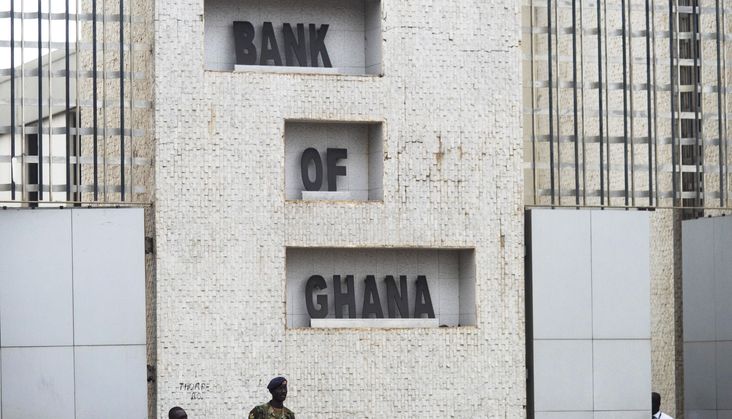
The Bank of Ghana (BoG) has attributed its GH¢60 billion loss recorded in 2022 to the controversial Domestic Debt Exchange Programme (DDEP).
The Central Bank said the losses are not due to irresponsibility on its part.
The Director of Research at BoG, Dr Philip Abradu-Otoo made this claim in an interview with Citi FM on Tuesday, August 1.
According to him, the Domestic Debt Exchange Programme was necessary to prevent the total collapse of the Ghanaian economy.
“What we are seeing on the balance sheets of BoG is not as a result of reckless policy, or bad decisions but the direct impact from DDEP. We can say [BoG] policy has been sub-optimal.”
“Sub-optimal in the sense that we chose an action to save the economy from total collapse but as a result of the DDEP, it has landed us here,” he said.
Meanwhile, Dr Philip Abradu-Otoo said measures have been put in place to ensure that the Central Bank recover the losses.
“We need to recover this GH¢60 billion. The central bank would have to retain its profits. We are now going to ensure that we strictly retain all our profits. One other problem that created this situation was the fact that we need now to move towards optimising the returns from our portfolio. We manage our funds ourselves at the Bank of Ghana.
“And we need to ensure that we get a lot of returns. Above all, we need to ensure that we get capitalised as we move along the process. Those talks have started with the government and along the line, we expect some capitalisation from the government,” he added.
The Annual Report and Financial Statements of the Bank of Ghana showed it recorded a loss of ¢60.8 in 2022.
The Central Bank’s record loss is coming after it posted a ¢1.2 billion profit in 2021.
According to the Annual Report and Financial Statements, the loss is attributed to a decline in the Group’s net worth position due to the impact of the Domestic Debt Exchange Programme (DDEP) and impairment of some assets.
Again, its total liabilities and subsidiaries exceeded its total assets by ¢54.52 billion.
In 2021, the Central Bank recorded a surplus of ¢5.72 billion.
Latest Stories
-
GES denies cancellation of Free SHS, warns against GH¢1,500 ‘chop box’ payment
40 seconds -
Mortuaries and Funerals Agency to deploy ‘funeral police’ nationwide to prevent corpse abuse
10 minutes -
Aisha Hospital delivers first-ever IVF Baby, opens new dialysis centre in Northern region
26 minutes -
GoldBod leadership may face ‘scary’ bail conditions in the future – Afenyo-Markin warns
31 minutes -
British couple on honeymoon killed in helicopter crash on Greek island
39 minutes -
Man, 20, drowns while helping travellers cross Ghana-Togo border river
48 minutes -
Top 10 online bill payment platforms in Nigeria
53 minutes -
Fire destroys more than 27 wooden structures at Spintex Coastal junction
56 minutes -
GoldBod: Day of reckoning will come – Afenyo-Markin
59 minutes -
In Photos: Defence Ministry welcomes Kenneth Gilbert Adjei as new Defence Minister
1 hour -
CSA fines EY Ghana GH¢360,000 for providing cybersecurity services without a licence
1 hour -
Bonsu Baah scores and assists in Al Qadsiah big win in Saudi King’s Cup
1 hour -
The Galamsey war and GWL’s fictitious and inaccurate rebuttal
2 hours -
Afenyo-Markin demands answers over alleged GH¢22bn GoldBod loss
2 hours -
GoldBod ‘Losses’: We’re not ignorant, we know our job – Afenyo-Markin
2 hours