

Audio By Carbonatix
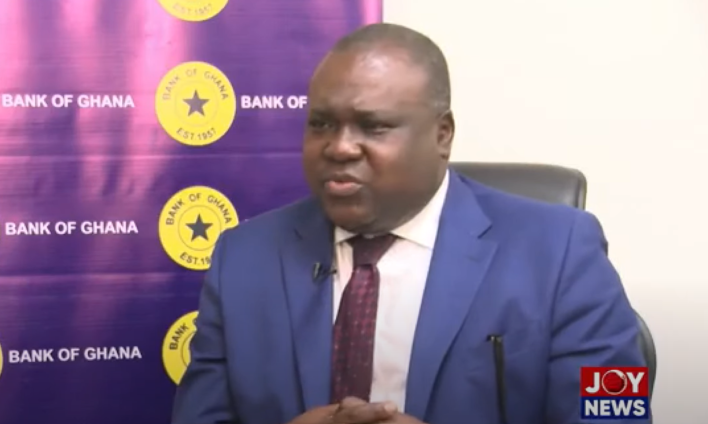
The Director of Research at the Bank of Ghana, Dr Philip Abradu-Otoo, is enforcing a zero financing policy where they are no longer lending money to the government to finance its operations.
Speaking on PM Express on JoyNews, he stated that this policy is one of the measures being implemented to help recover the ¢60.8 billion loss they recorded in 2022 and put the bank in a strong position.
According to him, seven months into 2023, the central bank has respected that zero financing policy noting “we are enforcing it to the letter and that is going to continue for the next three years under the IMF program."
Dr Abradu-Otoo said that “I don't think our hands are going to be bent again. Those steps that are put in place will ensure that we get out of this situation quickly. And if you read the forward in our annual report (BoG’s Annual Report and Financial Statements), four steps have been outlined.”
“One is trying as much as possible not to lend to government again, which in the IMF program we have logged that in as zero financing because it's part of the problem,” he added.
Dr Abradu-Otoo explained that failure to commit to their position could have implications for the IMF programme's implementations, among others.
According to him, going against zero financing for the government “might create all sorts of problems for us regarding the triggering of other flows associated with the completion of each IMF review. We would miss that critical target. It will become big news. It could flip into other things as we move along.”
The BoG’s Director of Research stated that knowing the implications involved they will not go back on their word to support the government even when asked.
This comes nearly a week after the Bank of Ghana revealed it recorded a loss of ¢60.8 Billion Ghana cedis in 2022, in its Annual Report and Financial Statements.
The Central Bank’s record loss is coming after it posted a ¢1.2 billion profit in 2021.
Reasons behind loss position
This was due to the impairment of the Government of Ghana securities holdings of ¢48.45 billion, impairment of loans and advances granted to quasi-government and financial institutions amounting to ¢6.12 billion and the depreciation of the local currency resulting in net exchange loss of ¢5.27 billion.
It was occasioned by the Government of Ghana Domestic Debt Exchange Programme.
Watch the full show below:
Latest Stories
-
Central banks should avoid reacting too strongly to headline inflation – IMF
48 seconds -
Kumasi: One injured, shops destroyed in Atasemanso fire in Kumasi
14 minutes -
Global economy proving resilient, growth projected at 3.1% in 2026 – IMF
18 minutes -
NDC targets all 6 parliamentary seats in Ahafo Region for 2028
21 minutes -
Ghana targets thousands of overseas nursing jobs under Labour Export Programme
23 minutes -
Pius Hadzide explains why Sports Ministry always attracts scandals
24 minutes -
APL says GoldBod terminated US$1bn Goldstream deal over failure to meet obligations
29 minutes -
Daily Insight for CEOs: Making better decisions under pressure
30 minutes -
Weta rice farmers seek urgent support after floods destroy crops
31 minutes -
Mahama commits GH¢200m in 2027 Budget to complete Police Hospital expansion
34 minutes -
Standard Chartered Bank delivers strong returns and sustainable shareholder value
45 minutes -
Akufo-Addo’s role in the artificial cedi stability is indisputable — Facts do not bend to political convenience
48 minutes -
Breaking Bad actor RJ Mitte dies aged 34
55 minutes -
Wontumi pleads not guilty in GH¢30m Exim Bank loan case
60 minutes -
Beyond the Flyer: Awareness without screening is not enough
1 hour