

Audio By Carbonatix
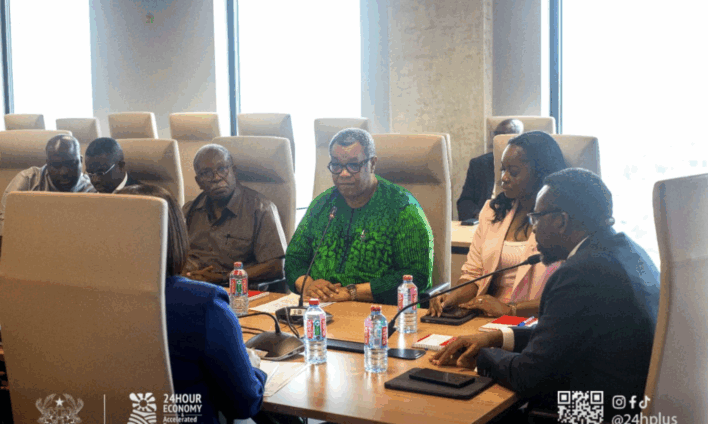
The 24-Hour Economy Secretariat has held a high-level meeting with the Bank of Ghana to align the flagship policy with the country’s broader macroeconomic framework.
The engagement forms part of the Secretariat’s ongoing consultations with key stakeholders to share details of the 24-hour economy policy, obtain institutional feedback, and secure strategic partnerships for implementation.
A statement issued by the 24-Hour Secretariat said the Central Bank is one of the latest institutions to be engaged as the programme transitions into its operational phase.
Mr Goosie Tanoh, Presidential Advisor on the 24-Hour Economy Programme, expressed appreciation to the Bank for the opportunity to engage its leadership and technical teams.
He said Ghana’s immediate priority was to build a resilient economy anchored on macroeconomic stability.
He commended the Bank of Ghana for providing the stability required to create platforms for growth, expansion, and increased economic activity, including higher domestic production and export output.
The Presidential Advisor said the 24-hour economy initiative is intended to deepen these gains by providing a targeted micro-level response to the macroeconomic stabilisation achieved.
He described recent economic indicators as notable, citing sustained treasury bill performance and a decline in inflation as evidence of a strengthening foundation for long-term growth.
A major focus of the discussions was the proposed establishment of a Food Security and Price Stabilisation Fund.
The Fund is expected to help moderate commodity price volatility, reduce food inflation, and enhance national food security, complementing existing monetary policy measures.
The meeting also explored practical areas of collaboration between the Secretariat, commercial banks and the central bank.
Proposals discussed included the development of a 24H+ credit policy and enterprise financing framework, coordinated appraisal of credit requests, syndicated and direct lending opportunities, and balance sheet support for eligible 24-hour enterprises subject to due diligence.
Additional areas covered include recognition of credit insurance schemes to strengthen collateral frameworks, regulatory considerations for 24-hour loan portfolios, foreign exchange hedging instruments to support SME lending at reasonable rates, and digital platforms to expand access to trade and finance.
It is expected that the deliberations with the Bank of Ghana will result in key strategic regulatory policy initiatives which will enhance the financial services infrastructure under which Ghanaian companies are expected to thrive.
Latest Stories
-
Freddie Blay accuses government of politically motivated demolitions targeting his family
3 minutes -
Ghana targets rice self-sufficiency by 2028 as government secures $18.8m AfDB grant
7 minutes -
Israelis mark three years since October 7 as Palestinians mourn Gaza’s destruction
10 minutes -
Support constitutional amendment to fix voting day on Tuesday – Asiedu Nketiah urges SDA Church
10 minutes -
‘It’s a systemic problem’ – All Black PRO dismisses Kurt’s resignation calls
15 minutes -
Vance says Iran must cut enrichment to end war
17 minutes -
Mahama orders sanctions for officials who fail to enforce building safety rules
18 minutes -
Court grants bail to banker accused of stealing GH¢1 million
22 minutes -
We have a winning team for 2028 – NPP Atwima Nwabiagya South Secretary
24 minutes -
Bono East Minister cracks whip on contractors over delayed 24-Hour Economy Market projects
27 minutes -
Zelensky condemns ‘vile’ large-scale Russian attacks that killed 15
30 minutes -
Trump to speak to Putin about plague lab worker’s death in Russia
30 minutes -
GHIPO makes case for local plant breeders to protect developed varieties for food sovereignty and reinvestment
33 minutes -
Ghana’s bamboo bikes entrepreneur gets a seat at World Economic Forum
33 minutes -
After years under trees, Akatsi children get a permanent school
34 minutes