

Audio By Carbonatix
The Government has affirmed its commitment to fully recapitalising the Bank of Ghana by 2032, following Parliament’s passage of the Central Bank’s amended legislation to ensure its long-term financial stability.
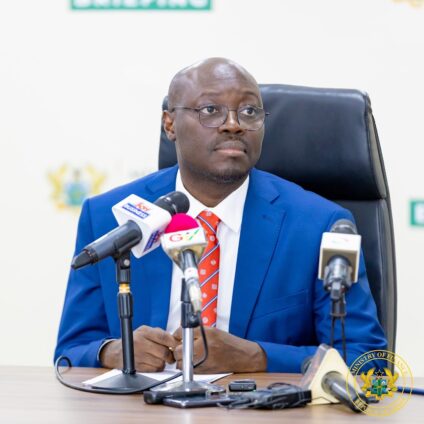
The Finance Minister, Dr Cassiel Ato Forson, disclosed at a press briefing on Friday, May 15, while announcing the end of the country’s three-year US$3 billion loan-supported programme with the International Monetary Fund.
He said the new legislation would provide the legal backing needed for the recapitalisation process, confirming that the government was working closely with the central bank to address its negative equity position.
The Bank of Ghana recorded an operating loss of GH₵15.63 billion and an Other Comprehensive Income (OCI) loss of GH₵19.32 billion in 2025. Its negative equity worsened from GH₵61.32 billion at the start of 2025 to GH₵96.28 billion by the end of the year, raising concerns among policymakers and international partners.
The Finance Minister explained that the recapitalisation would be undertaken gradually from now until 2032, in line with the government’s commitment to supporting the central bank in fulfilling its core mandate of maintaining price stability.
“The government is committed to fully recapitalising the central bank. It’s a gradual process from now to 2032. In the new amendment, we have also introduced automatic recapitalisation.
“What it means is that if at any time the central bank falls below its minimum capital requirement, the central government will automatically recapitalise the bank.”
He assured that the government was not complacent about the situation, stressing that restoring the Bank of Ghana to full financial health remained a priority, with the amended law providing a credible roadmap for resolving its capital deficit.
IMF Mission Chief to Ghana, Ruben Atoyan, described the central bank’s financial situation as a case of “financial sector inevitable capital,” but expressed confidence in the institution’s path to solvency.
He said the bank’s financial condition in 2025 was “challenging,” citing high open market operation costs due to a tight monetary policy stance, elevated interest rates, and aggressive liquidity mop-up operations.
He added that exchange rate movements also placed pressure on the central bank’s financial position during the period, but said the 2032 recapitalisation target was achievable.
Mr Atoyan noted that the Fund had factored the recapitalisation trajectory into its debt sustainability analysis and had supported the central bank’s move to sell some of its gold holdings at the end of 2025 to strengthen its balance sheet.
He said the Fund had held close discussions with Ghanaian authorities on minimising losses from the domestic bond programme and reducing associated risks, with further details expected in the staff report.
Mr Atoyan expressed confidence in Ghana’s economic direction, describing the combination of fiscal consolidation, debt sustainability improvements, and the Bank of Ghana recapitalisation framework as the basis for a credible and durable recovery.
He encouraged the authorities to remain vigilant, stay the course on reforms, and continue building an economy resilient enough to withstand future shocks without requiring another financial bailout.
Latest Stories
-
84 suspected drug offenders in custody as NACOC freezes nearly 73 assets – Muntaka
1 minute -
Immediate reconciliation key to building united NPP — COKA
4 minutes -
MPs, CSOs push for dedicated budget line for malaria
5 minutes -
Jeffrey Nortey’s viral Kanayo O. Kanayo bar gets the legend’s attention, leads to a meet-up
6 minutes -
Bagre Dam’s Annual Floods: Scientists seek a lasting solution as Northern Ghana’s farmers count the cost
6 minutes -
Why Corporate Communications Professionals Must Be Marketing-Oriented: The strategic advantage and the professional mileage
17 minutes -
DVLA hands 357 suspected cloned vehicles to GRA over customs duties
18 minutes -
Appeals will not end strike, FWSC must negotiate – GAUA General Secretary
24 minutes -
Haruna Iddrisu hails Ghana’s academic calendar as best in a decade
25 minutes -
Silent Football: A team, a dream, a $24,000 debt – the struggles of Ghana’s deaf footballers
25 minutes -
Education Minister Haruna Iddrisu demands merit-based admissions, appointments at Defence University
28 minutes -
National Defence University to strengthen Ghana’s response to emerging security threats – Haruna Iddrisu
31 minutes -
Pupil arrested after two teachers shot at French school
38 minutes -
Lamisi takes ‘Let Us Clap’ tour across five countries and 18 dates
56 minutes -
DVLA cuts roadworthy contract cost from $155.4m to GH¢2m – CEO
57 minutes