

Audio By Carbonatix
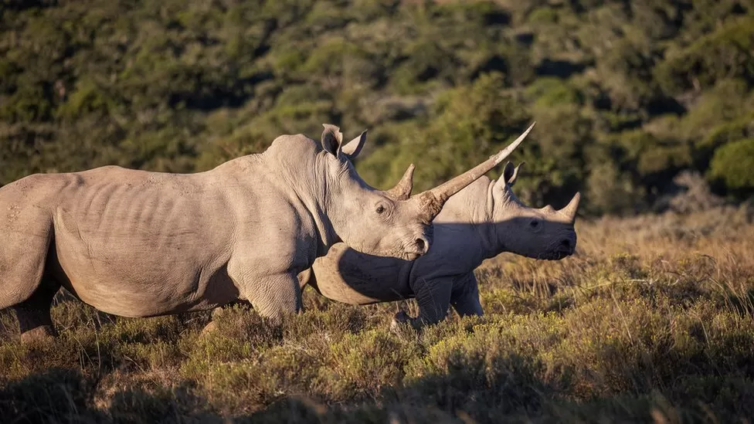
Conservation group African Parks plans to release 2,000 southern white rhinos into the wild after buying the world's largest private captive rhino breeding operation in South Africa.
The giant animals, the second-largest land mammal, are considered to be under extreme pressure due to poaching.
There are thought to be 18,000 southern white rhino left. They are classified as a near-threatened subspecies.
African Parks hopes to "rewild" the animals over the next 10 years.
The group secured emergency funding to buy the financially struggling 7,800-hectare (19,000-acre) rhino farm, known as Platinum Rhino, in South Africa's North West province, after owner John Hume put it up for sale in April.
African Parks' project marks one of the largest continent-wide rewilding programmes undertaken for any species.
CEO Peter Fearnhead said they initially had no intention of owning of a captive rhino breeding operation however they "fully recognise the moral imperative of finding a solution for these animals, so that they can once again play their integral role in fully functioning ecosystems".
The organisation says it plans to release the rhinos into secure, well-managed areas to protect them from poaching and it will work with funding partners, governments and other conservation groups to ensure this happens.
Mr Hume has received recognition as a conservationist however, he has also faced criticism for advocating the trade in rhino horn. He has argued that the trade was necessary to safeguard his rhinos from poaching and raise funds to sustain the farm.
The southern white rhino population plummeted to an all-time low of 30 to 40 animals in the 1930's however through effective conservation measures, the numbers surged to more than 20,000 in 2012.
There are only two surviving members of the other subspecies, the northern white rhino - both female and both in Kenya. It is thought that rhino-horn poaching brought about their near extinction.
Most of the southern white rhinos are found in South Africa, Namibia, Zimbabwe, and Kenya.
The International Union for Conservation of Nature says a species is "near-threatened" when it is thought it could be vulnerable in the near future.
Latest Stories
-
If the Ghana Premier League is financially weak and structurally fragile, Africa will expose its weaknesses
2 minutes -
Accra-Kumasi Expressway: 48 Engineer Regiment can deliver if well resourced – Political Lecturer
16 minutes -
Businesses above GH¢750,000 turnover must register for VAT – GRA
20 minutes -
Kenya confirmed hosts of World Athletics Championships 2029
31 minutes -
No more pothole ambulance rides: Mahama’s roads will change lives – Agbodza tells Upper West farmers
55 minutes -
‘Physically better’ Kudus can start against Liverpool – De Zerbi
1 hour -
Bonsu Baah sets up opener in Al Qadsiah win over Al Wasl
1 hour -
Ghana has now become a distribution hub for drugs
2 hours -
Africa Nations Volleyball Championship: Ghana’s Black Spikers leave for tournament in Tunisia
2 hours -
Today’s Front pages: Tuesday, September 15, 2026
2 hours -
Auditing the Auditor-General: How special audit understated a COVID-19 expenditure
3 hours -
A Partnership for Progress: Why the ProMark–KPMG collaboration matters for Africa’s digital assets future
3 hours -
Catholic Bishops pressure gov’t to sign long-delayed mission schools agreement
4 hours -
Cedi under fresh pressure as Christmas import demand drives dollar surge
4 hours -
Ato Forson eyes first-week November for 2027 Budget, promises jobs and major infrastructure push
5 hours