

Audio By Carbonatix
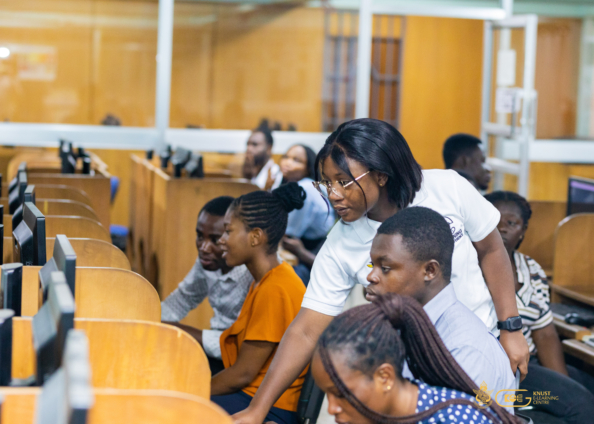
Students in tertiary institutions worry face to face teaching is gradually becoming a drawback in accessing higher education.
Socio-economic background and geographical location have excluded some groups from learning in institutions offering exclusive in-person classes.
This is slowing down the progress of education.
In-person teaching and learning has been the traditional way of learning for decades.
However, as the student population increases in all tertiary institutions, lecturers and teaching assistants find it hard managing class sizes.
On the other hand, students disregard unfavorable weather conditions to attend lectures or submit assignments.
Both parties describe this as tedious and worrisome. Benedict Afriyie, is a student at the Kwame Nkrumah University of Science and Technology.
“In class, I am unable to hear the lecturer. Usually, the lecturers do not use microphones. Sometimes, the class is so huge you will not find a sitting place. There are times we walk all the way from our hostels to submit assignments,” he revealed.
Tertiary institutions struggle with space for lessons. Emmanuella Gidi, a student lives farther from the university.
She reveals some of her colleagues have missed examinations and class hours due to change of venues for lectures.
“I live at Boadi and come to Kotei for lectures daily. It is quite a distance. I wake up early and rush is. Getting a shuttle from Boadi to campus is a struggle. My colleagues and I missed lectures a few times,” she said.
Frank Boateng Agyemang, a student, is intimidated speaking in front of a class of over 200 students
This has limited his interaction and opportunity for valuable feedback.
“Questions are asked and you will see the supposed brilliant students answering fiercely. This makes us question our intelligence,” he revealed.
The E-Learning Centre of the Kwame Nkrumah University of Science and Technology seeks to open up education to more people by offering online learning courses
The Centre is tutoring Teaching Assistants in the university on the usage of online platforms for teaching and learning.
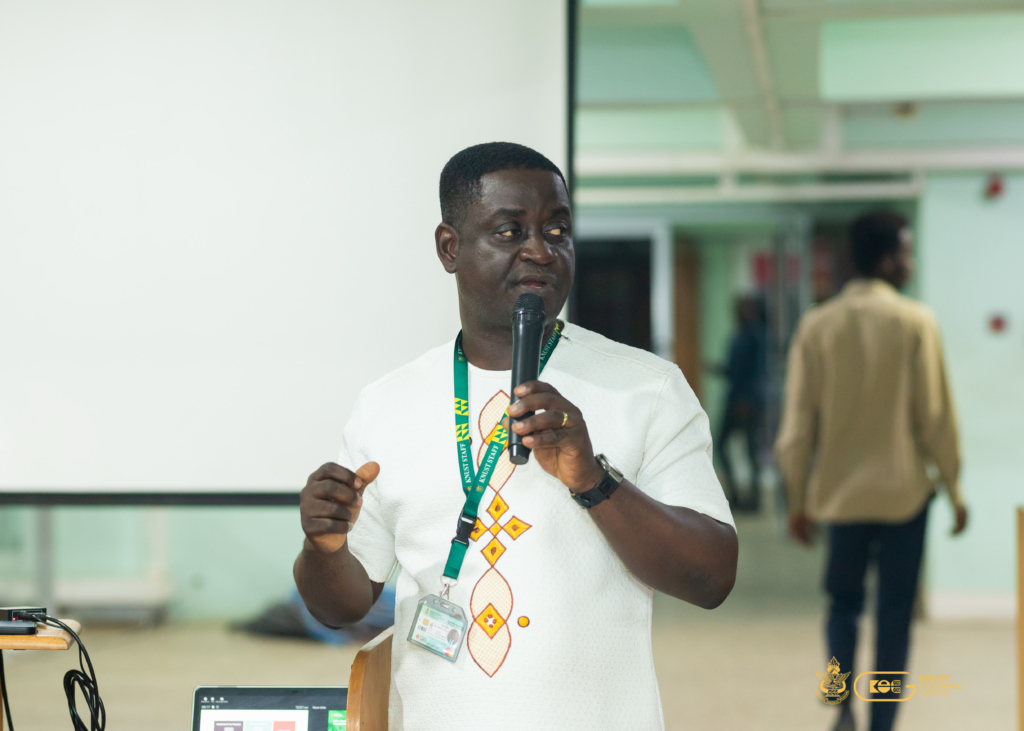
“They are going to offer teaching assistance to students who may be familiar with online platforms. This means they must always be a step ahead,” said Professor Eric Appau Asante, Director of KNUST E-Learning Centre.
Latest Stories
-
AMA says Konkomba traders were consulted ahead of Agbogbloshie 24-hour market project
25 minutes -
Let’s pilot Chinese in public schools before scaling up – EduWatch
34 minutes -
Ghanaian tech professionals develop SMS-based AI tool for non-smartphones
1 hour -
MTN@30: Three customers drive away brand-new Land Cruiser Prado in Kumasi
2 hours -
If BOST made GH¢684m profit, why use NPA Bill 2026 to weaken it? – IERPP questions Gov’t
2 hours -
NPP alleges executive, administrative confusion over Arabic, Chinese language policy
2 hours -
Minority accuses AMA of targeting Konkomba Yam Market in planned demolition over 24-hour market
2 hours -
Ghana struggles to raise local funds for delayed cocoa season as investors demand higher returns
2 hours -
GSA delays laboratory equipment replacement despite available funds
2 hours -
IERPP calls for withdrawal of proposed NPA Bill, raises concerns over BOST mandate
2 hours -
We’re not demolishing Konkomba Yam Market – Accra Mayor dismisses Minority’s claims
3 hours -
Nitiwul, Accra Mayor clash over Konkomba Yam Market demolition for 24-Hour-Economy market
3 hours -
BoG urges digital asset businesses to build compliance into operations at Digital Assets Summit Africa
3 hours -
NGIS Money Market Fund’s net assets rise 33.3% to GH¢11.78m
3 hours -
Vaglas join Vughin to mark Dɛng Festival of Sonyor in Savannah Region
3 hours