

Audio By Carbonatix
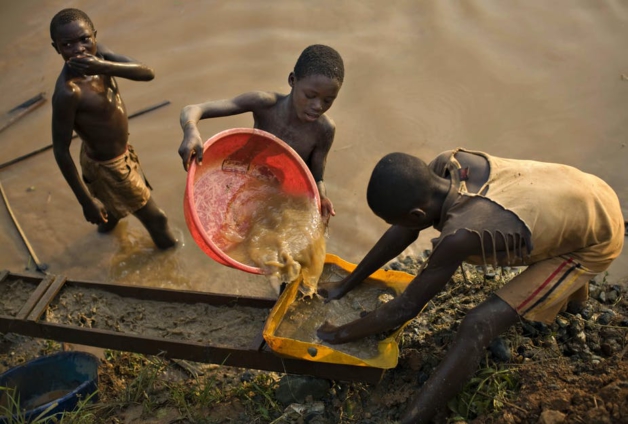
As the world marks the World Day Against Child Labour, the Ghana Statistical Service (GSS) has unveiled concerning statistics showing that close to 900,000 children aged 5 to 17 years are engaged in paid employment across the country.
In a statement issued to commemorate the day, the GSS highlighted that male children dominate the child labour force, comprising 56% of the working children. Disturbingly, nearly half a million (458,443) of these children are not attending school, including 68,500 who have never attended school and 389,943 who attended school in the past.
“The 2023 Annual Household Income and Expenditure Survey indicates that over 1.1 million children 5 to 17 years were involved in different forms of work in the fourth quarter of 2023, which represents one in every 10 (10.3%) children in this age range. Among these children, about 893,000 are involved in employment work, which is mostly paid work,” portions of the statement reads.
The report underscores a stark urban-rural divide, with 72% of working children residing in rural areas, compared to 28% in urban areas.
It added that "regionally, Ashanti leads with the highest percentage of working children at 13.6%, followed by Bono East (12.1%) and Northern Region (11.8%). Conversely, Ahafo (0.8%), Greater Accra (1.6%), and Western North (1.8%) have the lowest percentages of working children."
Breaking down the types of work, the GSS found that 35.4% of children are engaged in family help, 31.2% in farm work, 11.7% as unpaid trainees, and 7.3% in own-use production. Additionally, 6.2% of children are involved in non-farm work, 5.3% in wage work, and 2.9% in domestic, non-productive agriculture, voluntary work, or apprentice work.
Elementary occupations dominate the landscape for working children, accounting for 60.4%, followed by craft and trade-related work (19.8%) and skilled agricultural, forestry, and fish-related work (17.7%). Service and sales workers make up 1.7%, while plant and machine operators and assemblers represent 0.2%, and managers constitute 0.1%.
The services sector employs the majority (91.7%) of working children, with agriculture and industry accounting for 4.8% and 3.6%, respectively.
Latest Stories
-
Power restoration fault suspected in Kumasi Central Market fire
4 hours -
The 7-foot giant of Ngleshie Amanfro: Seven-foot Ghanaian Ephraim Saawa dreams of joining the national basketball team
5 hours -
Government promises support for Kumasi Central Market fire victims
5 hours -
Vibes The Movie: Big Ghun’s Ghanaian film earns five nominations at 2026 REFFA
6 hours -
MamaCare CEO warns unresolved conflicts among health workers could undermine maternal and neonatal care
6 hours -
Health professionals urged to translate medical knowledge into practice to save mothers
6 hours -
Conflicts among care providers linked to maternal, neonatal deaths – Expert
8 hours -
GIS marks 10th TIME conference, champions improved teaching practices
8 hours -
BRICS Or Balance? What Ghana’s bid really means
8 hours -
GPRTU wants full TRAFFITECH-GH implementation to start in 2027
9 hours -
How 10-mile walks for basic education birthed a 50-year legal career for Justice Korbieh
9 hours -
Mahama announces plans to import electric wheelchairs for PWDs
9 hours -
KGL U17 Colts 2026: Western beat Prempeh Elite Academy to set up final final with Greater Accra Region
9 hours -
Late Solanke strike salvages 10-man Spurs draw at Man United
9 hours -
Gender Ministry to monitor welfare of Nana Akua Addo’s children amid domestic violence case
9 hours